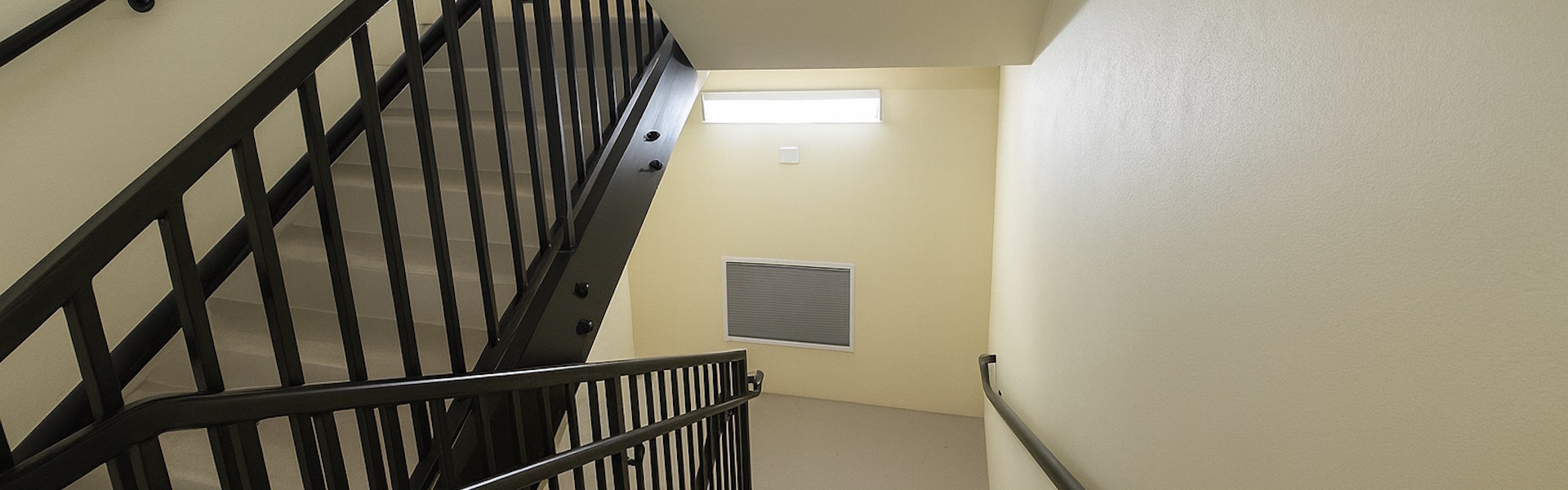
Stairwells are more than just passageways. In commercial, residential, and institutional buildings, they are critical life-safety zones that must remain illuminated for safe occupant egress. Because stairwell lights often run 24/7, they can become one of the most expensive lighting loads in a facility. Choosing the right LED stairwell fixtures ensures compliance with building codes, reduces operating costs, and improves safety. This guide is designed for contractors, building owners, and facility managers who want to understand the options, regulations, and financial benefits of upgrading stairwell lighting.
Why Stairwell Lighting Matters
Stairwell lighting does three jobs at once. It reduces the risk of slips and falls by keeping steps and landings visible. It supports compliance for means of egress and emergency illumination. And it helps security teams maintain visibility in areas that see intermittent use but must be safe at all hours. If it’s designed well, stairwell lighting quietly does all of this while keeping utility and maintenance costs in check.
- Safety: Clear visibility on stairs and landings to prevent accidents.
- Compliance: Illumination for occupied periods and required emergency backup.
- Security: Deterrence and camera-friendly lighting in low-traffic areas.
Stairwell Lighting Codes and Standards
Four references drive most stairwell designs. OSHA requires exit routes, including stairwells, to be illuminated whenever the building is occupied. NFPA 101 (Life Safety Code) treats stairwells as part of the egress path and requires emergency lighting capable of at least 90 minutes. IES recommendations target 1-2 foot-candles for egress minimums but suggest higher levels for active stairways. And ASHRAE 90.1 / IECC allow controls such as bi-level dimming or occupancy sensing if full output returns immediately upon use. Local jurisdictions may adapt these, so always check project-specific requirements before install.
IES & Code Reference Summary for Stairwell Lighting
- NFPA 101 / OSHA / IBC (egress codes):
- Require a minimum of 1 foot-candle average along the path of egress at the walking surface under normal conditions, with no point falling below 0.1 fc.
- In emergency mode (battery backup), the minimum drops to 1 fc average, 0.1 fc minimum (measured at floor level).
- These are life-safety minimums, not design best practices.
- IES Lighting Handbook (RP-33 for stairways, referenced in RP-28 & RP-29):
- Recommends higher maintained illuminance for stairways in active use.
- Guidance is typically 5 foot-candles minimum on stair treads for commercial stairwells that see regular traffic.
- For public facilities, schools, and healthcare, designers often target 10 foot-candles or more on stairs and landings for comfort, visibility, and liability reduction.
- Landings are often emphasized, with 10–15 fc recommended to help orientation.
- ASHRAE 90.1 / IECC (energy codes):
- Do not set light levels, but they do allow bi-level dimming so stairwells can drop to 50% or less when unoccupied as long as the minimum 1 fc egress requirement is still maintained.
Energy Efficiency with LED Fixtures
Fluorescent stairwell lighting is rapidly being phased out. Modern LED stairwell fixtures consume less energy, last longer, and integrate easily with controls. Expect 50-70% lower energy consumption than comparable fluorescent lamps, 50,000+ hour lifespans that cut labor visits, instant-on behavior for sensor use, and factory emergency options that simplify compliance.
ROI Example: A building with 50 stairwell fixtures using 64W fluorescents spends about $3,364 annually on lighting at $0.12/kWh. Replacing them with 20W LED stairwell fixtures reduces annual costs to $1,051. That’s a savings of approximately $2,313 every year, not including reduced maintenance.
Simple Payback: If new LED fixtures cost $95 each and installation can be done for $25 per fixture, the total project cost for 50 units is $6,000. With annual savings of $2,313, the payback period is just 2.6 years. Utility rebates can shorten this significantly in many regions.
Utility Rebates: Types, Requirements, and What to Expect
Rebates reduce up-front cost and speed payback. Most programs fall into three paths. Instant discounts (midstream) are taken right on the distributor’s invoice and typically require DLC or DLC Premium fixtures and, increasingly, integrated controls. Prescriptive rebates (downstream) reimburse a fixed amount per fixture or per sensor after installation and approval. Custom rebates compensate based on calculated kWh savings or watts reduced, which can be attractive for projects with controls or unique operating profiles.
Take Advantage of Utility Rebates
In addition to energy savings, many U.S. utilities offer cash rebates for upgrading stairwell lighting to high-efficiency LED fixtures with integrated controls. These rebates can significantly reduce project payback times. For example, a $150 LED stairwell fixture with a $50 utility rebate effectively costs just $100, lowering upfront expenses for building owners and speeding ROI.
Rebate programs vary by state and utility. To see what’s available in your area, visit the Database of State Incentives for Renewables & Efficiency (DSIRE) or contact your local utility provider directly.
Tip for Contractors: Positioning rebate opportunities as part of your project proposal can make your bid more competitive and demonstrate added value to clients.
Eligibility Requirements
Before you order, confirm three things. First, product listings: stairwell fixtures usually need DLC Standard or DLC Premium qualification; ENERGY STAR tends to apply to lamps and exit signs. Second, controls integration: many sponsors now prioritize or require integrated occupancy or dual-technology sensing for stairwell categories. Third, documentation: plan on spec sheets, invoices, and pre/post photos, with the possibility of inspection prior to payment.
Typical Incentive Amounts
Amounts vary by utility and program year, but contractors generally see $20-$100 per fixture and $15-$40 per sensor, with additional adders for dual-sensing or networked controls. Some custom programs pay $0.08-$0.15 per kWh saved or $1.00-$1.25 per watt reduced when controls are included.
Examples of Active Programs
ComEd (Illinois): Business Instant Lighting Discounts provide at-purchase incentives for DLC-listed LEDs via participating distributors. Mass Save (Massachusetts): Instant incentives increasingly steer buyers toward fixtures with integrated controls (LLLC, dual-sensing, or occupancy/daylight combos). DCSEU (Washington, DC): Publishes per-sensor incentives that typically land in the $15-$40 range depending on type. Duke Energy: Smart $aver offers prescriptive fixture rebates with custom options for advanced controls.
Adding Controls to Boost ROI
Controls are where many stairwell projects unlock their best savings. Let’s return to the 50-fixture example and hold the energy rate at $0.12/kWh.
Baseline fluorescent (64W each): ~28,032 kWh/year and ~$3,364/year.
LED without controls (20W each): ~8,760 kWh/year and ~$1,051/year. Savings: $2,313/year.
LED with bi-level occupancy sensors: If stairwells are occupied 30% of the time at 100% output and unoccupied 70% at 20% output, average draw is ~8.8W per fixture. For 50 fixtures that’s ~3,854 kWh/year and ~$463/year. Savings: $2,901/year vs fluorescent and ~$589/year more than LED-only.
Payback with Rebates
Without controls, a $6,000 project that saves $2,313 per year pays back in roughly 2.6 years. With controls, assume fixtures land at $170 each (integrated sensor) for an $8,500 total. If rebates cover $70 per unit ($50 fixture + $20 sensor), incentives reduce the net to $5,000. Divide by $2,901 annual savings and payback drops to about 1.7 years. In quieter stairwells the savings increase because lights spend more time dimmed; in busier stairwells the ROI is still strong but payback is longer since lights operate at full more often.
Types of Stairwell Lighting Fixtures
Linear LED Strip Fixtures (General Use)
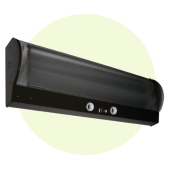
For most indoor stairwells, linear strips provide a clean look, even distribution, and an easy path to bi-level dimming. Many models mount to wall or ceiling and ship with through-wiring, which speeds installation and inspection. Integral emergency options keep egress requirements tidy and reduce coordination with separate units.
Vapor-Tight Fixtures (Durable and Abuse-Resistant)
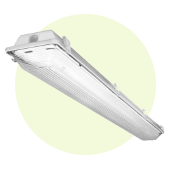
Parking garages, exterior-access stairs, and busy multifamily cores benefit from vapor-tight construction. Gasketed housings and polycarbonate lenses resist impact, moisture, and dust; many lenses are virtually indestructible. That durability reduces service calls and protects your lighting investment in high-traffic, abuse-prone environments.
Emergency-Integrated Fixtures
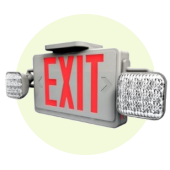
Because stairwells are egress paths, emergency lighting is non-negotiable. Choose fixtures with factory-installed battery packs rated for 90 minutes, or tie into a central inverter. Ordering emergency-integrated versions simplifies wiring, labeling, and compliance checks.
73470,65871,58489,57849,57848,34974,12206
Controls and Sensors
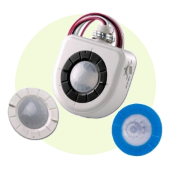
Good control strategy balances energy savings with immediate full-bright response when people enter the stair. Bi-level dimming is the staple: fixtures dim to 10-30% and return to 100% when motion is detected. Add daylight sensing where stairwells have windows, and consider networked systems in larger buildings to centralize scheduling and monitoring. Most modern fixtures offer dip-switch or remote programming to fine-tune time delays and dim levels during commissioning.
Maintenance and Durability Considerations
Labor is real money. LEDs eliminate frequent lamp and ballast changes, which is especially valuable where access is difficult. Polycarbonate lenses resist yellowing and stand up to routine cleaning. In locations where tampering or bumps are likely, vapor-tight designs protect optics and drivers, extending service life and keeping the space looking cared for.
Case Study: Multi-Family Parking Garage
A mid-rise apartment complex replaced 75 fluorescent stairwell fixtures in garage stairwells with 4-ft vapor-tight LED units featuring integral bi-level sensors. Annual energy costs fell by more than 60%, saving over $6,000, and a $3,000 utility rebate dropped simple payback to under 18 months. Security improved too; instant-on sensors brightened landings as residents entered, and maintenance tickets dropped to zero in the first two years.
Design Guidelines
When you lay out a stairwell, aim for more than just code minimums. NFPA 101 requires at least 1 foot-candle average at floor level with no point below 0.1 fc, which is adequate for emergency egress but dim for everyday use. The IES recommends about 5 foot-candles on stair treads and 10 foot-candles or more at landings for comfort and visibility. Many commercial projects target 5-10 fc throughout the stairwell, then use bi-level dimming to drop down to 1-2 fc during unoccupied periods while still maintaining code compliance.
Fixture Spacing: Position fixtures every 8-12 feet depending on lumen output and geometry. Provide extra light at landings to meet higher recommended levels.
Emergency Lighting: Ensure at least 90 minutes of illumination via integral packs or central inverters.
Controls: Occupancy sensors and bi-level dimming are permitted as long as fixtures return to full output immediately when triggered.
Durability: Specify vapor-tight polycarbonate designs for high-traffic, damp, or abuse-prone areas.
Installation: Favor fixtures with through-wiring and quick-connects to reduce labor time and simplify inspection.
Plan Your Stairwell Lighting Upgrade
Stairwell lighting upgrades deliver far more than code compliance. They reduce operating costs, improve safety, and increase long-term building value. By choosing durable LED stairwell fixtures with occupancy controls and emergency integration, you can ensure compliance with OSHA, NFPA, IES, and energy codes while maximizing ROI. Explore RelightDepot’s stairwell lighting solutions or contact our team for expert guidance on your next project.
Contact RelightDepot:
Phone: 888-548-6387
Email: [email protected]
Contact Us Online