An athletic field earns its keep after dark, but only when the lighting holds up. Light it poorly, and you get safety hazards, complaints, and a capital asset sitting idle half the week. Over-build it, and you have a burned budget that should have gone to the program. The job is to match each zone of the facility to the right foot-candle target, the governing standard, and the fixture and pole that hit it without overspending.
This guide covers the most common sports lighting applications, IES RP-6 light level requirements, fixture selection by area, controls strategies, and the ROI case for LED. For other commercial and municipal applications, visit our lighting applications guide hub.
Common Sports Lighting Applications
Sports facilities include several distinct lighting zones, each with its own target light level, mounting height, and glare constraint. Design each zone on its own terms, then integrate them into one site plan.
Athletic Fields
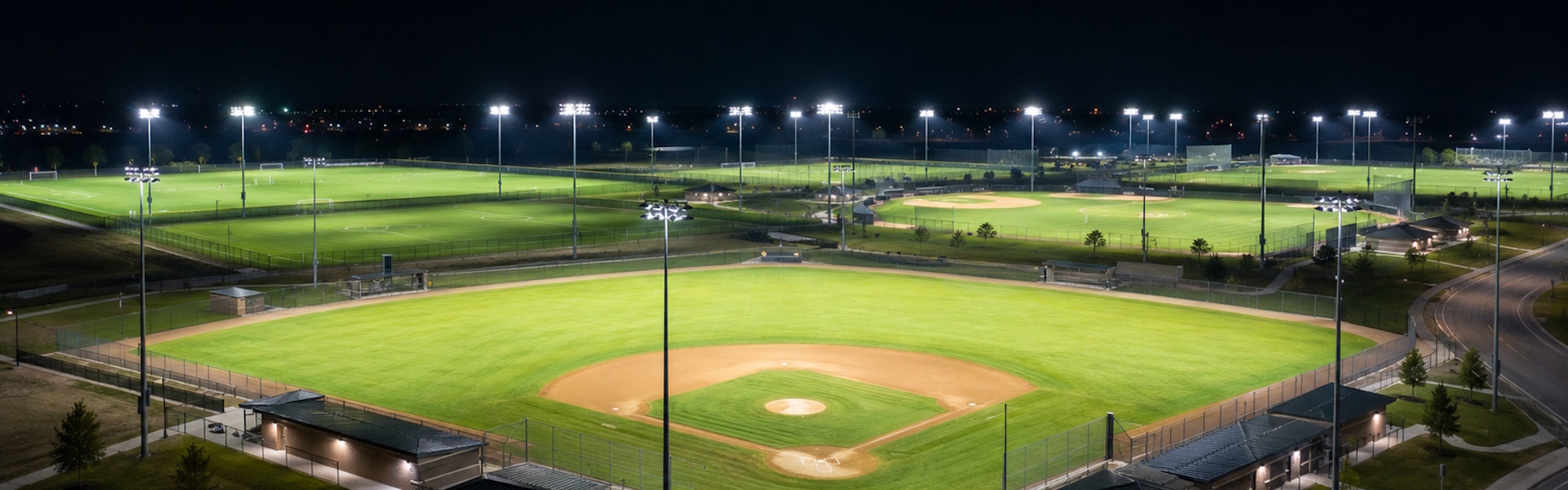
Football, soccer, baseball, and softball fields are the most demanding outdoor installations. High mounting heights (typically 50 to 80 feet on poles around the perimeter), wide coverage areas, and tight uniformity requirements all point to purpose-built LED sports floodlights. Pole placement, aiming angles, and fixture wattage get coordinated in a photometric study before anything goes in the ground. A full-size recreational football field typically runs 4 to 6 poles, each carrying 4 to 6 LED sports fixtures in the 500W to 1,000W range. Confirm the target foot-candle level and RP-6 class for your specific sport before sizing the array.
Tennis and Pickleball Courts
Court sports live and die on glare control. Players track a fast ball against sky and background, so fixtures above and behind the court have to keep direct glare out of the sightline. LED shoebox area lights on 20 to 25-foot poles, aimed inward toward the surface, are the standard for individual courts. RP-6 guidance runs roughly 30 foot-candles for recreational play and 50 for club-level competitive courts; verify the class for your court before you lock the design.
Multipurpose Recreational Facilities
Parks and rec departments often need one system to serve several sports on the same footprint: a field that hosts flag football and soccer, or a hardcourt used for basketball, volleyball, and pickleball. Flexible fixture selection and dimmable LED controls let a facility adjust output by sport and event, stretching use hours without a matching jump in energy cost.
Parking and Site Areas
Sports facilities dump concentrated foot and vehicle traffic into the lot well after dark. Parking, access roads, and pathways need their own lighting plan, separate from the field design. Area and site lighting on 15 to 25-foot poles covers these zones efficiently, cuts liability, and helps families get in and out safely during evening events.

Recommended Fixtures by Application
Each zone has different mounting, coverage, and performance targets. Matching fixture type to zone is what keeps a job cost-effective and on spec without over-building.
Sports Field and Stadium Fixtures
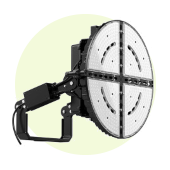
Open fields need high-output LED sports floodlights on tall poles. Precision optics throw a narrow, controlled beam across long distances with minimal spill onto adjacent property. A 1,000W LED sports light is the workhorse for full-size competitive fields; 500W fixtures serve recreational fields and smaller complexes. Spec DLC-listed fixtures so the job qualifies for utility rebates.
Top-Selling LED High-Mast and Stadium Lights
791
Browse all Sports Lighters and High Mast Lights
Moving off metal halide or high-pressure sodium pays back fast. A 1,000W metal halide stadium fixture draws about 1,080 watts at the fixture once you count ballast losses. A comparable LED replacement runs 600 to 700 watts, cutting per-fixture draw by 35 to 45 percent. LED hits full output instantly, with no 15 to 20-minute warm-up, so you can dim for practice and run full power for game night, and bring lights back up immediately if a game runs long. Rated life for LED sports fixtures typically exceeds 50,000 hours at L70, which means far fewer maintenance trips up the pole.
Quick ROI Read
Between the 35 to 45 percent energy cut, DLC rebates that offset 20 to 40 percent of fixture cost in many markets, and the drop in relamping trips, a well-designed LED sports retrofit usually lands a simple payback in the 3 to 6-year range. Ask your utility for the current rebate schedule before you quote the job.
Poles are the other half of the equation. Courts and parking run on poles in the 15 to 25-foot range, the heart of what we stock (our pole range runs up to 39 feet). Field poles in the 50 to 80-foot range need a structural engineer's foundation design and are usually sourced through specialty pole manufacturers, so build their lead time into the schedule early. See our light poles and site lighting accessories for court and parking pole specifications.
Court and Hardcourt Fixtures
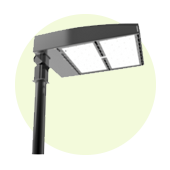
Tennis, pickleball, basketball, and multipurpose hardcourts work well with LED shoebox area lights on moderate-height poles. Adjustable-wattage models, such as the WSD Selectable LED Shoebox Light, let you set output at install based on the court's level of play. Position fixtures behind the baselines and sidelines to keep direct glare out of the sightline, and aim them down at a steep enough angle to hold backlight spill off neighboring property.
LED Shoebox and Area Lights for Sports Courts
893
Browse all Area Lights and Shoebox Fixtures
Parking and Site Lighting
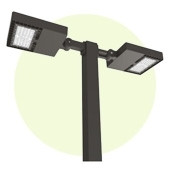
For lots and access roads around the facility, a quality LED area light on a 20 to 25-foot pole is the standard call. Choose DLC-qualified fixtures to capture rebate dollars, and 4000K to 5000K for clean color rendition across the lot. Controls that tie parking lighting to the game-night schedule stop the meter from running on dark nights.
Light Poles for Parking Lots
1018
Browse all Light Poles and Accessories

Design Guidelines and Light Level Standards
The Illuminating Engineering Society publishes IES RP-6, the North American standard for sports and recreational area lighting. RP-6 sets foot-candle targets, uniformity ratios, and glare limits for dozens of specific sports and facility classes. Any new build or major retrofit should be designed to the RP-6 class that matches the sport and level of play.
Foot-Candle Targets by Level of Play
Light level scales with the level of competition. Use the table as a planning starting point, then confirm the exact class and target in RP-6 for your sport; the numbers vary by field type and by whether the venue is televised.
| Level of play |
Typical avg. horizontal (fc) |
Typical uniformity (max:min) |
| Recreational / youth |
20 to 50 |
3:1 or better |
| High school / scholastic |
75 to 100 |
2.5:1 |
| College / competitive |
100 to 150 |
2:1 |
| Broadcast / televised |
200 and up (horizontal and vertical) |
1.5:1 |
A photometric study completed before pole locations are finalized is the most reliable way to confirm the design hits target before anyone pours a foundation.
Uniformity Ratios
RP-6 sets max-to-min uniformity for each sport. A 3:1 ratio or better (the brightest point no more than three times the darkest) is typical for recreational fields; competitive venues tighten toward 2:1. Poor uniformity creates visual fatigue for players and wrecks video, even when the average foot-candle level looks fine on paper.
Glare Control and Spill Light
Glare from sports lighting hits athletes, spectators, and the neighbors. Modern LED sports fixtures handle it with narrow-beam optics for tall poles, BUG (backlight-uplight-glare) ratings that quantify spill in each direction, and full-cutoff housings that kill uplight. For facilities near residential lots, the site permit or zoning often names a required BUG rating, verify the fixture's rating matches before you order, because a spill complaint after energizing is an expensive fix.
Color Rendering and Color Temperature
CRI 70 is acceptable for recreational play, but any venue that hosts video or broadcast competition should carry LED sports floodlights at CRI 90 or higher; where the spec is open, that is the number to hold. High CRI keeps uniform colors accurate on camera and sharpens ball-to-surface contrast under artificial light. 5000K (cool daylight) is the standard CCT for outdoor sports: it reads as clean white, supports player visibility, and sits close to the daylight athletes play under.
Controls and Energy Management
LED sports lighting earns its best return when controls match output to demand. A well-controlled system cuts consumption on off-peak nights, extends fixture life, and kills the "lights left on all night" problem that plagues facilities running manual switches.
Photocell controls automate on/off by ambient light. Field lights come on at dusk and shut off at a set time with no hand on the switch. Low cost, immediate impact on the bill for any site still switching manually.
Time-clock and scheduler controls let a facility program lighting to specific game and practice windows, say Monday to Friday, 5 PM to 10 PM, plus Saturday, 8 AM to 6 PM, with the controller handling on and off.
Dimming for multi-use is a defining LED advantage over HID. Metal halide does not dim effectively. LED steps from 100 percent for game night to 50 percent for practice with no warm-up between states, and no HID re-strike wait if you need full power back in a hurry.
Wireless control systems let a facility adjust zones, watch consumption, and catch fault alerts through a web interface. For a parks department running facilities across a city, that remote visibility is increasingly standard and pays for itself in staff windshield time.
Utility rebates apply to most DLC-listed LED sports lighting products. Amounts vary by utility, but in many markets they offset 20 to 40 percent of fixture cost. Stacked with the energy savings, simple payback on a well-designed project typically lands in the 3 to 6-year range.

Plan Your Sports Lighting Project with RelightDepot
The RelightDepot team works with municipal parks and recreation departments, school athletic directors, and electrical contractors on sports lighting projects nationwide. We stock the fixtures, poles, and controls for a complete athletic facility build, and we can match products to your foot-candle targets, pole heights, and budget, including value-engineered equals when a spec is open.
Call 888-548-6387, email [email protected], or visit our Contact Us page to talk fixture selection, pole specs, lead times, and availability. You can also browse the full outdoor lighting catalog for the complete range.