A full-service restaurant runs on four distinct lighting zones, each with its own foot-candle target, color temperature, and code requirement: the dining room, the bar, the kitchen, and the patio. Get the CCT wrong in the dining room and the operator is back on the phone before the punch list is signed off. Get the IP rating wrong over the dish pit and you're re-trenching conduit six months in. This guide breaks down what each zone actually specs out to, where the code citations that matter live, and which hospitality lighting categories cover the fixture types you'll be bidding and installing.
Dining Room Ambiance and Layered Lighting Design
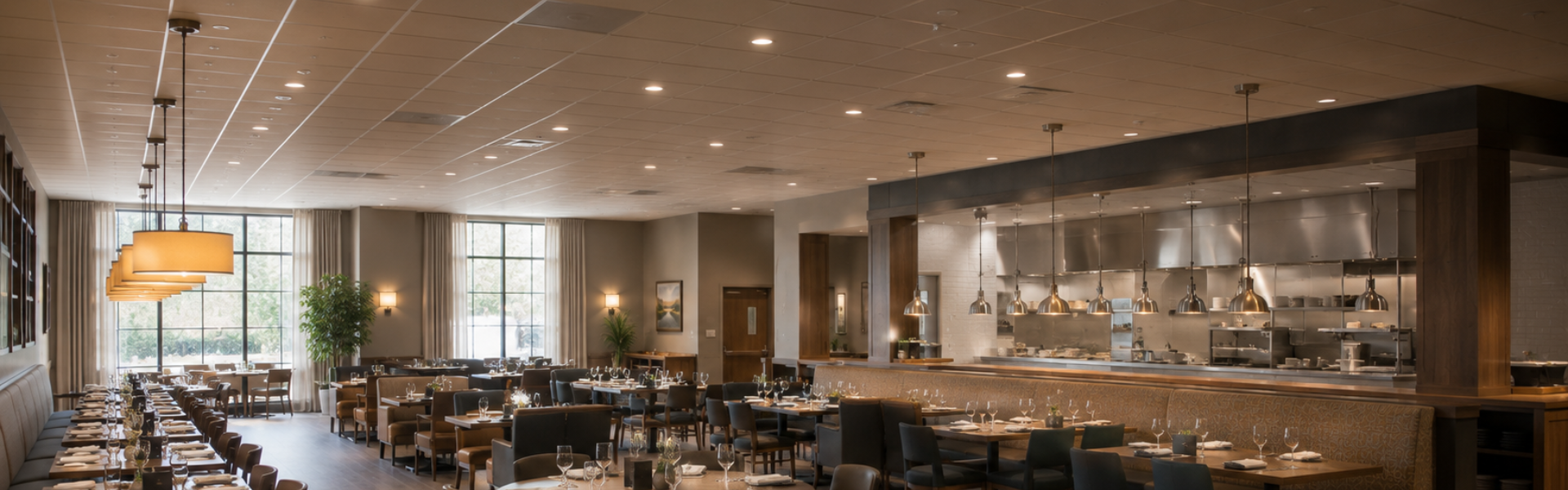
Dining room lighting on a full-service job comes down to three layers working on separate circuits: ambient, task, and accent. The designer sets the mix in the spec; your job is confirming the fixtures you're pricing hit those targets and that the dimming is actually compatible before it ships.
Ambient lighting foundation
Ambient light sets the baseline visibility and mood for the room. Specs for fine-dining and upscale-casual dining rooms commonly call out 10 to 20 foot-candles, well under typical office or retail targets, because the design intent is relaxation and conversation rather than task visibility. These are commonly cited industry benchmarks; confirm the actual figure against the IES recommendation or foot-candle table named in your spec, not this range alone. Warm 2700K to 3000K CCT is the default call in hospitality dining rooms because it renders food and skin tones better than anything cooler. Recessed downlights with 3000K dimmer-compatible LED modules are the workhorse spec here: low profile, even coverage, and they hold color temperature across the dimming curve instead of shifting amber the way a dimmed incandescent would.
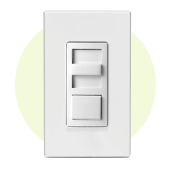
Dimming is non-negotiable on these jobs. A 0 to 10V or wireless dimming system lets the operator run bright during lunch and drop it down for dinner service without you coming back for a change order. Confirm dimmer and driver compatibility before rough-in, not at trim: a mismatched 0 to 10V dimmer and driver is one of the more common callback triggers on hospitality dimming jobs. Browse compatible dimmers before you finalize the fixture order.
Task and accent lighting layers
Task lighting keeps glare off the table so guests can read a menu without squinting into a downlight. Pendant lights hung 30 to 36 inches above the table deliver soft, downward light, typically specced in the 15 to 30 foot-candle range at the tabletop. Accent lighting, wall sconces, uplights on architectural features, or fixtures on display shelving, is the designer's tool for depth and finish. Where a sconce is specified at 2700K with a frosted or fabric shade, verify the shade material is rated for the wattage and doesn't trap heat before you install a whole run of them.

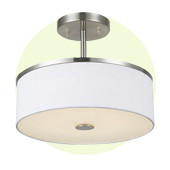
Recommended Decorative Pendants
765
Browse all Decorative Pendant Lighting
Bar and Lounge Accent Lighting
The bar is a secondary revenue center, and it gets its own zone on the panel schedule. Bartenders need enough light to read labels and pour accurately; the room wants theater. Both come from the same layered approach as the dining room: task light over the working bar, decorative accent on the back bar, on separate dimmer circuits from the ambient zone.
Feature and decorative lighting
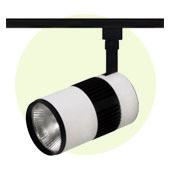
Track lighting or adjustable heads over the back bar put light on the bottles without spiking ambient brightness in the room. 2700K to 3000K is the standard call; some higher-end programs specify 4000K for a cooler look, check the spec before you substitute. Under-cabinet lighting behind the bar doubles as task light for bottle picking. Decorative string lights, neon, or LED strip under the shelving is finish work; keep it on its own dimmer circuit so the bartender can run it independent of the work light.
CRI matters at the bar: 90+ CRI is the usual spec so spirits color and label print read correctly, and so staff and guests don't look washed out under the accent lighting. Anywhere the bar sits directly under a soda gun, ice well, or gets hit by cleaning spray, specify a wet or damp-location listed fixture, not a standard dry-location unit; that's an inspection item that gets flagged if it's missed.
Track Lighting for Accent Illumination
838
Shop Track Lighting
Kitchen and Prep Area Lighting Requirements
Kitchen lighting is pure function, and it's the zone most likely to get flagged on a health or fire inspection if it's wrong. Typical specs call out 30 to 50 foot-candles over prep surfaces, 20 to 30 foot-candles in general kitchen circulation, and 50 to 75 foot-candles at pastry and plating stations. These are commonly cited industry benchmarks, not a substitute for the foot-candle table in your actual spec or local code; confirm before you order. Color temperature runs neutral to cool, 4000K to 5000K, so chefs get an accurate read on doneness and color; 95+ CRI is the common call for plating and pass stations.
Recessed troffers and LED high bays or linear fixtures cover most full-service kitchens: troffers in T-bar ceilings, high bays or linears where ceilings run higher or the cook line is a large open space. Every fixture in the kitchen needs an IP65 rating or higher for moisture and dust, and a housing you can actually hose down or wipe clean; stainless steel and anodized aluminum hold up to that better than painted steel. Pass-through and plating stations get their own dedicated 4000K to 5000K accent fixture so the final plate gets checked under consistent light before it leaves the kitchen.
NFPA 101 requires emergency lighting on kitchen exit routes (Section 7.9 in the current edition; confirm against whichever edition your AHJ has adopted). That's a separate battery-backed circuit, not an afterthought, and it's one of the first things a fire inspector checks on a restaurant walkthrough.
Work surface and task-specific lighting
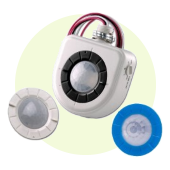
Prep tables, cutting boards, and cook lines need even, shadow-free light. Under-cabinet task fixtures mounted below open shelving kill the shadow a cook's own body throws across the board. Occupancy sensors in walk-ins and dry storage cut energy waste and are increasingly required by local energy code in unoccupied storage spaces; check before you leave them off the plan. Flicker-free drivers matter more in the kitchen than anywhere else in the building: line cooks are staring at a griddle under that light for a full shift, and a cheap driver that strobes at certain dim levels generates complaints fast.
Patio and Outdoor Dining Lighting
Patios add revenue and add problems: weather exposure, no architectural ceiling to hide anything in, and a lighting target that has to compete with nothing but the night sky. Every outdoor fixture on the job needs an IP65 rating minimum. Anywhere the patio sits within a few miles of salt air, specify 316 stainless, powder-coated aluminum, or composite housings; standard powder-coated steel corrodes and voids the finish warranty faster than the operator expects.
Ambient, decorative, and task considerations
Ambient patio lighting usually runs lower than the dining room, 5 to 15 foot-candles from overhead pendants, string lights, or lanterns, because the dark sky around the patio does a lot of the contrast work for you. 2700K stays the standard CCT outdoors for the same reason it works indoors. Landscape accent lighting, uplights on trees, path lights, or spotlights on the facade, is a life-safety item as much as a design one: steps and grade changes on a patio need to be lit well enough to keep the operator off the hook for a trip-and-fall claim.
Time-clock or photocell controls handle the schedule automatically, full brightness at peak service, dimmed after close or in the off-season, so nobody's relying on a manager to flip a switch. Amber or UV-A insect-control fixtures show up more on coastal and southern jobs; treat them as a separate circuit, not part of the ambient count. Battery-backed emergency fixtures still apply to any patio that's part of a required egress path, being outdoors doesn't exempt it from the same code that governs the dining room.
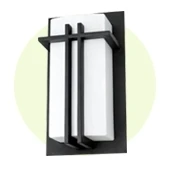
Decorative Wall Sconces
951
Shop Decorative Wall Sconces
Fixture Style Selection and Integration
Fixture style is the designer's call: brass, hand-blown glass, industrial Edison-style, mid-century polished metal, it's specced to match the concept, not something you're picking. Where you add value is knowing what a substitution actually costs in maintenance and callbacks: brass patinas over months, which some operators want and some will call you about; stainless and powder-coated steel hold up with zero maintenance and are the safer approved-equal to propose if the spec is open.
Dimmer compatibility is the part that actually falls on you. Verify every pendant, sconce, and specialty fixture on the order is compatible with the job's dimming system, 0 to 10V, DALI, or wireless, before it ships, not at trim. A mismatched dimmer shows up as flicker, shortened driver life, or a fixture that just won't dim. Neon and vintage-style LED filament decorative fixtures are the usual outliers here; confirm their control requirements separately, they don't always follow the same 0 to 10V curve as the rest of the order.
CRI and beam angle affect how the space reads, but they also affect what you'll hear about after opening: a wide-beam, warm 2700K, 90+ CRI pendant makes faces and food look right; a narrow-beam 5000K downlight in the same spot gets flagged by the operator even if it technically hits the foot-candle number on paper. Cheap drivers and optics are the most common source of return visits on a decorative package, price accordingly.
Design Guidelines, Codes, and Control Strategies
Code compliance on a restaurant job usually shows up in three places: automatic shutoff and occupancy controls, emergency and egress lighting, and glare control. None of these are optional line items.
ASHRAE 90.1 requires automatic shutoff or occupancy-sensing controls in specific spaces (Section 9.4.1, Interior Lighting Controls, in the 2019 edition; confirm the section numbering against whichever edition your jurisdiction has adopted). Restrooms, back-of-house corridors, and walk-in coolers are the usual triggers for additional local occupancy-control mandates. IECC sets minimum luminous efficacy for new LED installations, and the number changes by IECC edition and by state amendment, confirm the applicable cycle with your local AHJ before you bid the panel schedule on assumed values.
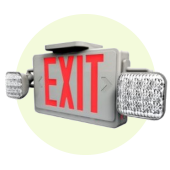
Emergency and exit lighting has to comply with NFPA 101 Section 7.9: exit signs on every egress path, battery-backed emergency lighting on escape routes, and a testing schedule the operator has to actually keep up with. Integrated battery packs built into the fixture housing cut down on the separate emergency-light package and simplify the rough-in.
Glare control is a punch-list item, not a nice-to-have. Bare LEDs in a pendant draw complaints; use diffusers, shades, or indirect optics. Keep uplighting and accent fixtures off a sightline that puts them directly in a diner's eyes. Task lights over the bar and kitchen prep tables need to avoid throwing a reflection back off a mirror or a stainless surface, and optical shields or louvers on recessed downlights cut veiling glare that shows up in inspection walkthroughs and in guest complaints alike.
Control strategy is where you can add real value on a bid: independent dimming circuits for dining room, bar, kitchen, and patio let the operator run each zone without touching the others, and wireless or 0 to 10V controls beat old relay switching on smooth dimming and flexibility. A preset scene controller, breakfast, lunch, dinner, is a small add that operators remember who installed.
ROI and Lifecycle Benefits
LED conversion delivers real ROI in hospitality, but the payback number depends entirely on operating hours and local utility rate. Don't quote a canned figure to an operator without running their actual numbers. The formula: connected watts times daily operating hours times 365, divided by 1000, gives annual kWh. Run that for the existing fixture count, run it again for the LED replacement wattage, and the difference times the local commercial rate is the annual savings.
Sample Calculation
A 5,000 sq ft full-service restaurant running 300 fixtures averaging 60 watts, 12 hours a day, 365 days a year, burns about 78,800 kWh annually. Swap to LED at an average 12 watts per fixture and that drops to roughly 15,800 kWh, a savings of about 63,000 kWh a year. At $0.13 per kWh, that's roughly $8,200 a year before counting reduced HVAC load or maintenance labor. Run the same math against the operator's actual fixture count, wattage, and hours before you put a number in a proposal.
LED lifespan of 30,000 to 50,000 hours means far fewer replacement trips: a fixture running 10 hours a day lasts roughly 8 to 14 years before the LED itself needs replacing, versus incandescent or halogen lamps that need swapping every few months in high-use fixtures. Dimming extends that further since a dimmed LED runs cooler than one at full output. Lower HVAC load from reduced fixture heat output and fewer service calls for lamp changes are the numbers that actually move an operator's decision.

Plan Your Restaurant Lighting Upgrade
Restaurant lighting jobs balance four zones, three code citations, and a designer's aesthetic call, all before you get to the punch list. If a spec is open or a fixture is on backorder, contact RelightDepot for dimmer-compatible substitutions that still hit the CCT, CRI, and IP numbers in the plan.
Call 888-548-6387 or email [email protected]. We can turn around a quote on fixture substitutions, confirm dimming compatibility, and flag anything in your order that doesn't meet code before it ships.