Lighting in hazardous locations carries real consequences when done wrong. If you manage a chemical processing plant, petroleum refinery, grain storage facility, or pharmaceutical manufacturing operation, the fixtures you install must match the classification of each area. This guide covers NEC hazardous location classifications, explains when to use explosion-proof versus vapor-tight fixtures, and lays out the practical benefits of LED technology in classified spaces.
Understanding Hazardous Location Classifications
The National Electrical Code (NEC) and National Fire Protection Association (NFPA) divide hazardous locations into three broad Classes and multiple Divisions or Zones, depending on the likelihood and nature of explosive or flammable materials. Knowing your facility's classification is the starting point for any compliant lighting strategy.
Class I: Flammable Gases and Vapors
Class I locations contain flammable gases, vapors, or liquids in sufficient quantity to create explosive atmospheres. Division 1 areas contain these materials under normal operation; Division 2 areas contain them only occasionally or in the event of equipment failure. Refineries, fuel distribution terminals, and pharmaceutical production facilities often fall into Class I. Fixtures in these spaces must be explosion-proof, meaning they can contain an internal explosion without rupturing and without igniting surrounding gases.
Class II: Combustible Dust
Class II locations house combustible dust in air suspension, including grain elevators, coal handling plants, flour mills, and wood processing facilities. Division 1 applies when dust is normally suspended in the air; Division 2 applies when dust is handled, stored, or processed but not normally airborne. Dust-tight fixtures rated for Class II use are essential here; they prevent dust accumulation inside the fixture, eliminating an ignition source. Class II dust is further sorted into Groups E, F, and G by conductivity and ignition temperature: Group E covers metal dusts like aluminum and magnesium, Group F covers carbonaceous dust such as coal and carbon black, and Group G covers everything else, including grain, flour, and wood dust. Match the fixture's group rating to the dust in your facility the same way you would match a gas group in a Class I space.
Class III: Easily Ignitable Fibers
Class III locations contain easily ignitable fibers, such as those found in cotton mills, woodworking shops, and paper processing plants. Division 1 means fibers are handled in normal operation; Division 2 means they are stored but not actively processed. Fixtures in Class III areas must be designed to prevent accumulation of fibers on or around the lamp.
Zone System (Alternative to Divisions)
Some facilities and jurisdictions use the IEC Zone system instead of Divisions. Under NEC Article 505 for Class I locations: Zone 0 means an explosive atmosphere is present continuously or for long periods of time; Zone 1 means an explosive atmosphere is likely to occur in normal operation; Zone 2 means an explosive atmosphere is not likely to occur in normal operation and, if it does, will exist only for a short time. The principle is the same as the Division system: match your fixture to the probability and nature of the hazard.

Typical Areas and Lighting Challenges in Hazardous Locations
Hazardous facilities contain distinct areas, each with unique lighting needs and compliance demands. Identifying these sub-areas helps you select fixtures correctly and ensures consistent safety across your plant.
Processing Floors and Production Areas
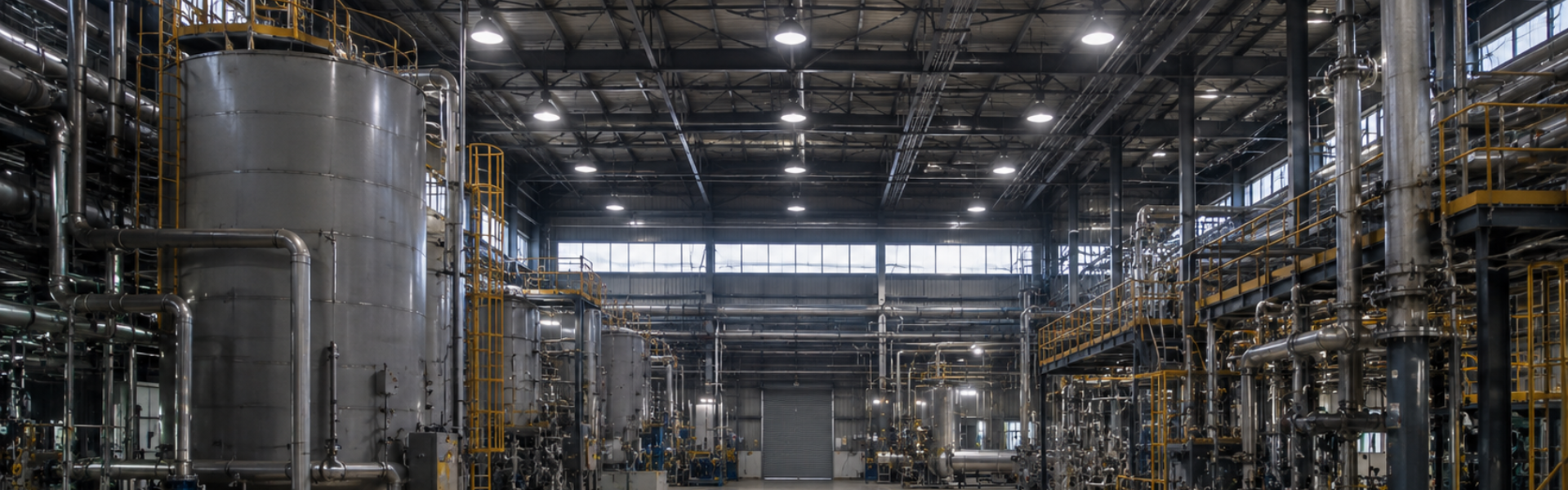
Processing floors in refineries or chemical plants need high intensity and uniformity. Operators must detect equipment leaks, read pressure gauges, and perform precise tasks safely. Poor visibility increases accident risk and operational errors. These areas typically require 30 to 50 foot-candles depending on task specificity. Explosion-proof high-bay fixtures with strong optical design are standard; they must withstand thermal cycling and vibration common in manufacturing environments.
Storage and Containment Areas
Storage tanks, drum storage rooms, and flammable liquid cabinets require lower intensity lighting, typically 10 to 20 foot-candles, but the fixtures must be certified for the specific Class and Division. Vapor-tight or dust-tight fixtures are often appropriate here, as the goal is containment rather than an explosion-proof design capable of managing an internal detonation.
Control Rooms and Administrative Spaces
Many facilities include non-hazardous control rooms adjacent to classified areas. These spaces can use standard commercial fixtures. However, if located within the classified boundary, fixtures must meet the same certification requirements as the production floor. Always verify the exact classification boundary on your facility drawings.
Egress Pathways and Emergency Lighting
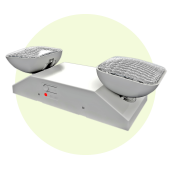
Emergency lighting in hazardous locations must operate on backup power and guide personnel to safety. Exit signage and pathway lighting must meet NFPA 101 Life Safety Code §7.9.2.1: an average of 1 foot-candle at floor level along egress routes, with no point falling below 0.1 foot-candle. Hazardous-location-rated emergency fixtures are available, though non-classified backup lighting is often permissible if located outside the classified boundary.
Explosion-Proof vs. Vapor-Tight: Key Distinctions
Two fixture types dominate hazardous location lighting. Understanding when each is appropriate prevents costly mistakes and ensures code compliance.
Explosion-Proof Fixtures
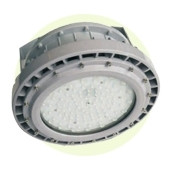
Explosion-proof fixtures are designed and tested to contain an internal explosion. They feature thick, heavy-duty housings; threaded connections with specific thread counts and depths; and tight mechanical tolerances. If a flammable gas pocket ignites inside the fixture, the housing contains the explosion and vents hot gases through small apertures that cool them below the ignition temperature of the surrounding atmosphere. Explosion-proof fixtures are required in Class I, Division 1 locations. They carry a T-code (for example, T4) indicating the maximum surface temperature reached during normal operation. That surface temperature must stay below the auto-ignition temperature of the specific gas or vapor present in the facility. Separately, the gas group (for example, Group D for propane, Group C for ethylene) sets the fixture's housing design requirements for flame paths and mechanical tolerances. Both the T-code and the gas group have to match your facility; one without the other doesn't get you a compliant fixture. Explosion-proof fixtures are heavy, expensive, and require careful installation, but they provide maximum protection in the most hazardous environments.
Pro Tip
T-code and gas group are not interchangeable checks. A fixture can carry the right T4 rating and still be the wrong fixture if its housing isn't rated for the gas group in your space. Pull both numbers off the facility's hazard classification study before you order, not off memory.
Vapor-Tight and Dust-Tight Fixtures
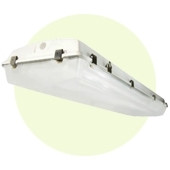
Vapor-tight and dust-tight fixtures seal the fixture interior to prevent external hazards from entering. No internal combustion means no need for explosion-proof construction. These fixtures are lighter, more affordable, and simpler to install than explosion-proof alternatives. They are appropriate for Class I Division 2, Class II Division 2, and Class III Division 2 locations where hazards are occasional or abnormal. One important distinction: "vapor-tight" is a physical construction descriptor, not a listing category. The fixture must carry a listing specifically for the applicable Class and Division to be code-compliant in that location. A sealed housing alone does not constitute a listed rating. In Division 1 environments, these fixtures do not provide the required protection, full stop.
Choosing Between the Two
Your facility classification dictates the choice. Division 1 areas require explosion-proof fixtures; Division 2 areas can use vapor-tight or dust-tight designs if they are listed for the applicable Class. Always verify the specific gas group or dust type, confirm the fixture's T-code against the auto-ignition temperature of materials in your space, and confirm the gas group matches the fixture's housing design rating. Consult your facility drawings and your facility engineer or EHS consultant to confirm classification boundaries.
Explosion-Proof Fixtures
774
Browse all Explosion-Proof Fixtures

LED Technology in Hazardous Locations
LED fixtures designed for hazardous locations offer measurable benefits over traditional incandescent and fluorescent alternatives, cutting maintenance requirements and improving operational reliability.
Energy Efficiency and Operating Cost Reduction
Hazardous-location-rated LED high-bay fixtures deliver 40 to 60 percent energy savings compared to traditional high-intensity discharge (HID) lamps. Combined with reduced maintenance labor in classified areas, facilities typically see payback within 2 to 4 years depending on local utility rates and maintenance costs.
Worked Example
A Class I facility running 100 traditional 400-watt HID fixtures 24 hours a day switches to 150-watt LED equivalents. That's roughly 25 kW saved continuously. At $0.12 per kWh, a national average, that's about $26,000 a year in energy costs alone, before maintenance savings. Run the math against your own rate and duty cycle before you commit to a payback estimate.
Extended Lamp Life and Maintenance Simplification
Traditional lamps in hazardous locations require replacement every 8,000 to 20,000 hours. In a 24/7 facility, that means bulb changes every few months, a labor-intensive and sometimes risky task in a classified environment. LED fixtures rated for 50,000 to 100,000 hours eliminate frequent lamp changes. Some facilities report reducing maintenance visits from monthly routines to annual or biennial inspections for lens cleaning and general condition checks. Fewer entries into classified zones also reduces safety exposure.
Thermal Management and Safety
LEDs generate significantly less heat than incandescent or HID sources. In explosion-proof fixtures, lower operating temperatures provide additional safety margin. A fixture with a T4 rating (maximum 135 degrees Celsius surface temperature) may operate at only 80 to 90 degrees Celsius with LED sources, whereas the same fixture with traditional lamps reaches or approaches its T-code limit. This thermal margin reduces ignition risk in edge-case scenarios and extends fixture life by reducing thermal stress on seals and housings.
Instant-On Performance
LEDs reach full brightness instantly. HID lamps need warm-up time on a cold start, and if a metal halide fixture loses power mid-cycle, it needs to cool down before it can restrike, often 5 to 15 minutes depending on the ballast and how hot it was running. In a process area where a momentary outage can leave operators without light during exactly the wrong moment, that restrike delay is a real liability LEDs remove.
LED Retrofit Consideration
When retrofitting existing hazardous-location-rated fixtures with LED engines, always verify that the LED driver, thermal design, and electrical integration meet the original fixture's hazardous-location certification. Swapping lamps alone may void certification. Consult fixture documentation or contact RelightDepot before proceeding with any retrofit.
Vapor Tight High Bays
799
Shop Vapor Tight High Bays
Design and Compliance Considerations
Beyond fixture selection, several design parameters ensure your hazardous-location lighting system meets code and operational needs.
Light Levels and IES Recommendations
IES RP-7 (Recommended Practice for Lighting Industrial Facilities) provides guidance on target illumination for industrial tasks. In hazardous locations, follow those recommendations while accounting for the limitations of available certified fixtures. General processing areas typically require 30 to 50 foot-candles; inspection and quality control areas may require 100 foot-candles or higher. Storage and containment areas generally fall in the 10 to 20 foot-candle range. Base light levels on the actual tasks performed in each area, not blanket industry defaults.
Layout, Spacing, and Uniformity
Hazardous-location fixtures are often mounted at high elevations (20 feet or more) to clear process equipment and maintain operator sightlines. Spacing ratios (fixture separation relative to mounting height) determine uniformity across the work surface. Most high-bay hazardous-location fixtures maintain acceptable uniformity at spacing ratios up to 1.5:1. Tighter spacing improves uniformity but increases fixture count and cost. The design lands with the engineer or lighting designer. If you're bidding the job, confirm the fixture count and spacing against the layout before you price it.
Control Strategies and Energy Code Compliance
ASHRAE 90.1 and IECC energy codes increasingly mandate occupancy sensors, daylight harvesting, and time-based controls in industrial spaces. In hazardous locations, control systems must also be listed for the applicable Class and Division. Wireless controls are generally not permitted in hazardous areas; hardwired systems are standard. In storage areas with irregular personnel movement, occupancy-controlled lighting can achieve 20 to 30 percent additional energy savings beyond LED efficiency gains.
Glare, Optics, and Visibility
Poor optics or high-angle brightness can reduce visual acuity and increase operator fatigue, particularly in environments where precision is critical. Asymmetrical or semi-cutoff optics help control glare while maintaining uniformity. Diffusers or secondary optics in some hazardous-location fixtures improve light distribution without compromising the sealed, certified design.
Thermal and Environmental Factors
Hazardous locations frequently experience temperature extremes, vibration, and corrosive atmospheres. Fixtures must be rated for the temperature range and environmental conditions of the facility. Stainless steel or epoxy-coated housings resist corrosion in chemical plants; standard mild steel is acceptable in grain facilities where moisture is the primary concern. Match materials and finishes to your specific environment.
Selecting and Purchasing Hazardous-Location Fixtures
RelightDepot offers industrial lighting solutions for Class I, II, and III facilities, including both traditional proven designs and the latest LED-based systems, certified by recognized laboratories such as UL or FM.
When you're ready to upgrade your hazardous-location lighting system, our team can help you work through gas groups, Division requirements, thermal ratings, and maintenance considerations. RelightDepot offers a broad selection of popular sizes and ratings, supporting fast delivery on many configurations, which matters when a lighting failure affects operations or safety.

Get in Touch
Hazardous location lighting is specialized, but it does not have to be complicated. RelightDepot serves electrical contractors, facility managers, and plant engineers across petrochemical, pharmaceutical, grain processing, and other regulated industries. For a single replacement fixture or a full system upgrade, contact us directly.
Back to Industrial Lighting Applications