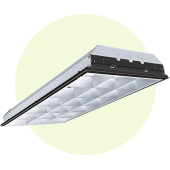
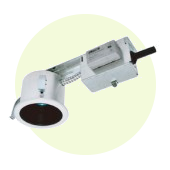
The IES recommends 50 foot-candles in serving areas to ensure staff can see food clearly and prepare meals safely. Dining areas should have 30 to 50 foot-candles. Use dimmable fixtures to allow flexibility between serving and events.
FREE SHIPPING ON ORDERS OVER $1K
EXPERT LIGHTING ADVICE
VALUE ENGINEERED QUOTES
ROI ANALYSIS AND DESIGN SUPPORT
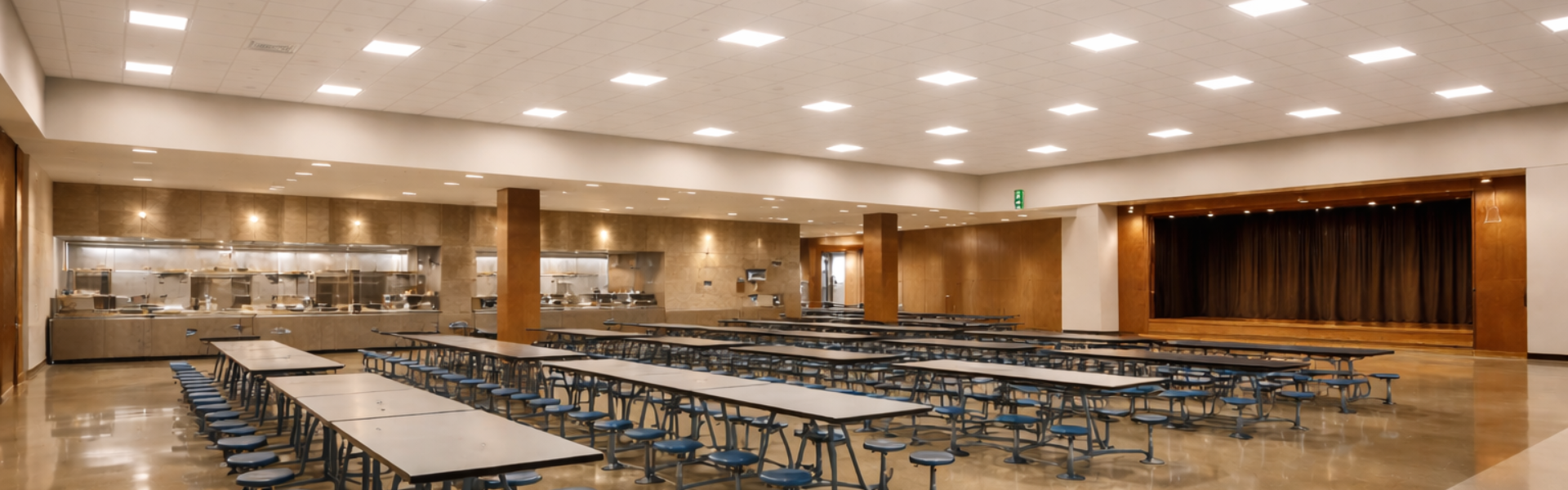
School cafeterias and multipurpose rooms face unique lighting challenges. These spaces must transition from serving lunch to hosting assemblies, performances, athletic events, and community gatherings, sometimes within hours. Each activity demands different light levels, color rendering, and control strategies. Proper lighting improves safety during crowded meal service, enhances sightlines during performances, reduces glare on gymnasium courts, and supports energy code compliance across varied uses. This guide covers fixture selection by ceiling type, design strategies, and control systems that help facilities managers and contractors deliver reliable, cost-effective lighting for these demanding spaces.
Modern school facilities often consolidate multiple activities into one large room or pair of connected spaces. Understanding each activity's lighting requirements is essential to selecting fixtures and controls that support all of them.
Cafeteria serving lines require bright, shadow-free lighting to help staff see food clearly and prepare meals safely. The IES recommends 50 foot-candles in serving areas and 30 to 50 foot-candles in dining zones. Fixtures must minimize glare on shiny food service equipment and account for ceiling heights that often reach 12 to 16 feet or more in multipurpose rooms. In rooms with suspended T-grid ceilings, LED panel lights and troffers provide even, shadow-free coverage directly over serving counters. In spaces with open or exposed ceilings, surface-mount commercial fixtures or linear pendants work well. Dimming should allow flexibility: brighter during morning setup and service, moderate during lunch hours, and lower when the space transitions to evening events.
Assemblies, theatrical productions, and concerts demand flexible control and high light quality. While full theatrical rigging may not be practical in a school multipurpose room, dimming-capable fixtures with good color rendering (CRI 90+) support presentations, school plays, and band concerts. The space must accommodate both stage and audience lighting. Color temperature matters here: warmer house lights in the 3000 to 3500K range create a more inviting atmosphere before and after productions and during intermission, while the cooler 4000 to 5000K fixtures used during lunch service or athletics can be dimmed or switched off during events. In rooms with open or exposed ceilings, pendant fixtures or track lighting near performance areas offer additional flexibility and directional control. In T-grid ceiling rooms, high-wattage recessed can lights can deliver enough intensity to the floor level for performance applications where focused light is needed.
When a multipurpose room serves dual duty as a gymnasium or volleyball court, lighting demands intensify. The IES recommends 30 to 50 foot-candles for recreational sports and up to 75 foot-candles for competitive play. Glare control becomes critical because athletes and spectators need clear sightlines without veiling glare on courts or bleachers. Fixtures must be spaced to eliminate dark zones where serve-and-volley sports could cause injury. LED high bay fixtures rated for impact resistance and vibration are ideal, and rooms with T-grid ceilings benefit from grid-mount high bay fixtures that integrate directly into the ceiling structure. If the space is used for both food service and athletics, protective fixture covers or impact-rated housings may be necessary to shield against moisture and occasional impact from balls.
Investing in well-designed, controllable lighting delivers multiple benefits that extend beyond visibility.
Safety: Adequate light levels and even distribution reduce trip hazards during meal service and prevent collisions in athletic areas. Staff working in serving lines experience less eye strain and make fewer food-handling errors. Athletes and spectators navigate bleachers and exit routes with confidence.
Operational Flexibility: Dimmable, zoned lighting allows facilities managers to adapt the space to different activities without changing fixtures. A dimmed gymnasium becomes a concert hall; ramped-up cafeteria lighting supports food prep. This versatility extends the room's usable life and justifies the capital investment.
Energy Efficiency: Modern LED high bay fixtures consume 50 to 70% less energy than older metal halide or fluorescent equivalents. Occupancy sensors and daylight harvesting further reduce consumption in spaces with variable occupancy. Many schools achieve 3 to 5 year payback through energy savings alone.
Maintenance and Lifecycle Cost: LED fixtures last 50,000 to 100,000 hours, eliminating the frequent relamping required by traditional lighting. In a high-ceiling multipurpose room, avoiding frequent climbs to change bulbs saves labor and reduces safety risks. Lower heat output also reduces cooling loads in already-warm spaces.
Assumptions: 10,000-square-foot multipurpose room, 40 fixtures, 12 operating hours per day, 5 days per week, 260 school days per year (3,120 hours annually), electricity rate of $0.12/kWh.
Before (Metal Halide): 40 fixtures at 400 watts each (approximately 460 watts with ballast losses) = 18.4 kW total load. Annual consumption: 18.4 kW x 3,120 hours = 57,408 kWh. Annual electricity cost: $6,889.
After (LED High Bay): 40 fixtures at 150 watts each = 6.0 kW total load. Annual consumption: 6.0 kW x 3,120 hours = 18,720 kWh. Annual electricity cost: $2,246.
Annual savings: 38,688 kWh and $4,643 in electricity. Project cost (fixtures at $125 each plus $100 installation per fixture): $9,000. Simple payback: 1.9 years. Reduced maintenance (no relamping for 10 to 15 years) adds further savings over the fixture's lifespan.
Browse all LED Panels and Troffers
Fixture selection depends on ceiling type, mounting height, activity type, and budget. Ceiling construction is one of the most important factors: a T-grid (drop ceiling) room calls for different fixtures than a room with an open or exposed structure.
Most school cafeterias have suspended T-grid ceilings. In these spaces, LED panel lights and lay-in troffers (2x2 or 2x4) provide uniform, glare-free illumination ideal for serving lines and dining areas. For rooms that double as gymnasiums with higher ceilings (16 feet and above), grid-mount high bay fixtures drop into the T-grid and deliver the higher lumen output needed for athletic activities. Grid-mount high bays also work well for general illumination in tall cafeterias where standard troffers cannot push enough light down to floor level. For performance applications in T-grid rooms, high-wattage recessed can lights (6-inch or 8-inch) can concentrate light on stage areas without the visual clutter of exposed fixtures.
Multipurpose rooms with open ceilings, exposed structure, or very high clearances (20 feet and above) need LED high bay fixtures as the primary light source. Round or linear high bays deliver 100 to 150 lumens per watt, dim down to 10% brightness, and eliminate the warm-up time and color shift of older technologies. For additional flexibility near performance areas, pendant fixtures, track lighting, or surface-mount cylinders provide directional and accent lighting that high bays alone cannot deliver. These fixture types mount easily to open structure and allow event coordinators to adjust lighting angles for assemblies or performances.
Mounting height is determined by the room's actual ceiling dimensions, not a one-size-fits-all rule. In rooms with 12 to 14 foot ceilings, LED panels or grid-mount high bays typically provide adequate light. In rooms with 16 to 24 foot ceilings, round or linear high bays become necessary because lower-output fixtures cannot push enough lumens to the floor. Space high bay fixtures 1.2 to 1.5 times the mounting height apart in a regular grid pattern. For a room with 14-foot ceilings, that means roughly 17 to 21 feet between fixtures. Always verify spacing with photometric software (most fixture manufacturers provide free layout tools) to confirm foot-candle targets at the working plane.
Controls are what make a multipurpose room truly flexible. A robust dimming system should support multiple zones (cafeteria, stage area, gymnasium) independently.
DALI (Digital Addressable Lighting Interface) or 0 to 10V analog dimming systems allow precise control and integration with building management systems. Occupancy sensors (passive infrared or microwave) reduce energy waste when the space is unoccupied. Time-based scheduling coordinates lighting changes with the facility calendar: brighter during lunch service, dimmed for assemblies, and off during unoccupied hours. For schools, integrating the lighting system with the bell schedule or access control system ensures fixtures activate when the space is in use and idle when not. Manual override buttons at multiple entry points give operators quick access to adjust lighting when schedules change or events run past their planned time.
For rooms that host both cafeteria service and performances, consider separating zones by color temperature where the budget allows. Warmer fixtures (3000 to 3500K) in the stage and audience seating area create a more comfortable environment for assemblies, concerts, and theatrical productions. Cooler fixtures (4000 to 5000K) over serving lines and athletic areas improve visibility and color accuracy for food preparation and sports. A zoned control system lets operators switch between these modes quickly.
Beyond fixture selection, several design principles ensure reliable, code-compliant multipurpose lighting.
The IES Lighting Handbook and ASHRAE 90.1 provide guidance on foot-candle levels for different activities. For school multipurpose rooms, use these benchmarks:
Measure foot-candles at the working plane (floor for athletics, counter height for serving lines, seat height for assemblies). Aim for uniformity: the ratio of maximum to minimum light across the space should not exceed 3:1 for athletic areas or 2:1 for dining areas to avoid dark zones and excessive glare.
NFPA 101 (Life Safety Code) and IECC (International Energy Conservation Code) require emergency egress lighting in multipurpose rooms. Fixture placement must ensure 1 foot-candle minimum on all exit routes and at least 0.2 foot-candles on the floor in unlit areas. In school multipurpose rooms, this typically means LED exit signs and emergency lighting above all doors, emergency lights above stairwells and corners, and continuous illumination (or backup battery illumination) along primary exit corridors. Coordinate emergency fixtures with the main lighting layout to avoid dark zones.
Multipurpose rooms with polished gym floors, stainless-steel serving equipment, and large windows are prone to glare. High bay fixtures should use asymmetric or wide-angle distributions to spread light evenly rather than creating hot spots. Choose fixtures with diffusers or louvered optics, especially for overhead mounting. For cafeterias, 3500 to 4100K color temperature provides neutral white light without a yellow cast on food. For athletic areas, 4000 to 5000K provides clearer sightlines and reduced eye strain. For performance and assembly use, fixtures in the 3000 to 3500K range create a warmer, more inviting environment. CRI should be 80 minimum; 90+ is preferred for food service and performances where color accuracy matters.
If glare is a persistent issue after installation, consider installing small baffles or louvered reflectors beneath high bay fixtures. Alternatively, raise fixtures higher (if ceiling permits) to reduce direct sightline to the light source, or add anti-glare film to gymnasium windows. Test changes during a practice session with student athletes before event night.
School multipurpose rooms experience moisture, heat, and occasional impact. Select fixtures rated IP54 (dust and splash resistance) as a minimum for athletic and food service areas. In spaces adjacent to kitchens or with high humidity, consider IP65 (water jet resistant). For athletic areas where balls might strike fixtures, choose impact-rated housings or install protective guards. Verify that any control wiring and occupancy sensor placement avoids moisture zones and high-traffic areas.
Modern energy codes set limits on lighting power density (watts per square foot). For schools, the IECC typically allows 1.3 to 1.4 watts per square foot for multipurpose assembly rooms. LED high bay fixtures at 150 watts and 40,000+ lumens easily meet this limit. Pair fixtures with occupancy sensors and daylight harvesting (in rooms with windows) to exceed code requirements and lower utility costs. Document all fixtures, controls, and dimming zones in the as-built drawings for future maintenance staff.
School cafeterias and multipurpose rooms are among the most complex lighting environments in the education sector. Whether you are retrofitting an older facility or designing a new space, the right fixture selection and control strategy can reduce energy costs, improve safety, and support flexible use for years to come. RelightDepot.com offers a complete range of LED high bay fixtures, LED panels and troffers, occupancy sensors, and emergency lighting designed for schools. Our team can help you calculate foot-candles, select fixtures for your specific ceiling type and height, and design a zoning strategy that matches your facility calendar. See our Lighting for Schools hub and School Gymnasium Lighting Guide for related guidance.
Ready to upgrade your school's multipurpose lighting?
If you don't see what you're looking for, don't hesitate to contact us to discuss your needs with one of our lighting experts. We would be happy to walk you through all of the design considerations and help you choose the best type of lighting for your application.