Common area retrofits in multifamily properties are a recurring bid for most electrical contractors working the residential side, and they come with a specific mix of code requirements, sensor and controls work, and durability specs that separate a job done right from a callback. Common areas and hallways cover lobbies, corridors, stairwells, laundry rooms, and amenity spaces, and each one carries its own illumination targets, wiring requirements, and fixture demands. This guide covers what actually appears in the spec or RFP for residential common-area lighting work: code-mandated emergency egress, dual-circuit stairwell wiring, occupancy-sensor controls, and fixture ratings that hold up in high-traffic, 24/7 spaces.
Overview: Why Common Area and Hallway Lighting Matters
Multifamily common areas break down into lobbies, corridors, stairwells, laundry rooms, and amenity spaces, and each one has different lighting demands. Lobbies need welcoming, well-distributed light. Corridors need reliable visibility for daily foot traffic and, more importantly, for emergency egress. Stairwells need dual-circuit wiring: normal power plus independent emergency backup, since these are life-safety spaces under building code. Laundry and amenity rooms need task lighting and fixtures that hold up to vandalism and moisture. Property managers and owners care about safety, liability, and operating cost; for the contractor bidding or installing the work, that translates into specific code requirements at inspection, sensor wiring that has to route around egress paths correctly, and fixture selections that need to survive the duty cycle without a service call in year two.

Typical Areas and Activities in Residential Common Spaces
Common area scope varies by property size and amenity mix, but most multifamily buildings break down into the same core zones:
Lobbies and Entrances
The lobby is the first thing a resident, prospective tenant, or inspector sees, so it needs to look finished and be bright enough for security monitoring and facial recognition at entry points. Lighting designers commonly target somewhere in the 20 to 30 foot-candle range for general circulation, with higher levels at reception counters and mailbox areas, distributed to kill dark corners and keep sightlines open to entry doors and management offices. Confirm the exact target against the IES Lighting Handbook or the project's photometric plan before bidding; treat this as a general range, not a hard spec.
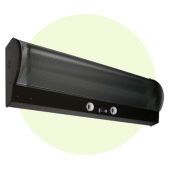
Wall Sconces for Common Corridors
820
Browse all Wall Sconces
Corridors and Hallways
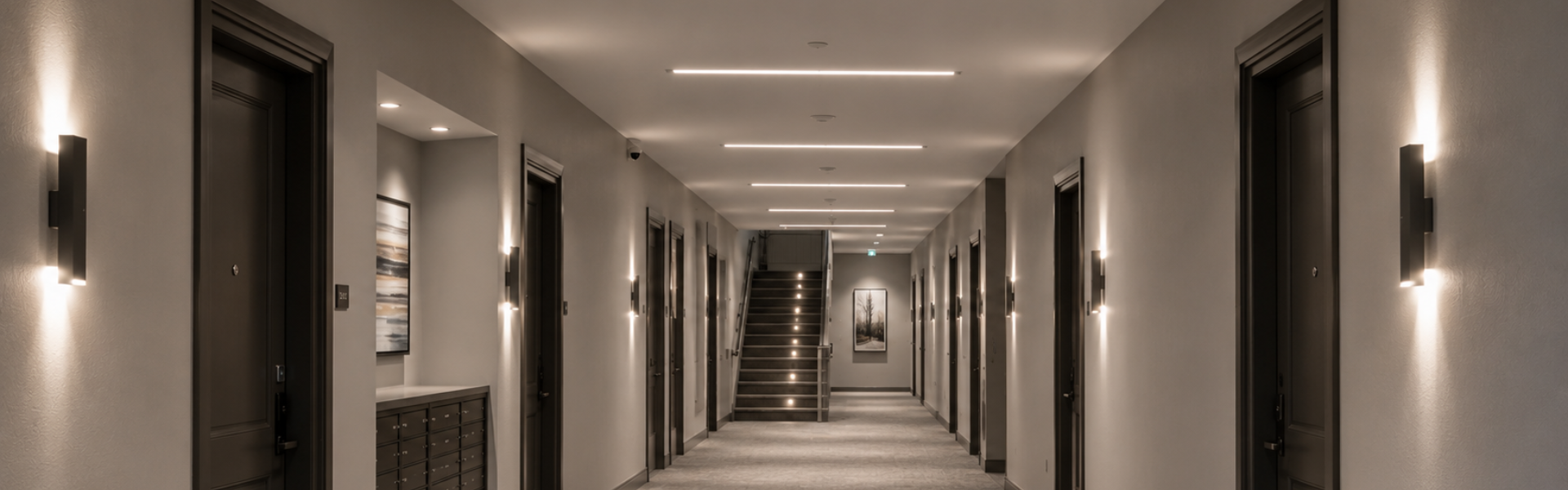
Hallways get walked constantly, often by residents carrying groceries or pushing strollers, and they're a means of egress under code, which means continuous illumination and backup power aren't optional. A typical hallway runs in the 10 to 20 foot-candle range, with even distribution to avoid the shadow zones that hide a trip hazard or confuse someone trying to find an exit during a power outage. Wall sconces handle the ambient layer; surface-mounted or recessed linear LED fixtures spaced 8 to 10 feet on center carry the primary task lighting with minimal shadow gaps. Spec CRI 80 or higher here: it's not a code requirement, but it's the difference between a resident being able to identify a face or a hazard at 11 PM and not.
Recommended Surface Mount Ceiling Lights
737
Browse all Surface Mount Ceiling Lights
Stairwells
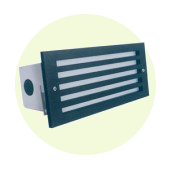
Stairwells are the highest fall-risk space in the building and the one place where the code numbers actually matter at inspection. IBC Section 1008.2 requires a minimum of 10 foot-candles at the walking surface on stairs in use, and NFPA 101 Section 7.9 governs the emergency condition: a minimum of 90 minutes of backup illumination, averaging 1 foot-candle with a low point no less than 0.1 foot-candle along the egress path. Many designers spec well above the 10 fc code minimum, commonly in the 20 to 30 foot-candle range, for comfortable navigation on treads and landings; confirm that target against the actual photometric plan rather than treating it as code. Step lights recessed into risers supplement overhead fixtures and sharpen tread-edge visibility. Whatever the spec calls for, the wiring is non-negotiable: normal power and independent emergency backup on separate circuits, with the emergency circuit tested and documented at final. Our Stairwell Lighting Guide breaks down the code and rebate side of this in more detail if you're bidding a stairwell-heavy job.
Laundry Rooms and Amenity Spaces
Laundry rooms need bright, even light for sorting and treating clothing, typically 30 to 50 foot-candles. Fitness centers, community rooms, and courtyard amenity spaces each carry their own target depending on use. In self-service spaces with high turnover or a transient tenant population, price in vandal-resistant fixtures rated IK08 or higher; it's cheap insurance against a broken lens turning into a callback six months after handoff.

Benefits of Proper Common Area Lighting
For the property owner or manager footing the bill, common area lighting is a safety, liability, and operating-cost decision. For the contractor, it's worth knowing why the customer is spending the money, because it shapes what they'll want to see in the bid.
Safety and Security
Well-lit common areas cut slip-and-fall incidents, make surveillance footage usable, and reduce the property's liability exposure for inadequate lighting in shared spaces. This is the argument that gets a retrofit approved; it's rarely the contractor's argument to make, but it's useful context for why the PM is willing to pay for occupancy sensors and IK-rated fixtures instead of the cheapest option on the shelf.
Operational Efficiency
LED fixtures paired with occupancy sensors typically cut common-area energy use by 30 to 50%. Payback timelines vary a lot by square footage, duty cycle, and local electricity rates: a large, continuously-lit common area can pencil out in 2 to 3 years on energy savings alone, while a smaller, already-intermittent space (see the worked example below) runs closer to a decade on energy alone before maintenance savings are factored in. Either way, LED retrofit kits also cut lamp replacement frequency, which is real labor savings for whoever holds the maintenance contract.
Resident Satisfaction and Retention
Clean, well-lit common areas read as well-managed property to residents and prospects. That's a leasing and retention argument for the owner, and it's part of why these retrofits keep getting funded even when the energy payback alone is a longer runway.
Recommended Fixtures by Area
Fixture selection for common areas comes down to durability, code compliance, and total cost of ownership over a 24/7 or near-24/7 duty cycle. The ranges below reflect common practice in multifamily common-area work; confirm project-specific targets against the photometric plan or spec before bidding.
Lobbies and Entrances
Lobbies typically combine wall sconces with flush-mounted or semi-flush ceiling fixtures: sconces at 5 to 6 feet above finished floor for ambient light, ceiling fixtures for the primary task layer. At a continuous or near-continuous duty cycle, a 25,000-hour-rated LED fixture runs roughly 2.9 years before end of rated life; a 50,000-hour fixture runs closer to 5.7 years. If the spec calls out a 10-to-20-year fixture life, that number assumes a substantially lower duty cycle than 24/7, worth confirming before you commit to a lifespan claim in a proposal. Confirm wet-location ratings if the lobby has exterior exposure or an interior water feature. 3000K (warm white) is the common call for lobbies; it reads as inviting without sacrificing brightness.
Corridors and Hallways
Keep corridor lighting simple and reliable: surface-mounted or recessed linear LED at 8 to 10 feet on center, CRI 80 minimum, 3000K or 4000K depending on the property's preference for warmth versus visibility. Confirm wet or damp location ratings in humid climates or any corridor with plausible moisture exposure; that's a common punch-list item at final inspection if it's missed.
Stairwells
Stairwells need dual-circuit lighting: normal power on one circuit, emergency backup (generator or battery) on an independent circuit, so residents can still see the treads if the building loses main power. Recessed or semi-recessed LED fixtures cut glare on treads and throw light where it's needed instead of into someone's eyes on the way up. Many jobs now spec fixtures with integrated LED emergency backup drivers that switch over automatically on power loss, which simplifies the wiring versus a separate emergency circuit and inverter.
Laundry Rooms and Amenity Spaces
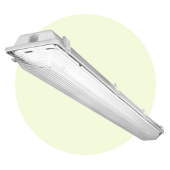
Laundry rooms run humid, so vapor-proof fixtures rated for damp locations are the right call over a standard flush-mount, and flush-mounted or semi-recessed LED panels work well for the even coverage these rooms need. Vandal-resistant construction (polycarbonate lenses, recessed mounting, protective guards) is worth pricing into any self-service space with high turnover. Fitness centers and community rooms run similar brightness levels; color temperature usually splits 3000K for lounge-style community rooms and 4000K to 5000K for fitness spaces where alertness matters more than ambiance.
Design Guidelines and Considerations
On retrofit and ongoing-ops work, a few system-wide principles keep the job out of the callback pile.
Light Levels and Distribution
Follow the project's photometric plan for illuminance by space type, and don't eyeball spacing on a job with a real spec. Recessed fixtures at 8 to 10 feet on center in a 10-foot-ceiling corridor is a reasonable rule of thumb for even coverage, but a foot-candle meter or a photometric layout from your distributor beats a guess, especially in lobbies or other open areas with mixed ceiling heights.
Emergency Egress and Exit Lighting
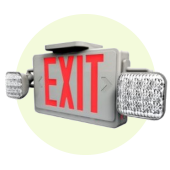
This is the part of the job that gets checked at inspection, so get it right. IBC Section 1008 and NFPA 101 Section 7.9 require continuous illumination on all means of egress, backed by emergency power that holds for a minimum of 90 minutes at an average of 1 foot-candle and a minimum of 0.1 foot-candle along the path of egress. Exit and emergency lighting, including exit signs, needs to be visible from any point in a corridor, and dual-circuit wiring is mandatory in stairwells and primary exit routes. Plan for this infrastructure early in a renovation; retrofitting emergency power circuits after the fact costs more than building it in from the start.
Occupancy Sensors and Automated Controls
PIR occupancy sensors cut energy use by dimming or switching off lights in intermittently used spaces, laundry rooms, amenity areas, and secondary corridors that aren't classified as means of egress. They trigger on motion and switch off, or drop to a low-level hold, after a 5 to 15 minute delay. The one rule that can't be broken: sensors do not go on primary egress routes, exit corridors, or stairwells serving as means of egress, where continuous, code-required illumination has to stay on regardless of occupancy. Get this wrong on a stairwell, and it's a failed inspection, not a warranty claim.
Occupancy Sensors for Energy Savings
974
Browse all Occupancy Sensors
Worked Example (Illustrative): LED and Occupancy Sensor Retrofit
A 150-unit property with 4,000 sq ft of secondary corridors, laundry rooms, and amenity areas is running twenty 40W fluorescent fixtures, 12 hours a day, at $0.10 per kWh: about $350 a year in lighting cost. Swap to PIR sensors and 12W LED fixtures, and effective burn time drops to roughly 6 hours a day, cutting energy cost to about $53 a year. At a retrofit cost of roughly $3,500, that's about 11 years simple payback on energy alone, a longer runway than the 2 to 3 year figure cited above for larger, continuously-lit spaces. The gap is real: this example is a smaller footprint running on sensors already, not a 24/7 space converting to sensors for the first time. Factor in that the LED swap also extends fixture life from 5 years to 20-plus and avoids replacement lamp and labor costs, and payback typically lands closer to 6 to 8 years. Bigger common-area footprints or higher local electricity rates shorten the payback further either way.
Glare and Visual Comfort
Bare lamps or high-intensity fixtures without diffusers cause glare and actually reduce visibility, the opposite of the goal. Frosted lenses, louvers, or recessed mounting soften distribution in corridors. In stairwells, aim fixtures down at the steps rather than up, so someone climbing isn't looking straight into the fixture.
Color Temperature and Circadian Comfort
In continuously-lit common areas, color temperature affects how bright a space reads and how it sits with a resident's circadian rhythm. Warm white (2700K to 3000K) suits lobbies and lounge areas but can feel dim in task-focused spaces. Neutral white (4000K) balances visibility and comfort, and it's the common call for stairwells used around the clock. Cool white (5000K) fits security-focused spaces where task visibility matters most.
Vandal-Resistant and Durable Fixtures
In properties with heavy tenant turnover or outdoor exposure, polycarbonate lenses beat glass, and recessed or protected mounting plus solid electrical construction cut the service-call rate. IK08 minimum for lobbies, IK10 for stairwells in higher-risk properties, is a reasonable baseline to price into the bid. It costs more upfront and shows up as fewer truck rolls over the life of the fixture.

Call to Action
Whether you're bidding a full common-area retrofit or sourcing a substitution on an open spec, RelightDepot stocks the fixtures, sensors, and emergency-rated components that hold up to code review and multifamily duty cycles.
Browse wall sconces, surface-mount ceiling lights, stairwell fixtures, exit and emergency lighting, and occupancy sensors on the Residential and Multi-Family Lighting application page, or get a quote turned around fast:
Contact Us: RelightDepot.com Contact Form
Phone: 888-548-6387
Email: [email protected]