Effective exterior and parking lot lighting is essential for multi-family properties. It protects residents, enhances curb appeal, and reduces liability while meeting energy efficiency expectations. This guide covers the key decisions property managers face when designing, upgrading, and maintaining exterior lighting systems that balance safety, compliance, and operational cost.
Overview: Why Multi-Family Exterior Lighting Matters
Multi-family properties face unique lighting challenges. Parking lots must provide uniform illumination to prevent accidents and crime. Building perimeters require security lighting. Pathways and landscaping need attention for both safety and aesthetic value. And with dark sky ordinances becoming standard in many jurisdictions, new installations must control light pollution while maintaining the security residents expect.
A well-designed exterior lighting system does three things simultaneously: it meets IES (Illuminating Engineering Society) standards for safety, reduces operating costs through LED efficiency and smart controls, and enhances property value by creating an inviting environment. For property managers, upgrading to LED often pays for itself within 3 to 5 years through energy savings alone.
IES Standards for Parking Areas
The IES RP-8 (Lighting Roadway and Parking Facilities) standard recommends 0.9 to 1.2 foot-candles (fc) of average illumination for parking areas used by the general public, with a uniformity ratio of 3:1 or better. For surface parking, aim for 0.5 to 1.0 fc in low-activity zones. Multi-family properties should target the higher end to ensure resident safety and reduce liability exposure. Verify specific targets against the current edition of IES RP-8 for your occupancy classification.

Typical Lighting Areas in Multi-Family Properties
Every multi-family complex has distinct zones that require different lighting approaches. Understanding each zone helps you prioritize budget and design decisions.
Parking Lots and Vehicle Access Routes
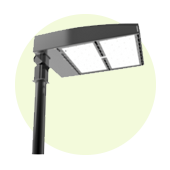
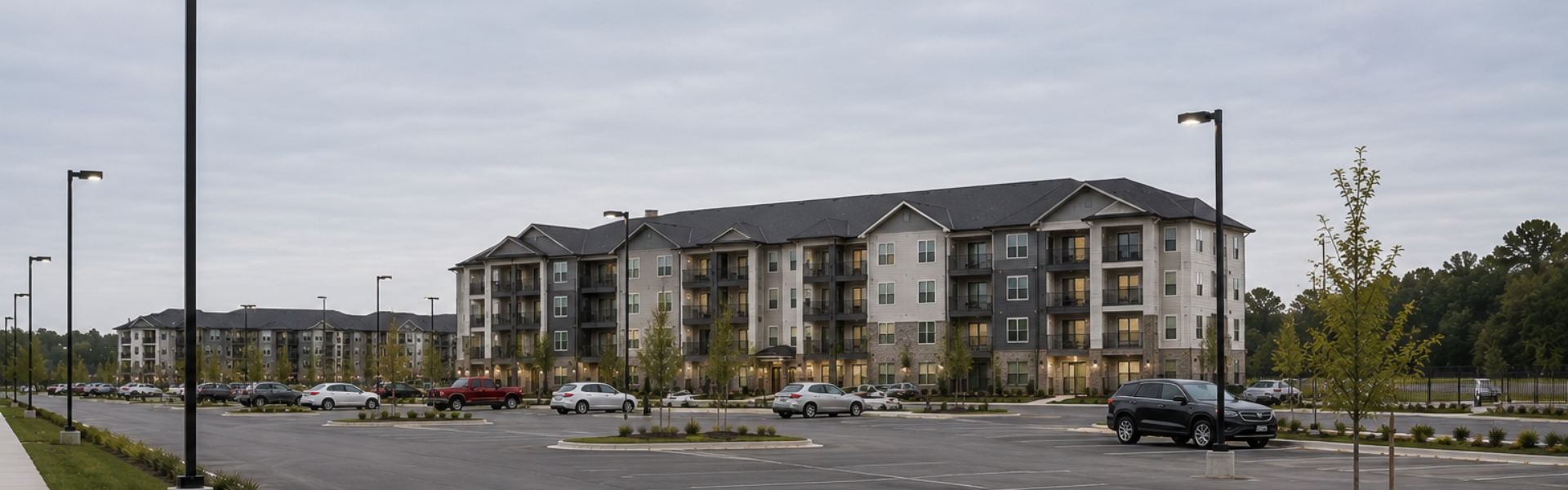
Parking areas are high-priority zones for both safety and security. Poor lighting increases accident risk and creates vulnerabilities for criminal activity. Area and site lighting (shoebox fixtures) mounted on light poles at 20 to 30 feet high provide uniform coverage with minimal glare. Spacing of 100 to 140 feet between poles is typical. Modern LED shoebox fixtures consume 30 to 50% less energy than older HPS or metal halide equivalents while delivering superior color rendering, making residents feel safer.
Building Perimeter and Entries
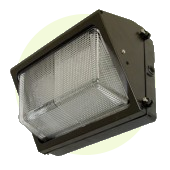
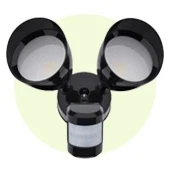
Wall packs mounted near main entrances, secondary exits, and loading areas deter unauthorized access and help residents navigate safely. These fixtures should provide 3 to 5 foot-candles at ground level. Motion-sensor wall packs reduce energy use in low-traffic areas like side entries or service areas. Building perimeter lighting also improves curb appeal and makes the property visible and welcoming at night.
Pathways and Pedestrian Walkways
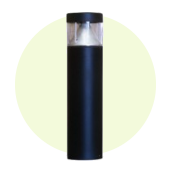
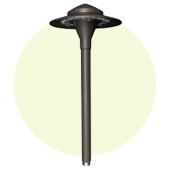
Pathways connecting parking to buildings, around courtyards, and through landscaped areas require softer, more directional lighting than parking zones. Bollard lights and low-level pathway fixtures create visual guides at 0.2 to 0.5 foot-candles while avoiding the harsh overhead look. Bollard lighting is both functional and aesthetic, and LED versions are extremely efficient for 24/7 operation.
Landscape and Accent Lighting
Strategic landscape lighting highlights trees, shrubs, and architectural features, creating visual interest and enhancing property appeal. This zone offers flexibility for energy reduction. Consider using warm color temperature (2700K) to create an inviting atmosphere. Landscape lighting often accounts for a small percentage of total exterior energy use, so efficiency gains here are modest but cumulative.
Key Benefits of Modern Exterior Lighting Upgrades
Upgrading to LED and smart controls delivers measurable benefits across multiple dimensions:
- Energy Savings: LED fixtures use 50% to 70% less energy than traditional HPS or metal halide. A 50-unit property with 40 parking lot fixtures, 20 wall packs, and 30 bollards can save $8,000 to $12,000 annually on electricity.
- Reduced Maintenance: LED lifetimes exceed 50,000 hours (10+ years at continuous use), eliminating frequent bulb replacements and labor costs.
- Improved Safety and Liability: Proper illumination reduces trip-and-fall incidents, vehicle accidents, and exposure to security-related claims. Better color rendering (CRI 70 minimum, CRI 80 preferred for security-critical areas) helps residents identify threats and navigate safely.
- Enhanced Curb Appeal: Modern fixtures and warm LED color temperatures create a welcoming, well-maintained appearance that attracts tenants and justifies higher rents or lease renewals.
- Dark Sky Compliance: LED fixtures with integrated shielding and directional design help meet emerging dark sky ordinances without sacrificing safety.
- Smart Control Integration: Photocells, timers, and motion sensors optimize usage patterns. A photocell prevents fixtures from running during daylight; motion sensors on low-traffic pathways can reduce runtime by 30% to 50%.
Recommended Fixtures by Lighting Zone
Selecting the right fixture type for each zone ensures efficient operation and resident satisfaction. Here is how to match fixtures to applications:
Parking Lots: Area and Site Lighting (Shoebox Fixtures)
Shoebox fixtures (also called site or high-mast lights) are the industry standard for parking areas. Modern LED shoebox fixtures deliver 40 to 150 watts depending on mounting height and area size, with efficacies of 130 to 160 lumens per watt. A 50-space parking area typically requires 8 to 12 fixtures on 20 to 30-foot poles. Look for fixtures with integrated photocells and surge protection. Total installed cost is typically $800 to $1,200 per fixture (verify with current pricing); electricity savings reach $150 to $250 per fixture annually, yielding payback in 4 to 6 years.
893
Browse all Area Lights and Shoebox Fixtures
Building Entries and Perimeter: Wall Packs
Wall packs are compact, durable fixtures mounted directly to the building facade. They deliver 20 to 40 watts in LED versions and provide localized illumination without requiring poles. Motion-sensor wall packs are ideal for secondary exits, service areas, and low-traffic zones. They typically cost $150 to $400 per fixture installed (verify with current pricing) and operate for 12 to 16 hours daily, saving $30 to $60 annually per fixture.
756
Browse all Wall Packs
Pathways and Walkways: Bollard Lighting
Bollard lights and low-level pathway fixtures guide pedestrians safely while creating an attractive landscape feature. LED bollards consume 3 to 8 watts and last 50,000+ hours. They are ideal for 24/7 operation since energy cost is minimal. Spacing of 8 to 12 feet apart is typical; a 100-foot pathway requires 10 to 12 fixtures. Cost per unit is $75 to $200 installed (verify with current pricing). Because they run all night, photocells are essential to avoid dawn operation.
769
Browse all Bollard Lights
Accent and Landscape Lighting
Directional fixtures, spotlights, and landscape lighting add visual appeal without significant energy impact. Use warm color temperatures (2700K or 3000K) to create inviting ambiance. These fixtures often operate 10 to 12 hours nightly; LED versions at 10 to 25 watts have minimal operating cost.

Design Guidelines and Compliance
A well-designed exterior lighting system balances safety, compliance, and cost. Follow these guidelines when planning upgrades or new installations:
Lighting Levels and Uniformity
Target IES recommendations: parking lots at 0.9 to 1.2 foot-candles with 3:1 uniformity; pathways at 0.2 to 0.5 foot-candles; building entries at 3 to 5 foot-candles. Verify exact targets against IES RP-8 (parking) and your local code for your occupancy classification. Uniformity prevents dark patches that create safety hazards and liability exposure. Use a light meter or consult a lighting designer if unsure.
Color Temperature and CRI
Neutral or warm white LEDs (3000K to 4100K) are preferred for residential settings. They create a welcoming appearance and reduce the institutional feel of older sodium vapor lighting. Choose fixtures with a CRI of 70 or higher as a minimum; CRI 80 is preferred for parking and security-critical areas where identification accuracy matters.
Dark Sky Compliance
Many jurisdictions now enforce dark sky ordinances limiting uplight and light trespass. Select fixtures with full cutoff or shielded optics that direct light downward only. Avoid uplighting of building facades or trees unless specifically required for architectural effect. Set timers to reduce late-night operation when residents are less active.
ROI Example: 50-Unit Property Retrofit
Baseline: 40 parking fixtures (150W HPS), 20 wall packs (75W HPS), 30 bollards (12W incandescent). Annual consumption: approximately 32,000 kWh at an assumed $0.14/kWh (your actual rate will vary) = $4,480. LED retrofit: same fixture count at 30% energy use = $1,344 annually. Savings: $3,136/year. Installed cost (materials + labor): $18,000. Payback: 5.7 years. Added benefits: 10+ year fixture life, reduced maintenance labor, enhanced curb appeal, improved resident safety.
Control Strategies
Integrate photocells and timers to minimize waste. A photocell prevents fixtures from operating during twilight or daylight, and dusk-to-dawn fixtures handle this automatically at the pole. Timers can reduce operation of accent and landscape lighting to peak hours (6 PM to 11 PM). Motion sensors on low-traffic pathways can cut energy use by 30% to 50% with minimal impact on safety.
Maintenance and Fixture Selection
Choose fixtures rated for wet, outdoor environments (IP65 or better). LED modules should be replaceable, not integrated, to extend fixture life. Select reputable brands with strong warranty coverage; check the spec sheet for specific warranty terms. Schedule annual cleaning to maintain light output as dirt accumulates.

Next Steps: Planning Your Upgrade
Ready to improve your multi-family property's exterior lighting? Start with a simple audit: walk the property at night, note dark areas and problem zones, and identify fixtures that are failing or inefficient. Then gather your team:
- Request an energy audit or lighting assessment from RelightDepot.com
- Consult your local building department or utility company for dark sky compliance requirements
- Review your current maintenance and energy costs to calculate ROI
- Prioritize areas by safety risk and visibility (parking lots first, then building entries, then pathways)
The RelightDepot.com team can help you select the right fixtures for each zone, answer product questions, and discuss options that fit your budget. Most LED upgrades pay for themselves within 5 to 7 years while improving safety and curb appeal immediately. For a broader look at lighting across all multi-family zones, including interior common areas, see our Residential and Multi-Family Lighting application hub.
Contact RelightDepot.com Today
RelightDepot.com offers the exterior and site lighting products multi-family operators rely on, backed by a team that can spec the right fixtures for each zone. Browse our Area Lights and Shoebox Fixtures, Wall Packs, and Bollard Lights collections, or reach out directly:
Our team can assess your property's needs, recommend fixtures that meet IES standards and local codes, and provide ROI projections tailored to your situation.