 Properly designed athletic field lighting is essential for safe, high-performance play during evening practices and games. This guide covers IES lighting standards, equipment selection, pole placement, energy efficiency, and community-friendly design for football, soccer, baseball, and multipurpose athletic facilities. Both new installations and retrofits are covered, and RelightDepot.com offers the fixtures and poles for either. See our Sports Lighting application hub for the broader category.
Importance of Quality Athletic Field Lighting
Athletic field lighting affects player safety, game quality, energy costs, and how the school gets along with the neighbors. Inadequate or unevenly distributed light causes eye strain, missed plays, and real safety hazards. Too much spill in the wrong direction creates complaints and wastes money lighting up someone's backyard instead of the field. The right design balances all three.
A single high school campus often shares one stadium field across football, soccer, and track, plus separate baseball and softball diamonds and tennis courts, each running its own season and practice schedule. LED has changed the economics of lighting all of it: manufacturers commonly report 50% or more energy savings over metal halide, instant on and off with no warm-up lag, and tighter beam control that keeps spill off neighboring property. Add dimming controls for separate practice and game modes and total operating cost drops further, though the real number depends on your utility rate and how many hours the field actually runs each year.

IES Light Level Requirements by Sport
The Illuminating Engineering Society publishes ANSI/IES RP-6, the recommended practice for sports and recreational area lighting, most recently updated as RP-6-24. RP-6 organizes recommendations into four classes based on level of play and spectator count: Class I for professional and televised venues (around 100 fc), Class II for college and large-attendance amateur play (around 50 fc), Class III for high school competition with spectators (around 30 fc), and Class IV for recreational and practice play with no spectators (around 20 fc). Most high school programs design to Class III for game nights and Class IV for practice. The ranges below are typical starting points, confirm the exact class and target with your lighting designer or manufacturer's photometric team before finalizing a layout.
| Sport / Activity |
Recommended Levels (fc) |
Notes |
| Football (practice) |
20 to 30 fc |
IES RP-6 Class IV, no spectators |
| Football (competition) |
30 to 50 fc |
Class III for high school; Class II range for college or higher-attendance venues |
| Soccer (practice) |
15 to 20 fc |
Minimal spill for residential areas |
| Soccer (competition) |
20 to 50 fc |
Higher end for tournaments and larger attendance; requires even distribution |
| Baseball infield |
50 to 100 fc |
Most demanding target; precise depth perception on batted balls is critical |
| Baseball outfield |
30 to 50 fc |
Lower than infield; watch for sky glow |
| Tennis/courts |
20 to 30 fc |
Uniform coverage; avoid shadows |
| Track |
20 to 30 fc |
Minimal spill; directional fixtures essential |
Uniformity matters as much as the absolute light level. RP-6 expresses it as a max-to-min ratio: tighter for the higher classes, looser for practice-only play. As a working rule of thumb, expect roughly 2:1 for televised or Class I venues and up to 4:1 for practice fields, but pull the exact ratio for your class from the current standard rather than assuming. Uneven lighting causes visual fatigue and missed plays even when the average foot-candle number looks fine on paper.
Pro Tip: Practice vs. Game Modes
Design your system with two lighting layers: full capacity for competitions (50 to 100 fc depending on sport) and 50% to 75% capacity for practice (20 to 30 fc). This cuts practice-mode energy costs substantially while maintaining safe play. Smart controls (0 to 10V dimming) make switching between modes simple and automatic.
Light Pole Heights and Placement Strategy
Pole height, spacing, and position directly affect light uniformity, spill control, and cost. Too short, and you get uneven coverage and glare. Too tall, and you increase materials cost and wind load while making maintenance harder. Too few poles, and you waste light on spill. Too many, and you are overspending. Before you lock in a layout, compare a few pole and mounting configurations against your site's actual constraints, since setback and soil conditions often decide the final height more than the field itself.
Standard Configurations
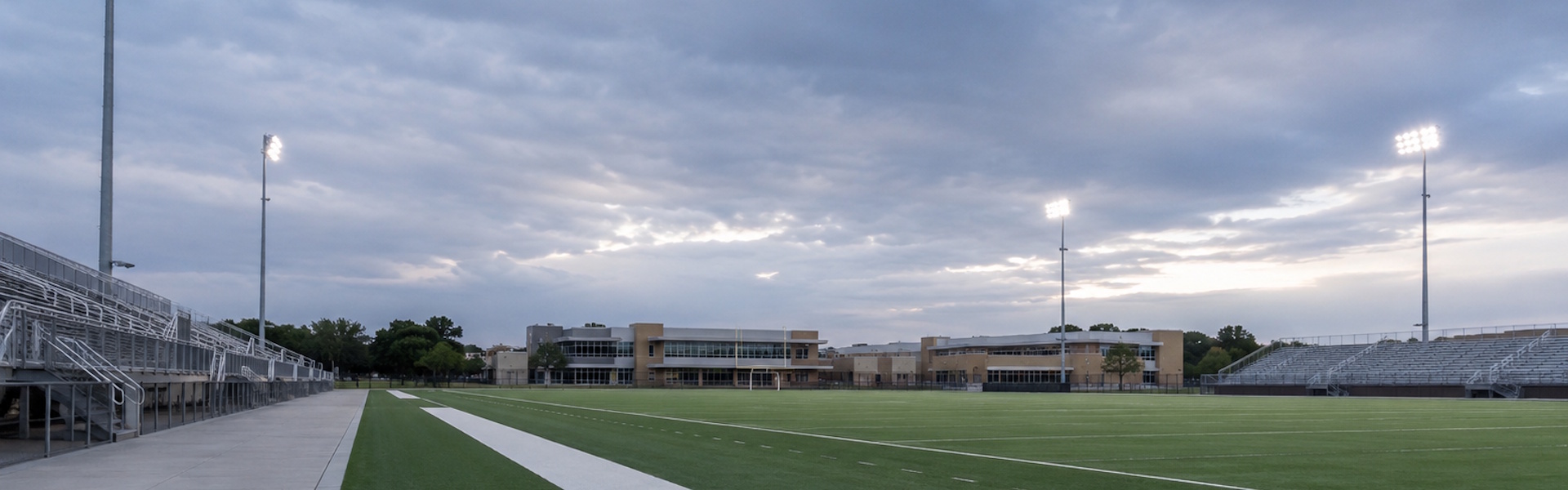
- Football fields: Four 80 to 100 ft poles at the corners (legacy layout) or six 60 to 80 ft poles along sidelines (modern preferred layout). Six-pole sideline arrangements deliver better uniformity with lower mounting heights.
- Soccer fields: Six to eight 60 to 80 ft poles along sidelines. Wider pole spacing reduces neighbor glare while maintaining coverage.
- Baseball diamonds: Six to eight poles at 60 to 90 ft for high school fields, 90 to 120 ft for college or higher class facilities, positioned behind bases and outfield to minimize glare in the batter's line of sight.
- Multipurpose (track + field): Eight to twelve 80 to 100 ft poles in a symmetric grid for uniform coverage across all zones.
Pole setback is critical. Position poles 20 to 30 feet outside the field boundary to keep glare out of the playing surface and reduce spill into residential areas. Directional fixtures (flood lights with controlled beam patterns) should point inward and slightly downward, never upward.
Foundation and Installation
High school athletic fields are often in space-constrained urban or suburban settings. Concrete foundation pads (4x4 feet, 3 to 4 feet deep) are standard. Allow 3 to 4 weeks for concrete cure before installing the pole. Electrical rough-in should be completed before pole installation; underground conduit runs to a central control cabinet with disconnect switches and dimming controls.
LED vs. Traditional HID Lighting
High-intensity discharge (HID) lamps (metal halide and high-pressure sodium) dominated athletic lighting for decades. LEDs are now the clear choice for new installations and retrofits. The comparison below shows why:
| Factor |
LED |
Metal Halide (HID) |
| Efficiency (lumens/watt) |
130 to 160 lm/W |
65 to 90 lm/W |
| Energy cost (annual) |
Lower by 50% to 60% |
Baseline |
| Lifespan |
50,000 to 100,000 hrs (10 to 15 years) |
10,000 to 20,000 hrs (3 to 5 years) |
| Warm-up time |
Full brightness instantly |
5 to 15 minutes to full output |
| Dimming capability |
0% to 100% smooth control |
Limited; requires additional ballasts |
| Color rendering (CRI) |
80 to 95 CRI (warm or cool) |
65 to 75 CRI (cool cast) |
| Directional light |
Tight beam control; minimal spill |
Omnidirectional; requires reflectors |
The efficiency gain holds up at any scale. A pole carrying four to six LED sports lighters in the 600W to 850W class typically replaces the same fixture count in 1,000W to 1,500W metal halide, cutting connected load on that pole by roughly 40% to 50% while improving color rendering and adding instant restrike and dimming that HID never had. The dollar savings scale with how many hours the field actually runs each year, see the example below.
ROI Reality Check: What Actually Drives Payback
Marketing materials often cite 2 to 3 year paybacks on sports lighting LED retrofits. Those numbers usually come from municipal complexes running lights most nights across multiple leagues, not a single varsity field lit for practices and a dozen home games a year. Run your own numbers: kW reduction multiplied by annual operating hours multiplied by your utility rate equals annual energy savings. A 6-pole field carrying 24 fixtures at a 1,200W HID average (28.8 kW total connected load) versus a 700W LED average (16.8 kW total) saves 12 kW. At 500 operating hours a year, a reasonable estimate for a shared-use high school stadium field, that is 6,000 kWh saved annually, about $720 a year at $0.12 per kWh. On energy alone, an $18,000 retrofit can take decades to pay back on a single field with a light game schedule. What actually closes the gap: eliminating relamping labor and bucket-truck rentals every 2 to 3 years for HID, avoiding mid-season lamp failures during a game, and any utility or DLC rebate on the table. Ask your utility about sports lighting retrofit rebates before you finalize a budget.

Glare Control and Neighbor Relations
The most common complaint about athletic field lighting is light spill into residential neighborhoods. Glare affects sleep, wildlife, and quality of life. Smart design protects neighbors while maintaining performance.
Design Principles for Glare Control
- Directional fixtures: Use flood lights with asymmetric beam patterns that direct light downward and inward. Avoid wide-angle fixtures that scatter light across property lines.
- Setback poles: Position poles 20 to 30 feet outside field boundaries. The extra distance dramatically reduces glare perceived from adjacent homes.
- Fixture tilt angle: Aim fixtures 15 to 20 degrees below horizontal to prevent light from reaching the sky or distant properties. Horizontal or upward-tilted fixtures are poor practice.
- Screening: Where poles are close to neighbors, consider shield structures (metal baffles on fixture sides) to block lateral light. This adds 5% to 10% to fixture cost but is worth it for community relations.
- Scheduling: Establish lighting hours (no light after 10 PM on weekdays, midnight on weekends, for example). Use timers to enforce automatic shutoff.
- Dimming: Reduce to 50% capacity during practice, full capacity for games. This cuts evening energy use and perceived glare during off-peak hours.
Compliance and Variance
Most municipalities that regulate sports field lighting set a maximum spill limit measured at the residential property line, often lower after a set curfew hour than during game hours. Limits vary widely by jurisdiction: some model their ordinance on IES and International Dark-Sky Association guidance, others write their own. Do not assume a number, pull the local ordinance or ask your AHJ directly before finalizing pole placement and aiming angles. A system built with directional fixtures, proper setback, and correct tilt angle clears most ordinances without a fight, but confirming the actual limit early avoids a failed inspection after the poles are already in the ground.
Recommended Fixtures and Equipment
RelightDepot.com offers fixtures and poles engineered for high school athletic venues. Here is what we recommend by application:
Sports Lighters and High Mast Lights
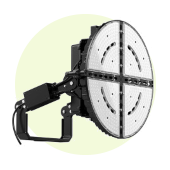
For field lighting, Sports Lighters are the cornerstone. Look for models that include:
- 600W to 850W power rating (replaces 1,000W to 1,500W HID)
- Asymmetric beam patterns (Type II, Type III, or Type IV) to control spill
- 0 to 10V dimmable driver for practice and game mode switching
- 4000K to 5000K color temperature (daylight-neutral for visibility and sport coverage)
- Powder-coated aluminum housing (withstands outdoor weather)
- UL-listed for wet locations and high wind areas
RelightDepot's WSD Stadium Eyes series delivers all of these. Our fixtures are pre-configured for athletic venues; confirm warranty terms and included components on the current product spec sheet before quoting. They are built for retrofit installations too, with standard yoke mounts that fit existing arms on your poles.
Sports Lighters and High Mast Lights
791
Browse all Sports Lighters and High Mast Lights
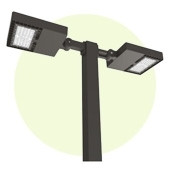
Light Poles
Poles must be structural, durable, and maintainable. When reviewing quotes or ordering, look for:
- Hot-dip galvanized steel (withstands salt air and rain)
- Heights from 40 to 150 feet depending on field size and setback
- Appropriate base diameter for wind loads (consult a pole engineer)
- Ladder or climbing rings for maintenance access (required for worker safety)
- Electrical conduit and cable tray pre-installed (saves installation labor)
- Top-mount yoke arms or side-mount braces for fixture attachment
RelightDepot offers standard tapered light poles in galvanized and painted finishes. We provide quick-ship lead times and can coordinate with your electrical contractor on rough-in.
Light Poles and Accessories
892
Browse all Light Poles and Accessories
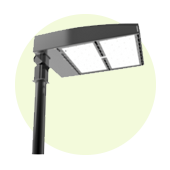
Area and Site Lighting
Parking areas, walkways, and perimeter lighting around athletic facilities are equally important. Use lower-wattage LED fixtures (30W to 75W) with warm color temperatures (3000K) to minimize sky glow while ensuring safe pedestrian movement. Bollards and area lights around the field perimeter reduce tripping hazards and enhance security.
Smart Controls and Operational Modes
Modern athletic field lighting systems should include controls that allow operators to:
- Schedule automatic on/off: Timers can light the field at dusk and shut down at a preset hour, eliminating manual overhead.
- Dimming by zone: Dim one pole or section for small practice groups; light all poles for full-field games.
- Practice mode (50% to 75%): Reduce brightness during non-game hours to cut energy and reduce neighbor complaints.
- Game mode (100%): Full brightness for competitions and televised events.
- Remote monitoring: Some systems offer DALI or wireless controls so the athletic director can manage lighting from the office.
A basic setup uses a wall-mounted 0 to 10V dimmer with time-clock relay (under $500 installed). Premium systems add wireless control and occupancy sensors, allowing the field to auto-adjust based on weather or activity. Over a 10-year cycle, smart controls typically pay for themselves through energy savings alone.
Design Guidelines and Best Practices
Planning Phase Checklist
- Verify light level requirements with your state athletic association and IES RP-6.
- Check local zoning codes and lighting ordinances (some municipalities require dark-sky compliance).
- Conduct a site survey: measure distances to nearest residences, identify obstructions, note prevailing wind direction.
- Get a photometric layout from your fixture supplier or a lighting designer showing pole locations, heights, fixture types, and aiming angles before you order steel. RelightDepot can put this together once you know the fixture count and pole heights you are working with.
- Get preliminary approval from your AHJ (building/planning department) before purchasing equipment.
- Identify funding sources: grants, capital budgets, energy efficiency rebates.
Installation and Commissioning
- Hire a licensed electrician experienced with outdoor sports lighting. Incorrect wiring or grounding can be dangerous and void warranties.
- Ensure all poles meet the National Electrical Code (NEC) and local amendments for bonding and grounding.
- Photometric testing (by a third-party lighting engineer or via manufacturer data) confirms light levels meet design intent before final acceptance.
- Commission controls: verify timers, dimmers and sensors, and any wireless systems work as intended.
- Document all settings, fixture models, and maintenance contacts in a binder kept at the field office.
Ongoing Maintenance
- Annual inspection: Check poles for rust, fixtures for debris or water intrusion, and electrical connections for corrosion.
- Lens cleaning: Dust and pollen reduce output by 10% to 20% per year. Clean lenses every 6 months in high-pollen areas.
- LED driver monitoring: LED drivers last 10 to 15 years; keep spares on hand. Test HID ballasts every 2 years on legacy systems.
- Scheduling documentation: Keep a log of operating hours, maintenance performed, and any issues reported by coaches or neighbors.

Ready to Light Your Athletic Field?
RelightDepot.com has the expertise and products to deliver safe, efficient, neighbor-friendly athletic lighting for new facilities and HID-to-LED upgrades alike. Our WSD Stadium Eyes fixtures and steel light poles meet the demands of high school and municipal athletic venues.
Have questions about photometrics, pole sizing, or controls? Our lighting specialists can provide a free site assessment and design recommendations tailored to your budget and sport.
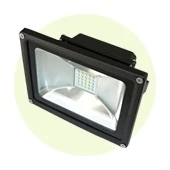
Recommended Flood Lighting
740
Browse all Flood Lighting