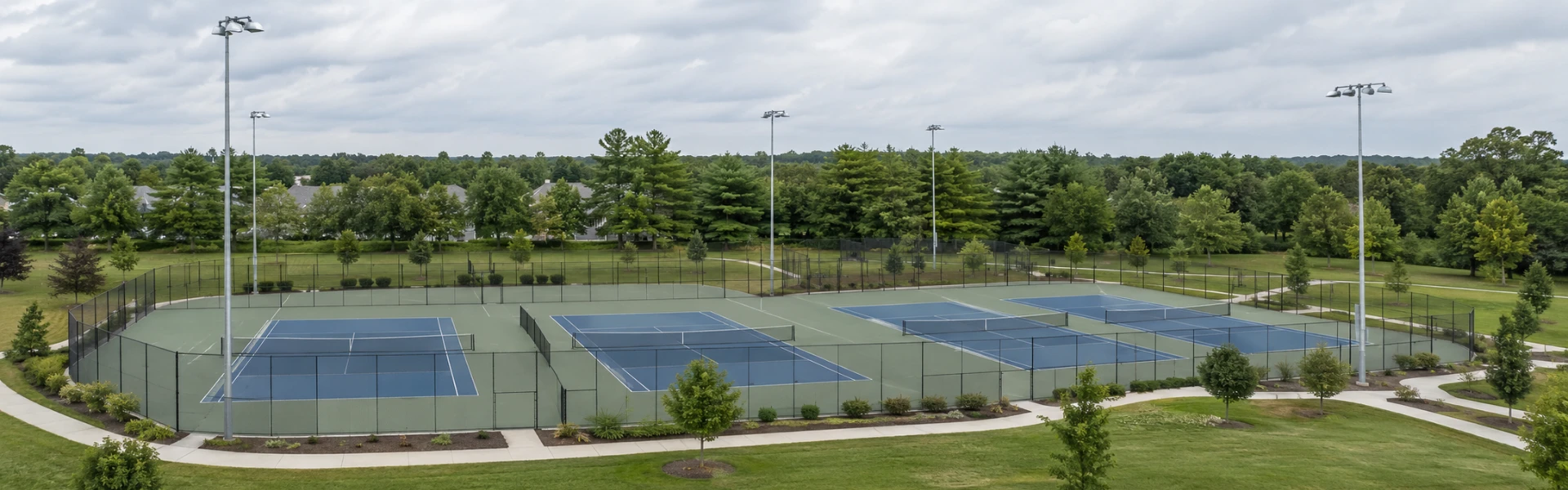
Pickleball courts are being added to parks, recreation centers, and HOA facilities at a rapid pace, while tennis remains a cornerstone of club and municipal recreation programs. Proper lighting is essential for player safety, game quality, and long-term operating cost, whether you are upgrading aging HID systems or designing a new facility from the ground up. For a broader look at stadium and field installations, see our Sports Lighting hub.
Overview of Court Lighting Standards
Court lighting must balance player visibility, neighbor-friendly operation, and operational cost. The Illuminating Engineering Society (IES RP-6-15) provides clear recommendations that differ based on whether courts serve casual recreation or organized competition. Understanding these standards helps you right-size your investment and avoid both underlit and over-specified installations.
For outdoor courts, IES RP-6-15 and USTA guidelines define four tiers: 30 fc maintained at the playing surface for Class I recreational play, 50 fc for Class II club or competitive use, 75 fc for Class III tournament installations, and 100 fc or higher for Class IV professional and broadcast facilities. Pickleball outdoor courts follow similar tiers per USA Pickleball facility standards, with 30 fc as the recommended minimum for recreational play. The layout, court surface color, and pole placement all affect how efficiently you deliver that light and how evenly it spreads across the court.
IES RP-6-15 / USTA Class Reference (Outdoor Courts)
Class I (Recreational): 30 fc | Class II (Club/Competitive): 50 fc | Class III (Tournament): 75 fc | Class IV (Professional/Broadcast): 100+ fc. Aim for a uniformity ratio (max/min illumination) of 3:1 or better. Tennis and pickleball share these tiers for general planning purposes; consult the current USTA or USA Pickleball facility guidelines for sport-specific layout requirements.
Court Types and Lighting Requirements
Tennis and pickleball courts share similar lighting fundamentals, but their dimensions and usage patterns differ. Pickleball courts are smaller and often located closer to residential areas, requiring special attention to light spillage and neighbor relations. Tennis courts demand larger coverage areas and often benefit from pole arrangement strategies that minimize shadows on the playing surface.
Pickleball Court Specifications
A regulation pickleball court measures 20 feet wide by 44 feet long (1,760 square feet). Most facilities install courts in clusters of two, four, or more, with 10 to 15 feet of space between sidelines for safety. This tight layout allows for efficient pole placement and fixture sharing. Many new facilities use two 400 to 500W LED fixtures mounted on a single 30 to 35 foot pole at one end of the cluster, delivering 30 to 40 fc with minimal spillage beyond property lines.
Tennis Court Specifications
A regulation tennis court is 78 feet long by 27 feet wide (2,106 square feet) for singles play, or 78 by 36 feet (2,808 square feet) for doubles. Most installations are lined and lit for doubles. The larger footprint typically requires four poles (one at each corner or positioned around the perimeter) and four to six fixtures to achieve uniform illumination. Tournament-grade installations often use eight fixtures with advanced aiming to eliminate shadows and achieve 75 fc or higher per USTA Class III standards. Modern LED fixtures reduce the number of poles and fixtures needed compared to legacy metal halide systems.

LED Benefits and Energy Savings
Replacing outdated HID (high-intensity discharge) systems with LED fixtures delivers strong financial returns, especially on courts that operate evening and weekend hours year-round. LED technology has matured over the past decade, offering better light quality, faster warm-up, dimming capability, and 50,000-plus hour lifespans.
Energy and Maintenance Cost Reductions
A typical four-pole tennis court installation with 400W HID fixtures (1,600W total) costs roughly $350 to $450 per month to operate at average commercial electric rates on a heavy-use schedule. The same court retrofitted with modern 250W LED fixtures (1,000W total) drops to $220 to $280 monthly, a savings of 35 to 40% or $840 to $2,160 annually per court. These are illustrative estimates; actual results vary by region, utility rates, and usage schedule. Add in eliminated ballast replacements, reduced labor for relamping, and eliminated warm-up time, and LED systems typically pay for themselves within three to five years.
Pickleball facilities often see faster payback. A two-fixture LED upgrade (typically 500 to 800W total) on a cluster of two courts costs less to operate than a comparable HID system, with annual savings that can exceed $2,000 to $3,000 depending on hours of operation.
Illustrative ROI Example
Pickleball facility with six courts (three clusters) retrofits from 1,800W HID to 1,200W LED. Estimated annual savings: $7,200 (electricity) + $1,500 (maintenance). Estimated project cost: $18,000. Estimated payback: 2.1 years. These figures are illustrative; contact RelightDepot for a quote specific to your facility.
Recommended Fixtures and Pole Solutions
Selecting the right fixture and pole configuration depends on court type, player level, neighbor proximity, and budget. Modern LED flood lights and purpose-built sports fixtures offer flexible aiming, dimming, and control options that legacy HID systems cannot match.
Fixture Types for Courts
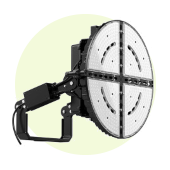
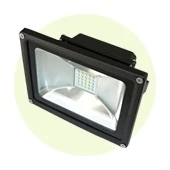
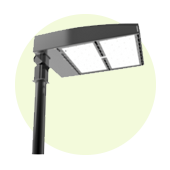
LED flood lights (typically 150 to 500W) designed for sports use feature asymmetric or rectangular beam patterns that match court geometry, reducing light spillage. Shoebox fixtures are ideal for high-mounting applications (35 feet or higher) where you want a compact, efficient envelope. For lower-mounted systems (25 to 30 feet), flood lights with tighter beam control offer better neighbor relations and less sky glow.
Look for a Color Rendering Index (CRI) of 70 or higher for good visibility and color discrimination on court, and a color temperature of 4000 to 5700K. Warm dimming (CCT shift as brightness decreases) is available on premium LED sports fixtures and can improve evening usability while reducing light pollution.

Recommended Flood Lighting
740
Browse all Flood Lighting
Pole Placement and Height
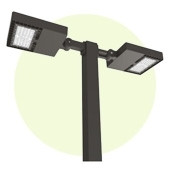
Pole placement is critical to eliminate shadows on the playing surface and minimize neighbor glare. For a single pickleball court cluster (two courts side-by-side), one or two light poles at 30 to 35 feet height, positioned 15 to 20 feet behind the baseline, work well. For tennis courts, four poles at 35 to 40 feet (one behind each baseline and ideally set back 20 feet or more from the sideline) provide the most uniform light and fewest shadows.
Avoid placing poles directly behind the baseline where they block sight lines or create shadows during serve or overhead play. Instead, angle or offset them slightly to the side, aiming fixtures back toward the net to maximize court coverage while minimizing glare for players facing the fixture direction.
Light Poles for Court Installations
892
Browse all Light Poles and Accessories
Design Guidelines and Best Practices
Proper design ensures safe, comfortable play while respecting community light and noise standards. A few key principles apply to most court installations.
Uniformity and Shadow Management
Aim for a uniformity ratio (maximum illumination divided by minimum illumination) of 3:1 or better across the playing surface. This means no area of the court is more than three times brighter than the darkest area. Uneven lighting causes eye strain and makes it hard to track the ball. Multi-fixture designs with precision aiming allow you to overlap beam patterns and fill dark zones.
Shadow-free courts are essential for tournament play and valuable for any competitive use. Achieve this by using four or more fixtures on tennis courts, aiming from multiple angles to eliminate the dead zone directly under player sight lines.
Neighbor Considerations and Light Spillage
Many municipalities now enforce light trespass limits. Courts within 100 feet of residential properties should limit spillage beyond the property line to 0.1 foot-candles or less. Using fixtures with appropriate beam angles, shields, and precise aiming helps you meet these limits without over-specifying the court itself. LED fixtures are easier to control than HID systems and allow directional dimming or scheduling adjustments if needed.
Dimming and Control
Modern LED systems support 0-10V dimming, occupancy sensors, and scheduling. Many facilities dim courts to 50 to 75% brightness during off-peak hours or low-utilization periods, extending lamp life and reducing consumption. Some systems integrate with facility management software to allow easy on/off control and usage tracking by court.
LED Retrofit Considerations for Existing Courts
If you own or operate a court facility with aging metal halide systems, retrofit is usually the quickest path to energy savings and better light quality. Most LED retrofit projects retain existing poles and wiring, replacing only the fixtures. Plan for a phased rollout if you manage multiple courts.
Before retrofitting, verify your pole structural integrity and electrical service capacity. Some facilities discover corroded or weakened poles during retrofit and choose to replace them as well, ensuring another 20 to 30 years of reliable service. Budget $8,000 to $15,000 per court for a complete retrofit (fixtures, labor, and any necessary wiring updates) as a general planning range; your actual cost will depend on existing infrastructure, local labor rates, and fixture selection. Contact RelightDepot for a quote tailored to your facility.

Get a Quote for Your Court Project
Upgrading your tennis or pickleball court lighting is an investment in player safety, game quality, and long-term cost savings. RelightDepot offers a full range of LED flood lights, shoebox fixtures, and light poles designed for sports applications. Our team can help you evaluate your options, pull together a quote, and match the right fixtures to your court type and budget.
Ready to light your courts right?
Contact RelightDepot today:
Browse our sports lighting products: