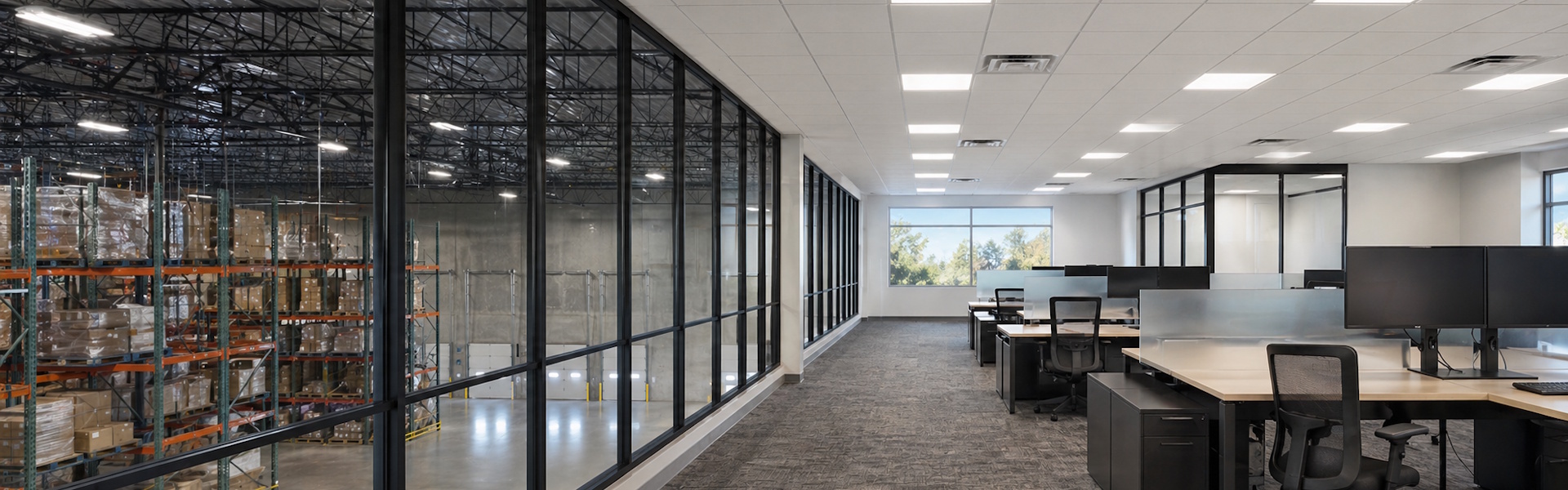
Modern warehouses rarely operate as single-function spaces. Most facilities include elevated office areas, mezzanines, breakrooms, and restrooms alongside open warehouse floor space. The challenge: transitioning seamlessly between the durability needs of the floor and the comfort and compliance needs of office areas, without sacrificing efficiency or creating visual inconsistency. This guide walks you through fixture selection, code requirements, and integration strategies to light your mixed-use warehouse properly. For guidance on the warehouse floor itself, see our Warehouse Lighting overview.
Why Office-Grade Lighting Matters in Warehouses
Mezzanine offices and administrative spaces inside warehouses operate under a different rulebook than the warehouse floor. IES (Illuminating Engineering Society) standards and ASHRAE 90.1 energy code requirements specify higher illumination levels, color rendering properties, and glare control for task-intensive office work. The IECC (International Energy Conservation Code) adds specific efficiency metrics, control strategies, and daylight-harvesting opportunities that do not apply to warehouse floor or loading areas.
The gap between warehouse floor lighting (often 30 to 50 foot-candles for picking and packing) and office lighting (typically 30 to 50 foot-candles ambient with task lighting on top for paperwork) creates opportunities to optimize costs while meeting code. Strategic zoning, fixture selection, and occupancy controls can reduce energy consumption by 20 to 40 percent compared to uniform lighting across the entire facility.
Typical Lighting Zones in Mixed-Use Warehouses
Effective warehouse office and mezzanine design starts with understanding the distinct zones and their unique lighting demands. Each area has specific occupancy patterns, task types, and code requirements that drive fixture and control choices.
Mezzanine Office Spaces
Mezzanine offices house management, planning, and administrative functions. These areas typically have drop ceilings (8 to 9 feet in mezzanine subspace, sometimes 10 to 12 feet in larger facilities). IES RP-1 recommends 30 to 50 foot-candles of ambient illumination for general office work and computer-based tasks, with supplemental task lighting bringing detailed paperwork or drafting up to 75 foot-candles or more at the work surface. Spaces benefit from indirect or semi-direct lighting to keep ambient levels low enough to avoid screen reflections while task lights handle close work. Lay-in LED panels (2x2 or 2x4) or LED troffers in recessed installations are the industry standard.
Breakrooms and Common Areas
Breakrooms and lunch areas can operate at 30 to 50 foot-candles, similar to desk work areas. These spaces are intermittently occupied, making occupancy sensors and dimming valuable for energy management. Fixture selection can be more flexible here, allowing surface-mounted ceiling lights or lay-in troffers depending on aesthetic goals and facility maintenance standards.
Restrooms
Restrooms require 30 to 50 foot-candles for grooming tasks and safe movement. Standard sealed or gasketed LED ceiling fixtures handle typical warehouse restroom humidity without issue. For shower rooms or other wet areas (uncommon in standard warehouse facilities, but present in some larger distribution centers with locker rooms), step up to dedicated vapor-tight or IP65-rated fixtures. Occupancy sensors are nearly universal in restroom applications, reducing energy waste in intermittently used spaces.
Stairwells and Corridors
Transition zones connecting the warehouse floor to mezzanine offices must meet life-safety lighting requirements (IBC and NFPA 101 set minimum 1 foot-candle at floor level on means-of-egress paths; IES RP-1 recommends 10 to 20 foot-candles on stair treads and in corridors for routine use) and provide safe wayfinding. Wall sconces, recessed ceiling lights, and step lights are common. Occupancy control is appropriate for low-traffic areas, but primary stairwells may require continuous or daylight-responsive switching for safety.
Code Compliance Note
ASHRAE 90.1-2022 requires automatic occupancy sensors in rooms smaller than 250 square feet (restrooms, small offices, storage). Larger open office areas may use manual override with a 20-minute auto-off timer. IECC adds daylight harvesting requirements for spaces with skylights or windows within 15 feet of the perimeter.
Why Optimize Office Lighting in Your Warehouse
Investing in proper office and mezzanine lighting delivers measurable financial and operational returns. Most warehouse operators underestimate the impact of lighting on productivity, operating costs, employee satisfaction, and regulatory compliance.
- Energy Savings: Switching to LED panels and troffers with occupancy controls reduces lighting energy by 40 to 60 percent compared to older fluorescent systems. In a 50,000 square foot facility with 5,000 square feet of office and mezzanine space running 16 hours per day, LED upgrade plus controls saves approximately 4,000 to 6,000 dollars annually.
- Lower Operating Costs: Beyond energy, LED systems cut maintenance trips, lamp and ballast replacement spend, and HVAC load (LEDs throw off less heat than fluorescent). For a typical mezzanine office, the combined operating-cost reduction often exceeds the raw energy savings.
- Code Compliance: Proper fixture selection and spacing help you meet IES, ASHRAE, and IECC requirements, avoiding costly retrofits or inspection failures during building audits.
- Employee Productivity: Adequate, flicker-free, high-CRI lighting reduces eye strain and fatigue in office areas, improving accuracy in administrative tasks and reducing sick time by an estimated 5 to 10 percent.
- Maintenance Simplicity: LED panels and modern troffers have 50,000-plus hour lifespans, reducing replacement frequency and labor costs. Occupancy sensors further extend fixture life by reducing run hours.
- Flexibility: Recessed or lay-in fixtures accommodate future layout changes without major rewiring, supporting agile warehouse operations and space reconfigurations.
Recommended Fixtures by Area
Fixture selection depends on ceiling type, space function, maintenance tolerance, and energy goals. The following recommendations align with IES and ASHRAE standards while optimizing for warehouse environments. Pricing reflects typical RelightDepot fixture costs (uninstalled); expect installation labor of roughly 30 to 60 dollars per fixture for retrofit lay-in work.
Mezzanine Office Spaces: Drop Ceiling Installation
Most mezzanine offices sit above drop ceilings (typically 9-foot finished ceiling with 2 to 3 feet of structural space above). In this environment, lay-in LED panels and recessed LED troffers dominate.
LED Panel Fixtures (2x2 or 2x4): Flat-panel designs are the cost-effective workhorse for general office and administrative areas. Modern LED panels deliver 130 to 150 lumens per watt, CRI 80 or higher with 90-plus options available, and 4000K to 5000K color temperature. Diffuser layers control glare for screen-heavy work. Dimming (0-10V) is standard. Typical fixture cost: 55 to 130 dollars (median around 75 dollars at RelightDepot).
LED Troffer Fixtures (2x4 or 2x2): Recessed lay-in troffers, especially center-basket and volumetric designs, sit at the more architectural end of the category. They deliver 120 to 140 lumens per watt, CRI 80 or higher, and 4000K to 5000K color temperature. Diffuser panels (frosted acrylic or microprismatic) soften and distribute output while controlling glare. Dimming (0-10V) pairs well with occupancy sensors and daylight harvesting controls. Typical fixture cost: 110 to 210 dollars (median around 160 dollars at RelightDepot).
Recommended LED Panels and Troffers for Mezzanine Offices
843
Browse all LED Panels and Troffers
Breakrooms and Common Areas
Breakrooms can use either recessed lay-in panels or troffers (if ceiling permits) or surface-mounted ceiling lights. Surface-mounted fixtures reduce installation complexity and cost, especially in retrofits. Recommended: 2x2 LED panels or 12 to 18 watt integrated surface-mount fixtures. Pair with occupancy sensors to reduce on-time in intermittently used spaces.
Restrooms
Most warehouse restrooms are well served by sealed-housing LED ceiling fixtures (typically 12 to 24 watt integrated units), which deliver 40 to 50 foot-candles at 6 to 8 foot mounting heights and shrug off normal humidity. Typical fixture cost: 30 to 90 dollars. For shower rooms or other wet areas, specify a true vapor-tight or IP65-rated unit; these run 100 to 260 dollars and warrant the upgrade where direct moisture exposure is expected. Occupancy sensors with 20-minute auto-off timers are standard across all restroom types and trim phantom loads to near zero.
Stairwells and Corridors
Transition zones benefit from a mix of recessed ceiling lights, wall sconces, and step lighting. Use 10 to 15 watt LED recessed downlights at 3 to 4 foot spacing for corridors; 12 to 18 watt units for stairwells. Consider wall sconces (12 to 24 watt LED) for secondary safety and aesthetic appeal. Occupancy sensors are acceptable for low-traffic secondary stairs; primary stairwells should remain on or use daylight-responsive dimming.
Design Guidelines: Layout, Spacing, and Control Strategy
Proper fixture spacing and control strategy are critical for uniform illumination, code compliance, and energy efficiency. The following guidelines apply to typical mezzanine and office scenarios in warehouse facilities.
Spacing and Illumination Levels
For mezzanine office spaces with 9-foot finished ceilings and standard drop ceiling tiles, space fixtures in a grid pattern to achieve target ambient illumination. A 2x2 LED panel or troffer typically delivers 3,500 to 4,500 lumens (depending on product). Using IES Zonal Cavity calculations, this generally requires spacing of 8 to 10 feet between fixtures for uniform 30 to 50 foot-candles ambient. Always calculate based on actual ceiling height, surface reflectance, and fixture output, and plan for task lighting where higher illumination is needed at the work surface.
Controls: Occupancy, Dimming, and Daylight Harvesting
Modern warehouse office lighting should integrate three control layers: occupancy sensors, dimming, and optional daylight harvesting. Occupancy sensors with 15 to 20 minute auto-off timers reduce energy in all office and support spaces. Dimming (0-10V protocol) allows task-tuned lighting, reducing energy when full output isn't needed. Daylight harvesting (photosensors near windows or skylights) continuously adjusts fixture output to maintain target illumination as natural light changes, yielding an additional 10 to 20 percent energy savings in perimeter spaces.
Occupancy Sensors for Mezzanine Controls
974
Browse all Occupancy Sensors
Real-World ROI Example
A 10,000 square foot mezzanine office retrofitted from fluorescent troffers to LED panels with occupancy and daylight controls: 120 fixtures at 150 dollars installed cost = 18,000 dollars capital. Annual lighting energy drops from approximately 85,000 kWh to 35,000 kWh (59 percent reduction). At 0.12 dollars per kWh, annual savings equal 6,000 dollars. Simple payback: 3 years. Remaining asset life (15 years): 90,000 dollars cumulative savings.
Troffer vs Panel: When to Choose Each
Choose Panels if: Budget and quick installation are your priorities. Lay-in LED panels are typically the most cost-effective option in the category, deliver clean uniform output, and work well in standard administrative areas, breakrooms, and back-office spaces.
Choose Troffers if: You want a more architectural look, need higher CRI options for color-critical work, or are matching an existing higher-end office aesthetic. Modern LED troffers, especially center-basket and volumetric designs, generally read as more premium than flat panels and offer better optical control for spaces with frequent client visits or executive offices.
Integration with Warehouse Systems
Mezzanine and office lighting often coexist with warehouse floor lighting, HVAC, and access control systems. Proper integration reduces operational complexity and maximizes efficiency.
- Building Management Systems (BMS): Modern LED fixtures with 0-10V or wireless dimming protocols integrate directly into BMS platforms (Honeywell, Johnson Controls, Crestron, and similar). Centralized control allows shift-based scheduling, occupancy override, and energy reporting.
- Separate Circuits for Office vs Warehouse: Always keep mezzanine and office lighting on a dedicated circuit separate from warehouse floor lighting. This allows independent scheduling and prevents energy waste when only the office is occupied.
- Emergency Lighting: Mezzanines and stairwells require emergency backup lighting per NEC Article 700. Use battery-backed or generator-tied fixtures to ensure egress pathways remain lit during outages.
Ready to Get Your Project Started?
Ready to upgrade your warehouse office and mezzanine lighting? RelightDepot.com offers a complete range of LED panels, troffers, and control systems designed for mixed-use warehouse facilities. Our lighting team can help you specify the right fixtures, plan spacing, and integrate controls for efficiency and compliance.
Contact us today:


