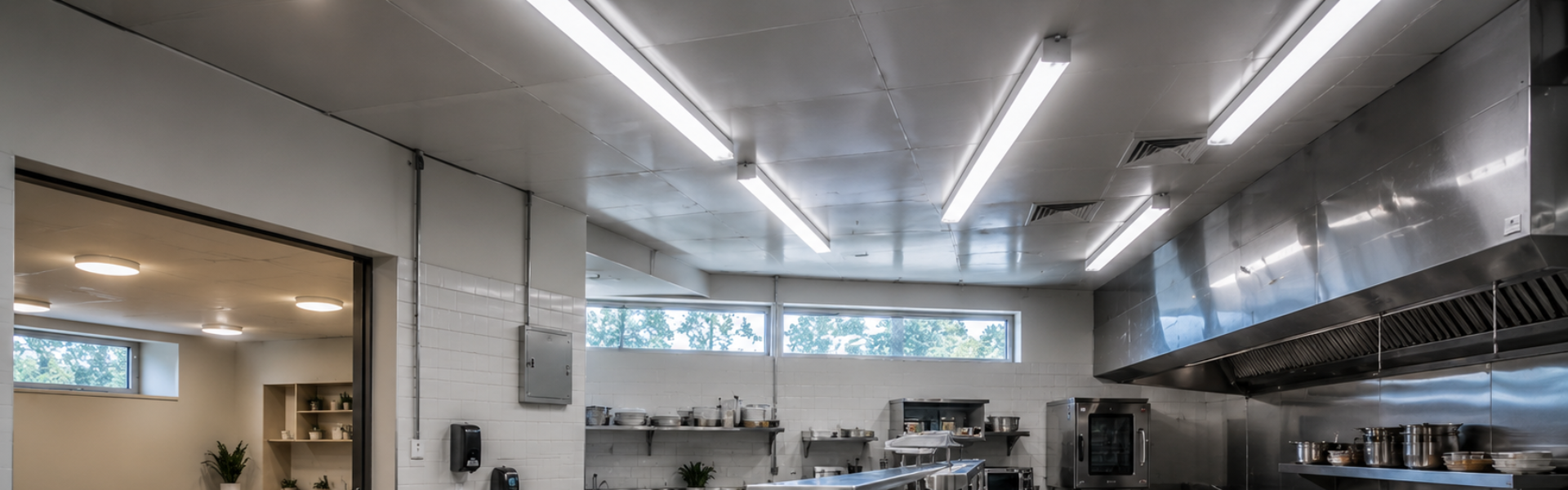
Break rooms and commercial kitchens serve fundamentally different purposes, but both demand thoughtful lighting. A poorly lit break room feels uninviting and discourages employees from taking proper rest. A poorly lit commercial kitchen creates safety hazards, slows food preparation, and risks code violations. This guide covers lighting requirements, fixture recommendations, and design considerations for facility managers and building owners getting these spaces right.
Overview: Why Break Room and Kitchen Lighting Matters
Break rooms are rest and recovery spaces where employees eat, socialize, and recharge. Lighting should be comfortable, evenly distributed, and warm enough to feel like a respite from task-intensive work areas. Commercial kitchens, by contrast, are high-activity zones where speed, safety, and sanitation are paramount. Lighting must be bright enough for detailed food prep, resistant to heat and moisture, easy to clean, and compliant with health department and building codes.
Many facilities combine these functions in a single space or adjacent rooms, which means the lighting design must transition smoothly from the relaxed atmosphere of a dining area to the high-output demands of a food preparation zone. Getting this balance right reduces workplace injuries, helps your facility pass inspection, and gives employees a break room worth using. Applicable codes include local health department requirements, ASHRAE 90.1 energy standards, and the FDA Food Code (Section 6-303.11) for illumination in food service areas.

Typical Areas and Lighting Challenges
Understanding the sub-areas within break rooms and commercial kitchens helps you choose the right fixtures and light levels for each zone.
Break Room Dining and Seating Areas
The primary break room space where employees eat, take coffee breaks, or have informal conversations. Target light levels of 30 to 50 foot-candles provide comfortable visibility for eating, reading, and using mobile devices without the harshness of a task-lit workspace. Warm color temperatures (3000K to 3500K) create a welcoming atmosphere. Avoid direct downlights aimed at seating positions, which cause glare and discomfort during meals.
Kitchen and Food Preparation Surfaces
Commercial kitchens require 50 to 75 foot-candles at counter and cutting surfaces, with some health departments requiring higher levels in inspection areas. Color rendering is critical: a CRI of 80 or higher ensures food looks natural under artificial light, helping staff identify spoilage, contamination, or improper cooking. Fixtures in this zone must handle heat from cooking equipment, steam from dishwashers, and regular cleaning with water and chemicals.
Ventilation Hood and Cooking Line Areas
The cooking line sits directly under ventilation hoods, exposing fixtures to extreme heat, grease-laden air, and steam. Standard fixtures fail quickly in this environment. Fixtures rated for use in commercial kitchen hood applications, or positioned outside the hood perimeter with directed light into the cooking area, are essential. Confirm fixture suitability with the hood manufacturer and your local authority having jurisdiction. Many ventilation hoods include integrated lighting, but factory output is often insufficient for proper task illumination and should be supplemented.
Storage, Walk-In Coolers, and Utility Areas
Dry storage areas need 20 to 30 foot-candles for reading labels and locating inventory. Walk-in coolers and freezers require vapor tight fixtures rated for cold environments with instant-on capability. Fluorescent tubes lose output in cold temperatures and take time to reach full brightness. LED fixtures maintain consistent output regardless of ambient temperature, making them the practical choice for refrigerated spaces.
Benefits of Proper Lighting in Break Rooms and Kitchens
Appropriate lighting in break rooms and kitchens has direct payoffs across three areas.
Safety and Compliance
Adequate lighting in food preparation areas reduces knife injuries, burns, and slips on wet floors. Local health department codes, typically based on the FDA Food Code, specify minimum light levels for commercial food service areas. Failing an inspection due to insufficient lighting can result in fines, temporary closure, or loss of operating permits. Proper lighting also ensures emergency exit routes are visible and that fire suppression equipment can be quickly located.
Employee Wellbeing and Productivity
Break rooms that feel warm and comfortable encourage employees to take genuine rest breaks, which improves afternoon output and reduces burnout. Kitchen staff working under appropriate light levels complete food prep tasks faster and with fewer errors. Reducing eye strain in both areas contributes to lower absenteeism and higher retention.
Energy Efficiency and Maintenance
LED fixtures in break rooms and kitchens consume 40 to 60% less energy than the fluorescent tubes they typically replace. In a commercial kitchen operating 12 to 16 hours per day, those savings add up quickly. LED vapor tight fixtures carry L70 ratings of 50,000 hours or more (confirm with the specific product spec sheet), dramatically reducing maintenance in hard-to-reach locations above cooking lines or in walk-in coolers. A typical kitchen retrofit pays for itself in 2 to 4 years through combined energy and maintenance savings.

Recommended Fixtures by Area
Each zone in a break room or commercial kitchen has specific fixture requirements driven by environment, code compliance, and task demands.
Surface Mount Ceiling Lights for Break Rooms
Surface-mounted LED fixtures are the standard choice for break room ceilings, especially in spaces with 8 to 9 foot ceilings where recessed fixtures may not be feasible. Look for fixtures with diffused lenses to minimize glare, 3000K to 3500K color temperature for a comfortable dining atmosphere, and 80+ CRI for natural color rendering. For break rooms with drop ceilings, 2x2 or 2x4 LED troffers provide even distribution with easy installation and maintenance access.
Recommended Surface Mount Ceiling Lights
737
Browse all Surface Mount Ceiling Lights
LED Wraps for General Kitchen Illumination
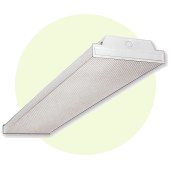
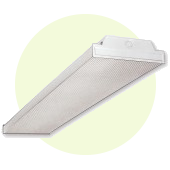
LED wrap fixtures provide wide, even light distribution and work well as general ambient lighting in kitchen areas outside the direct cooking zone. Their slim profile mounts close to the ceiling, keeping them clear of equipment and reducing grease accumulation. Choose wraps with a minimum IP44 rating for splash resistance and 4000K color temperature for the brighter, more alert atmosphere appropriate for food preparation. Dimmable models allow you to adjust light levels during off-peak hours to save energy.
Vapor Tight Fixtures for Kitchens and Wet Areas
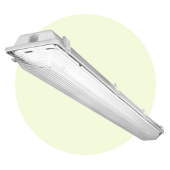
Vapor tight (or vapor proof) fixtures are sealed against moisture, dust, grease, and chemical cleaning agents. They are the correct choice for areas directly adjacent to cooking lines, dishwashing stations, walk-in coolers, and any location subject to washdown cleaning. Look for fixtures with appropriate NSF listing for the installation zone, IP65 or IP66 ratings for water resistance, and shatterproof polycarbonate lenses (required by most health codes to prevent glass contamination of food). LED vapor tight fixtures maintain consistent output in cold environments, making them suitable for coolers and freezers.
Pro Tip: Ventilation Hood Lighting
Many commercial ventilation hoods include factory-installed lighting, but output is often insufficient. Supplement with vapor tight LED fixtures mounted just outside the hood perimeter, angled to illuminate the cooking surface without sitting in the direct grease stream. This provides better light levels, easier maintenance access, and longer fixture life.
Design Guidelines and Considerations
Beyond fixture selection, several design factors determine whether your break room and kitchen lighting installation succeeds long-term.
Light Levels by Zone
Verify requirements with your local health department and building authority. The following ranges reflect common code requirements and industry practice:
- Break room dining area: 30 to 50 foot-candles at table height. Higher levels (40 to 50 FC) suit multipurpose break rooms used for meetings or training.
- Food preparation surfaces: 50 to 75 foot-candles at counter height. Some jurisdictions require 50 FC minimum; verify with your local health department.
- Cooking line (under hoods): 50 to 75 foot-candles at the cooking surface.
- Dishwashing area: 30 to 50 foot-candles.
- Dry storage: 20 to 30 foot-candles.
- Walk-in coolers and freezers: 20 to 30 foot-candles; fixtures must be rated for the operating temperature range.
Fixture IP Ratings and Food Safety Certification
Commercial kitchens are wet, greasy, and cleaned with high-pressure water and chemicals. Fixtures must carry appropriate Ingress Protection (IP) ratings: IP44 minimum for general kitchen areas, IP65 or IP66 for areas subject to direct water spray or washdown cleaning. Fixtures should carry NSF listing appropriate to their installation zone; confirm the specific listing with the fixture manufacturer or distributor before purchasing. Polycarbonate or other shatterproof lens materials are required in food zones to prevent glass contamination.
Color Temperature Strategy
Use different color temperatures to define the transition between break room and kitchen zones. Break room seating areas benefit from 3000K to 3500K (warm white) for a relaxed atmosphere. Kitchen prep and cooking areas perform better under 4000K (neutral white), which improves visual acuity for detailed food work. Consistent CRI of 80+ across both zones ensures food and skin tones look natural.
Energy Code Compliance
ASHRAE 90.1 and the IECC set lighting power density (LPD) limits for commercial kitchens and dining areas. The exact limit for your space depends on the space classification and the code edition your jurisdiction has adopted; verify with your local building department. Compliance strategies include choosing high-efficacy LED fixtures (typically 100 lumens per watt or more), installing occupancy sensors in storage rooms and break rooms that are not continuously occupied, and using daylight harvesting where windows or skylights are present. Many facilities achieve compliance by switching from fluorescent to LED, as the wattage reduction alone often brings the space under the LPD cap.
Controls and Scheduling
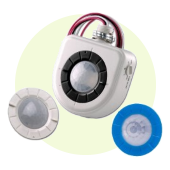
Break rooms benefit from occupancy sensors that turn lights off during unoccupied periods (evenings, weekends, overnight). Kitchen lighting typically runs on time-clock schedules aligned with food service hours, with manual overrides for early prep or late cleaning. Dimmers in break rooms allow light levels to be reduced during off-peak hours, extending fixture life and saving energy. Kitchen fixtures generally run at full output during operating hours but can be reduced during cleaning-only periods.

ROI Example: Kitchen Lighting Retrofit
A 1,500-square-foot commercial kitchen currently lit with 16 fluorescent vapor tight fixtures (total draw 1.8 kW) operating 14 hours per day, 365 days per year consumes approximately 9,200 kWh annually at $0.12/kWh, costing $1,104 per year. Replacing with 14 LED vapor tight fixtures (total draw 700W) reduces annual consumption to 3,577 kWh, costing $429. Annual savings of $675 in energy plus an estimated $400 in avoided relamping labor yields a total annual benefit of $1,075 and a simple payback of 2 to 3 years on a typical $2,500 to $3,000 retrofit investment. Figures are illustrative estimates; request a quote for a project-specific ROI analysis.
Call to Action
Proper lighting in break rooms and commercial kitchens reduces injuries, supports employee wellbeing, and keeps your facility compliant with health and energy codes. RelightDepot offers a full selection of surface mount fixtures, LED wraps, vapor tight fixtures, and controls designed for food service and employee amenity spaces.
Contact our team to discuss your break room or kitchen lighting project: