FREE SHIPPING ON ORDERS OVER $1K
EXPERT LIGHTING ADVICE
VALUE ENGINEERED QUOTES
ROI ANALYSIS AND DESIGN SUPPORT
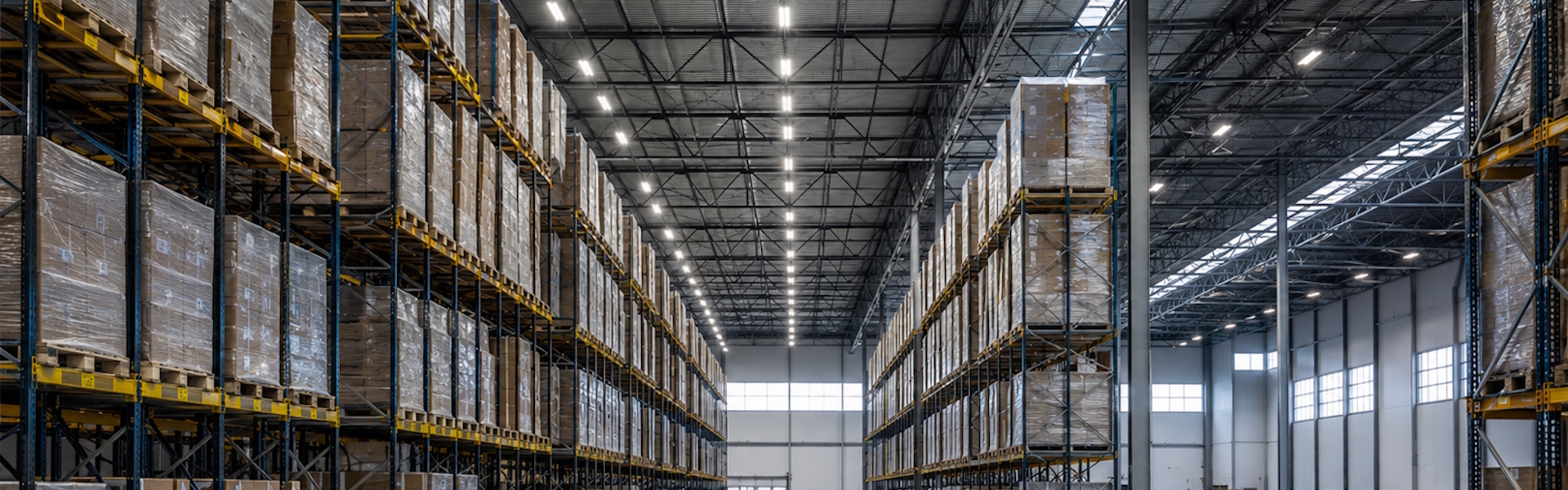
Warehousing and distribution is one of the fastest growing segments in construction today. With more and more of us shopping online, companies like Amazon and others are scrambling to put large warehouses and fulfillment centers closer to their customers. Warehousing is quickly becoming a competitive advantage for modern merchants. Every system in these facilities has to operate at peak efficiency to ensure profitability. One often-overlooked component that can make a big difference in operating cost is the warehouse lighting. In this application guide, we'll discuss the requirements and recommendations for picking the right warehouse lighting fixtures for your project.
Facility owners and managers have too much to do to think about how to light their warehouses, but a little research will go a long way to ensuring their design professionals are leading them in the right direction. If you happen to be one of those design professionals, or if you are an electrical contractor called in to propose a lighting retrofit, the following high-level considerations should guide your approach before taking on the project.
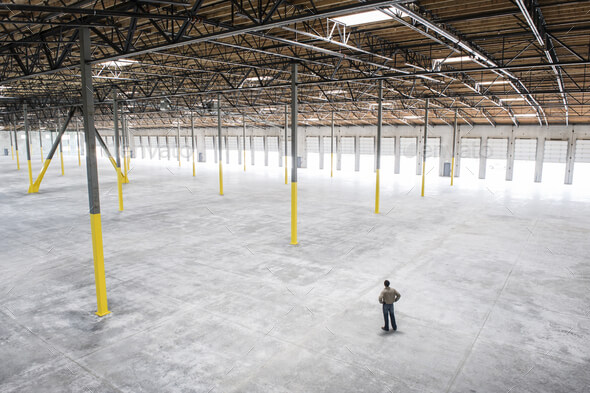
The decision to build a facility, lease a new tilt-up shell, or move into an older existing building is quite likely one of the first made when looking for additional warehousing space. That decision will also guide the lighting design for the project. At one end of the spectrum, you end up with a facility built to suit your needs in every way. At the other, your options may be limited by an existing infrastructure. Each scenario has its own pros and cons.
While it's true that you have greater flexibility when building a facility from scratch, the time and expense involved can be prohibitive. Chances are that you'll occupy this new space for many years, so care should be taken to ensure the lighting system is designed to the needs of each space. These newer facilities have ceiling heights of 35 feet or higher. Lighting them requires high-lumen fixtures that can punch light down to where it's needed. Rack aisles in modern warehouses need specialized high bay lighting with distribution patterns designed to light the vertical face of the rack from ceiling height.
When moving into an existing facility, the current placement of fixtures may not work for your racking layout, or it may restrict where racks can be located. If you're paying the utility bill, discuss the lighting system with the property owner before signing the lease. You may be able to have them retrofit the facility or provide incentives for you to improve the lighting before moving in.
Every warehouse is different, and the activities done in each area will dictate the type and amount of lighting needed to accomplish tasks safely. The following overview covers the types of activities common to most warehouses along with design notes to guide fixture selection.
Receiving Area - typically open storage and staging with high traffic. Tasks include unloading trucks, inspecting bills of lading, and moving material to staging areas or more permanent storage. Provide general illumination throughout the area to an average of 30 to 50 foot candles (FC). General purpose LED high bay fixtures are a good choice for these areas.
Bulk Storage - open storage area with low traffic. Tasks include reading labels and locating large items. Lighting should be between 15 to 30 FC of general illumination. Inactive bulk storage areas can be lit to an even lower 5 FC average. Fixtures can be similar to what is used in the receiving area, with lumen output or spacing modified to reduce the average light level.
Rack Aisles - storage of larger items in high-rack systems with movement by forklift or pallet jack. Tasks include locating and reading labels and maneuvering material handling equipment safely. Narrow spaces may require specific fixtures with distribution that can light the face of the rack and the floor from a high ceiling. Light these areas to an average of 15 to 30 FC.
Pick/Pack or Shipping Area - area used to pick small items from shelving to be placed into totes, or where orders are packed into cartons for shipping. If items are larger, this may be a staging area where pallets wait to be loaded onto trailers or containers. Tasks here typically require more light than a general storage area to read orders and material labels correctly. General illumination or task lighting to 30 to 50 FC would be appropriate.
Bay Doors - the opening leading to trailers or containers where workers are moving material for outbound shipping. The most practical way to light the inside of shipping containers or trailers is with wall-mounted dock lights.
Office and Administration - office space typically carved out from the rest of the warehouse, with lower ceiling height, for general administration of the facility. Tasks include computer use, filing, copying, and similar activities. Average light levels in office areas should be between 30 to 50 FC.
We'll cover lighting recommendations in more detail in the requirements section below.
You may be tempted to pick the least expensive light fixtures that can get the job done, but you would miss a real opportunity to cut operating costs if efficiency isn't a priority in your decision. Lighting can account for over 30% of the energy cost for warehouse spaces. New LED high bay fixtures can cut that by more than 60% compared with traditional high bays. Those savings are substantial.
 If moving into an older space, a close look at the existing lighting system can reveal a significant savings opportunity. Retrofitting the lighting in an existing warehouse is best done before moving in, so the work can be completed without interrupting operations. The easiest approach is a one-for-one count of new fixtures for old, but if the existing fixture locations don't work for your intended layout, adding 10 to 12-foot cords or replacing each old fixture with two smaller new fixtures adds flexibility.
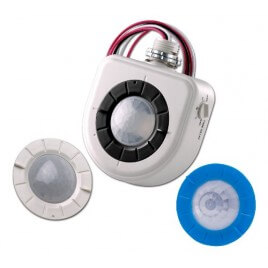
To maximize efficiency, consider adding occupancy sensors or other lighting controls that will automatically dim or switch off fixtures when the area below them is empty. Fixture-mounted sensors detect when workers are present and quickly bring the controlled fixture to full brightness. When workers leave an area, the sensors can dim or turn off the fixture to save power. Many projects we've completed delivered a better return on investment and total cost of ownership when sensors were added, even when the upfront product cost was higher. Focusing only on material cost for these projects would have left significant savings on the table.
A large warehouse can be a difficult place to navigate when the power goes out if there isn't an adequate emergency lighting system in place. While the height and sheer size of modern warehouses make emergency illumination challenging, there are solid products designed specifically for this problem.
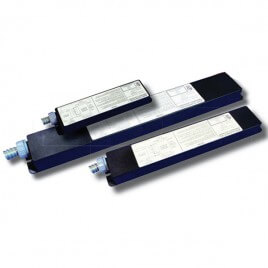 The most common solution is industrial-grade exit and emergency lighting units. Many of these are holdovers from the HID era, when high bays could not be outfitted with emergency backup batteries. LED high bays are ideally suited for use with emergency battery backup drivers. These compact battery and driver combinations sense when power is lost and automatically switch to battery power. They bring the fixture back online much more quickly than traditional HID. Modern LED high bays turn on instantly without the restrike delay of HID fixtures, which reduces the time your facility relies on emergency systems.
Browse all Emergency Battery Backup Drivers
Many studies have shown a direct correlation between lighting quality and worker productivity. Lighting also affects mood and alertness, and can significantly improve performance. Providing proper light levels will lower mis-pick rates and reduce errors across the entire organization.
The Illuminating Engineering Society publishes recommended light levels for many types of spaces. We rely on these recommendations as a starting point when helping customers with warehouse lighting projects. Light levels can be adjusted up or down based on the size of objects being handled or the age of the occupants. The recommended levels for common warehouse areas are as follows:
| Space / Area | Recommended Light Level |
|---|---|
| Break Room | 10 to 30 FC |
| Bulk Storage Area | 5 to 30 FC |
| Locker Room | 10 to 30 FC |
| Mechanical Room | 20 to 50 FC |
| Office or Admin Area | 30 to 50 FC |
| Pick/Pack Area | 30 to 50 FC |
| Rack Aisle Storage Area | 15 to 30 FC |
| Receiving Area | 30 to 50 FC |
| Restrooms | 10 to 30 FC |
| Shipping Area | 30 to 50 FC |
| Stairwells | 5 to 10 FC |
For areas subject to moisture, wash-downs, or cold temperatures such as refrigerated storage and freezer rooms, specify vapor-tight high bay fixtures rated for wet or damp locations. These sealed units maintain full performance in environments where a standard high bay would fail prematurely.
Browse all Vapor Tight High Bays
When selecting your warehouse lighting, and even more importantly when replacing fixtures over time, pay attention to color temperature. We recommend a color temperature of 5000K for warehouse spaces. This crisp, clean white light closely matches natural sunlight. Since warehouses often have bay doors open or skylights that let in natural light, a 5000K source blends well with daylight and keeps the space feeling consistent throughout the day.
Over the years, we have provided lighting layouts for warehouses of all sizes. While every project has its own special requirements, two ceiling heights come up consistently: 25 feet and 35 feet. These leave fixtures mounted at 23 feet above finished floor (AFF) and 32 feet AFF respectively. For both heights, spacing criteria rarely exceeds 1.0, so fixtures are typically spaced at roughly the building height or less. The designs below assume a 200 by 100 foot floor plan with varying ceiling height. A 0.92 light loss factor is used to account for lumen depreciation, and the calculation plane is set at 3 feet AFF. Because larger warehouses don't change the underlying calculations or introduce obstructions, these layouts can be extrapolated to larger facilities.
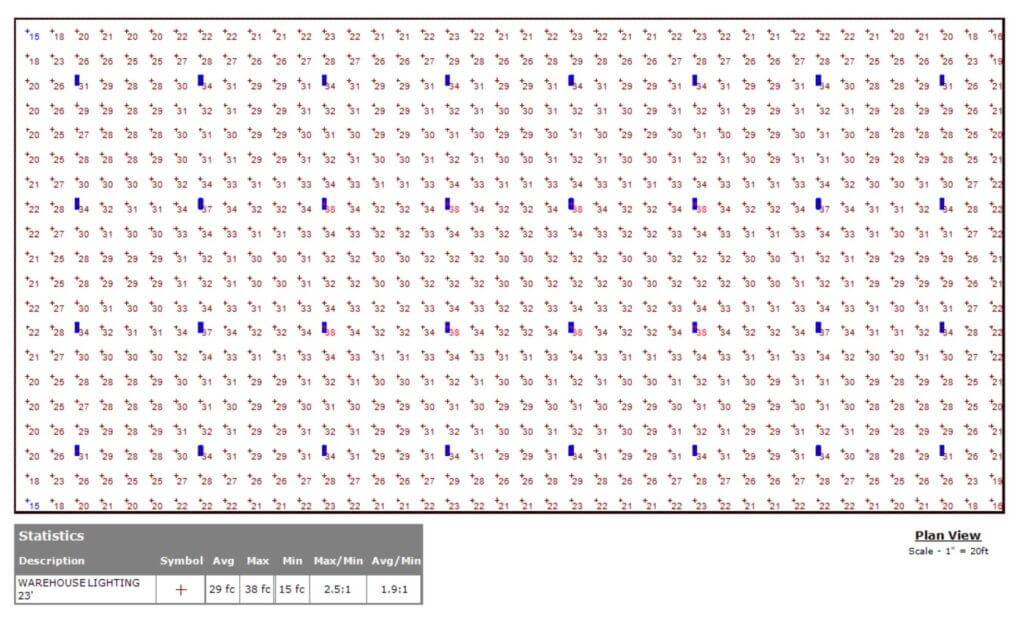
The layout above for a 200 by 100 by 25-foot facility uses 32 of the 165W Linear LED High Bay fixtures to reach an average light level of 29 FC. These are very common fixtures available from multiple manufacturers. They are arranged in a 4-row by 8-column grid spaced 25 feet apart in both directions. This allows for 17-foot-wide aisles. If a narrower 12-foot aisle is preferred, dropping the wattage to 90W and the fixture spacing to 20 feet will accomplish that goal while maintaining the same light level.
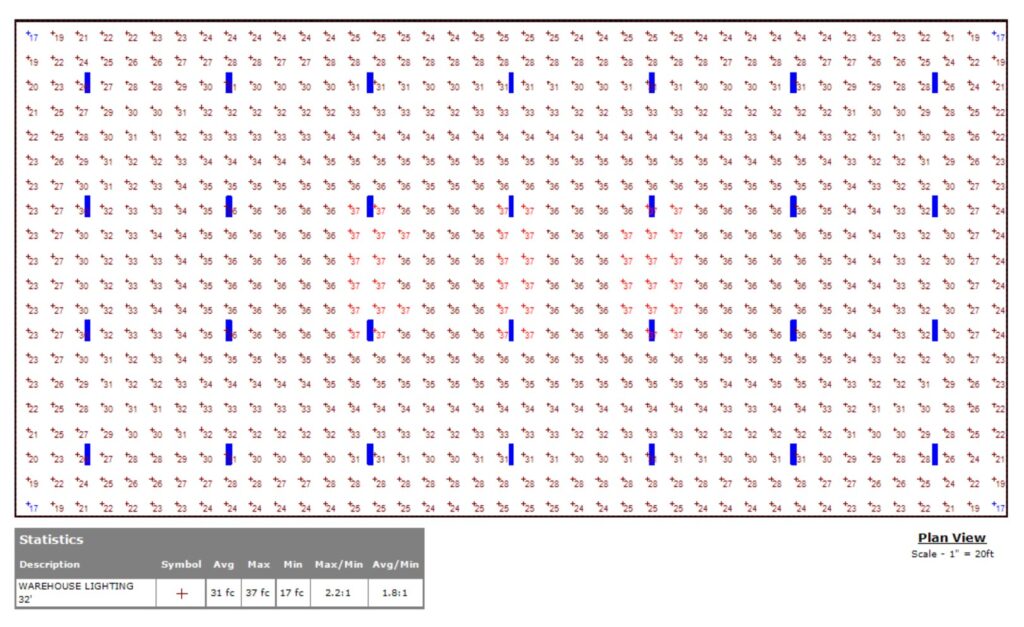
The example layout above for a 200 by 100 by 35-foot facility uses 28 of the 225W Linear LED High Bay fixtures from the same series as the prior layout to reach an average light level of 31 FC. With the increased ceiling height, more lumens are needed to reach the same light level at a similar spacing. If narrower aisles are called for, switching to the 165W linear high bay and maintaining 20 by 25-foot spacing delivers a 30 FC average.
At RelightDepot, we've helped our customers light millions of square feet of new warehouse space and millions more that have been upgraded and retrofitted. We've seen all types of facilities and can help with the concept, design, and implementation of the right lighting system for yours. We'd be happy to provide a custom lighting layout for your space, help you choose the right fixtures, identify available incentives, and manage the rebate process. Our contractors use us as an extension of their team.
Ready to discuss your warehouse lighting project? Contact us, call 888-548-6387, or email [email protected]. Our lighting specialists are ready to help you choose the right fixtures, plan your layout, and maximize your ROI.
If you don't see what you're looking for, don't hesitate to contact us to discuss your needs with one of our lighting experts. We would be happy to walk you through all of the design considerations and help you choose the best type of lighting for your application.
