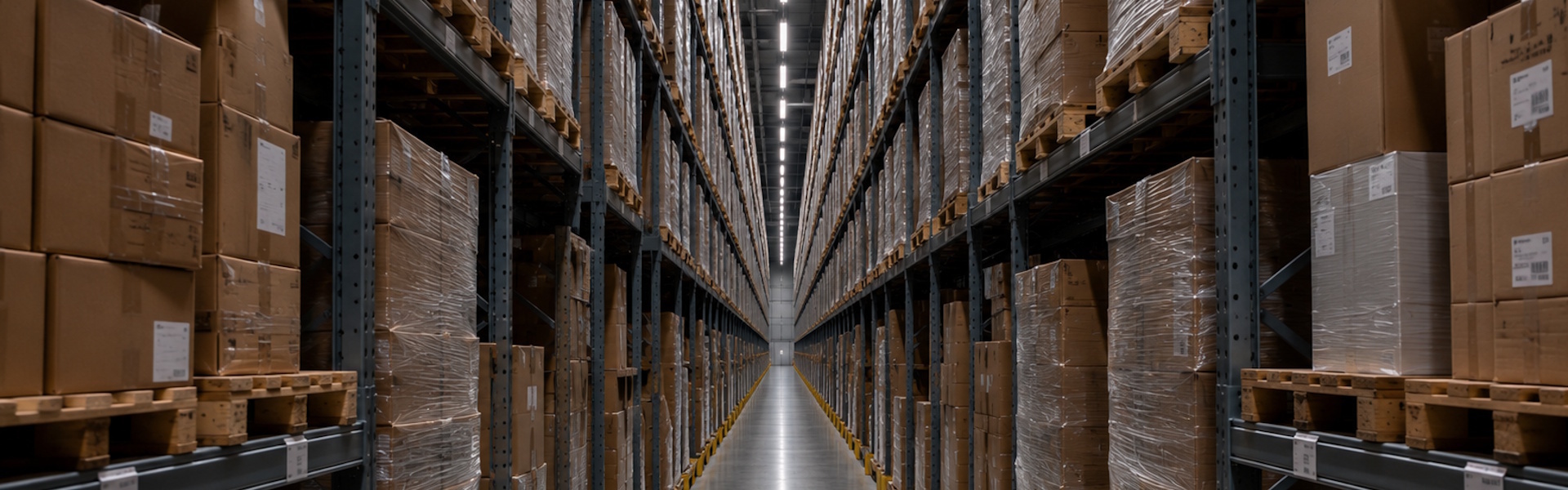
Warehouse aisles are among the hardest spaces to light well. Unlike open floor areas, narrow and very-narrow-aisle (VNA) racking demands light aimed down the aisle and onto the vertical face of the rack, where the labels are, not just onto the floor. Symmetrical round high bays built for open bays do not do this, and always-on lighting wastes energy in aisles that sit empty between picks. This guide covers the fixture optics, mounting, sensor strategy, and ROI that actually work in warehouse aisles.
Why Aisle Lighting Matters in Warehouses
Forklifts, order pickers, and moving inventory share the same narrow aisles all shift, and the lighting has to serve all three. Poor lighting drives safety incidents, mis-picks, and slowdowns. At the same time, individual aisles sit empty during slow periods and between picks, which makes them strong candidates for sensor-based control.
IES RP-7 (Recommended Practice for Lighting Industrial Facilities) gives tiered foot-candle targets by task: roughly 20 to 30 foot-candles for general industrial work, 30 to 50 for active storage aisles, and 50 or more for detailed picking and label reading. Confirm the current edition's values for your task before you design to them. Occupancy sensors, motion controls, and dimming can cut aisle lighting energy 40 to 60 percent while holding those levels when workers are present.

Typical Warehouse Aisle Types and Their Lighting Needs
Aisle width and rack height drive the fixture, mounting, and control choices. Use this as a quick reference before scoping a layout.
| Aisle type |
Aisle width |
Rack / lift height |
What the lighting has to do |
| Standard narrow aisle |
6 to 9 ft |
15 to 25 ft |
Even light down the aisle with enough on the vertical rack face for label reading, no dark gaps between bays. |
| Very-narrow-aisle (VNA) |
4 to 6 ft |
35 to 40+ ft |
Aisle-optic distribution that reaches the floor of a tall canyon and the upper rack faces, with glare kept off turret and reach-truck operators. |
| Transverse (cross) aisle |
10 to 15 ft |
Varies |
General circulation light for safe lift transitions; less specialized than storage aisles. |
| Pallet staging and dock |
Open |
Lower |
Consistent bright illumination for high, continuous traffic; usually not a good fit for occupancy sensors. |
Receiving and shipping zones near the docks are covered in the loading dock and shipping area lighting guide.
How Aisle Optics Work
The fixture that lights an aisle well is not defined by its shape alone; it is defined by its optic. A standard round high bay throws a symmetrical cone straight down, which is right for an open floor but wrong for a narrow aisle: most of the light lands on the rack tops and the aisle floor directly below, while the vertical rack faces and the lower shelves fall into shadow.
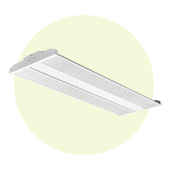
A linear high bay built for aisles uses an elongated, asymmetric distribution (sometimes called an aisle or Type V-short optic) that stretches the beam along the length of the aisle and pushes light sideways onto the vertical face of the storage. You run a single row of these fixtures centered over the aisle, long axis aligned with the aisle, and they cover the run continuously instead of pooling under each unit. In a tall VNA canyon this is the difference between readable labels at every level and a dim well with bright rack tops.
Vertical illuminance is the metric that matters here. Measure light on the face of the stored product at label height (about 4 to 6 ft up), not just horizontal foot-candles on the floor. Aisle-optic linear fixtures are built to deliver it; symmetrical round high bays are not.
Benefits of Motion-Activated and Occupancy-Sensor Aisle Lighting
Sensor-driven aisle lighting pays off across energy, maintenance, safety, and compliance.
- Energy savings. Motion and occupancy control typically cut aisle runtime 40 to 60 percent, since any given aisle is unoccupied most of the shift. In a large distribution center that can run into six figures of kWh per year.
- Lower maintenance. Fixtures and drivers that run fewer hours last longer, stretching replacement intervals and cutting lift-truck-and-ladder service trips in tall racking.
- Safety on demand. Sensor control brings the aisle to full output the moment a worker or lift enters, instead of sending someone into a dim canyon.
- Dim, don't switch. Pairing sensors with dimming controls holds a low ambient level during idle periods and ramps to full on motion, which avoids hard on/off and keeps operators' eyes adapted.
- Auditability. Control logs help demonstrate consistent illumination for OSHA and internal safety reviews.
ROI Example: 40-Aisle Sensor Retrofit
ROI Example
A 300,000 sq ft distribution center with 40 active picking aisles, each about 250 ft long, adds occupancy sensors and 0-10V dimming to its existing linear high-bay fixtures (roughly 15 fixtures per aisle, about 2.5 kW connected per aisle).
Assumptions: two-shift operation, about 5,000 lighting hours per year; each aisle sits idle roughly half of those hours and dims to 20 percent when idle.
Retrofit cost: about $1,200 per aisle (sensors, 0-10V drivers, control wiring, labor) = $48,000
Energy saved: about 5,000 kWh per aisle per year, ~200,000 kWh total, at $0.12/kWh = about $24,000 per year (roughly a 40 percent cut, in line with the range above)
Maintenance: modestly lower from reduced runtime
Simple payback: under 2 years
These figures are illustrative; actual savings depend on fixture wattage, operating hours, and how often each aisle is occupied.
Round High Bays vs. Linear High Bays in Aisles
Fixture selection comes down to distribution, not wattage. The optic has to match the geometry of the aisle.
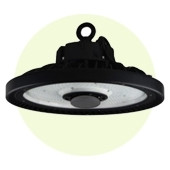
Round (UFO) high bays throw a symmetrical beam straight down. They are the right tool for open floor, transverse aisles, and staging areas, where there is no canyon. In a storage aisle they waste light on the rack tops, leave dark gaps on the lower shelves, and can put glare on a lift operator's windshield during turns.
Linear high bays run as a single continuous row down the center of the aisle. The elongated optic spreads light along the aisle and onto the vertical rack faces, which is what label reading and vertical foot-candles require. This is the default fixture for both standard narrow and VNA storage aisles.
Low-output strip fixtures are a linear shape but not a high-bay output. Reserve them for low racking and low-bay aisles (mounting around 12 to 16 ft). They do not belong over 35 to 40 ft VNA racking, where you need a high-bay-output aisle fixture mounted at or above the top of rack.
Recommended Linear High Bay Fixtures for Aisles
For sensor-controlled aisles, look to sensor-ready (0-10V) linear high bays so the dimming driver and the occupancy sensor work together out of the box.
796
Browse all Linear High Bay Lights

Design Guidelines: Rack Height, Spacing, and Sensor Placement
These guidelines are intended for facility managers and operations teams planning a sensor upgrade or fixture replacement. New construction layouts are engineered to the project drawings.
Rack Height and Fixture Mounting
For racking up to 20 feet, mount linear fixtures 12 to 16 feet overhead, centered in the aisle. This height positions the light source at or slightly above the top rack level, delivering illuminance down the full height of the pick face and keeping the fixture out of the forklift's working envelope. For VNA aisles with 35 to 40-foot racking, drop to narrower high-bay units (100 watts LED, 30-degree beam angle) mounted 25 to 28 feet high, spaced 15 to 20 feet apart along the aisle centerline. At this height and beam angle, light reaches the upper rack levels without overshooting the aisle width and washing energy onto adjacent aisles. Avoid mounting fixtures at mid-rack height in VNA configurations; that position creates direct glare for operators at the same elevation on the turret truck.
Vertical Illuminance
Most facility lighting audits measure foot-candles on the floor, but for warehouse aisle work, that number is the least useful one on the report. What drives picking accuracy and safety is illuminance on the vertical face of stored boxes, the surfaces where labels, barcodes, and product markings live. Target 30 to 40 foot-candles minimum on the vertical face at label height, typically 4 to 6 feet off the floor for the lowest rack level and at every level above. Linear fixtures outperform round high-bays on this metric because their elongated light source naturally spreads illumination horizontally across the rack face rather than concentrating it directly below. If you're evaluating your existing setup, hold a foot-candle meter perpendicular to the rack face (not the floor) at each rack level before specifying any new fixtures.
Sensor Placement and Coverage
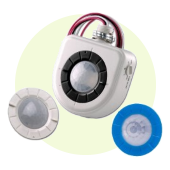
Mount occupancy sensors 8 to 10 feet high on aisle endcaps or on the side of rack uprights at the aisle entrance. This height keeps sensors below forklift mast height in most narrow-aisle configurations and keeps their detection cone aligned with the aisle width rather than sweeping adjacent aisles. Use sensors rated for a 15 to 20-foot detection range with a field of view that covers the full aisle width from side to side. For aisles over 80 feet, add a second sensor at the midpoint, 30 to 40 feet from each end to cover the full run without dead zones in the center where a worker might be out of range of the entry sensor but not yet in range of a hypothetical far-end sensor. Set sensor timeout to 5 to 10 minutes for most picking operations; if your average pick cycle regularly exceeds that window, adjust up to avoid lights dimming while workers are still active in the aisle.
Dimming Strategy
Pair occupancy sensors with 0-10V dimming drivers or smart LED drivers rated for the fixture wattage. Set the baseline ambient level to 20 to 30 percent brightness for unoccupied aisles, enough for forklift navigation and contrast with occupied aisles, but well below full output. Configure the ramp-up to reach 100 percent within 2 to 3 seconds of motion detection. A smooth ramp is preferable to an instant switch-on because abrupt full-brightness activation causes a brief flash that degrades the forklift operator's eye adaptation coming from a dimmer adjacent aisle. On the dim side, a 20-percent floor also extends LED driver life by reducing thermal cycling; each on-off cycle is a stress event, and dimming to a low level instead of cutting power entirely adds years to driver lifespan.
Occupancy Sensors for Aisle Controls
974
Browse all Occupancy Sensors

Forklift Safety and Visibility
Consistent aisle lighting is as much a forklift safety requirement as it is an energy decision. Poor lighting contributes to collisions, pedestrian injuries, and rack damage, and it's one of the first items OSHA inspectors look at in a warehouse audit.
Glare Control
High-bay fixtures mounted directly above aisles create glare on forklift windshields, especially as operators turn into or out of an aisle and the fixture drops directly into their sightline. The fix depends on the fixture type: for round high-bays, specify asymmetric or wall-wash optics that direct light toward the rack faces rather than straight down, or add deep-cone louvers to cut the direct downward component. For linear strips, glare is less of an issue because the elongated source runs parallel to the operator's direction of travel, keeping it out of direct sightlines in most positions. If glare complaints are coming from a specific aisle, check the fixture aiming angle first; even a standard fixture aimed 10 to 15 degrees off-center can eliminate the problem without replacing hardware.
Contrast and Shadow
The most common forklift incident pattern in warehouse aisles involves an operator whose eyes are adapted to a brightly lit transverse aisle turning into a storage aisle that is significantly darker. The contrast is sharp enough that for the first several seconds, the operator is essentially navigating blind. Keeping unoccupied storage aisles at a 20 to 30-percent dim level rather than full off eliminates this contrast gap — the difference between the transverse aisle and the storage aisle stays within the range the eye can adapt to in a normal turn. Avoid configurations where adjacent aisles are at dramatically different brightness levels (one fully on, the next fully off), even if each aisle has its own sensor circuit. Staggering the aisle controls so that a triggered aisle also bumps adjacent aisles to 40 percent provides a better visual transition for operators.
Aisle Marking
OSHA 29 CFR 1910.22 requires that permanent aisles and passageways be appropriately marked. Yellow floor striping at aisle boundaries is the standard approach, but striping is only effective when the illumination level is high enough to make the contrast between the stripe and the floor visible to a forklift operator at approach speed. In facilities where floor striping has worn or faded at low-light aisle intersections, the root cause is often inadequate illumination rather than a floor marking maintenance problem; workers can't see the lines clearly enough to avoid scuffing them with pallet jacks. Retroreflective tape along rack uprights at aisle entry points adds a second layer of visibility that works at lower light levels and is visible in the forklift's headlights even in partially lit areas.
Recommended Configurations by Aisle Type
Use these as starting points for scoping a retrofit or new install. Costs are installed (fixture or sensor, controls, labor) and approximate.
| Aisle type |
Fixture approach |
Mounting |
Controls |
Approx. installed cost |
| Standard narrow (6 to 9 ft, 15 to 25 ft rack) |
Single row linear high bays, 4000K to 5000K |
Centered, near ceiling or top of rack |
Occupancy sensor + 0-10V dimming, 10-min timeout |
$800 to $1,200 per aisle |
| VNA (4 to 6 ft, 35 to 40+ ft rack) |
Aisle-optic linear high bays |
At or above top of rack, centered |
Sensor + dimming, idle 20% |
$1,500 to $2,000 per aisle |
| Transverse (10 to 15 ft) |
Linear or round high bays |
14 to 18 ft, spaced for width |
Sensor for safety on-demand |
$1,200 to $1,600 per aisle |
| Dock and staging |
Continuous linear or round high bays |
16 to 20 ft |
No occupancy sensor (continuous traffic) |
$2,000 to $3,000 per area |
Get a Quote on Aisle Lighting
RelightDepot stocks linear high bays, sensor-ready drivers, and occupancy sensors for warehouses and distribution centers. Call 888-548-6387 or email [email protected] for specs, lead times, or a quote on fixtures and controls for your layout.