
Commercial Exit and Emergency Lighting
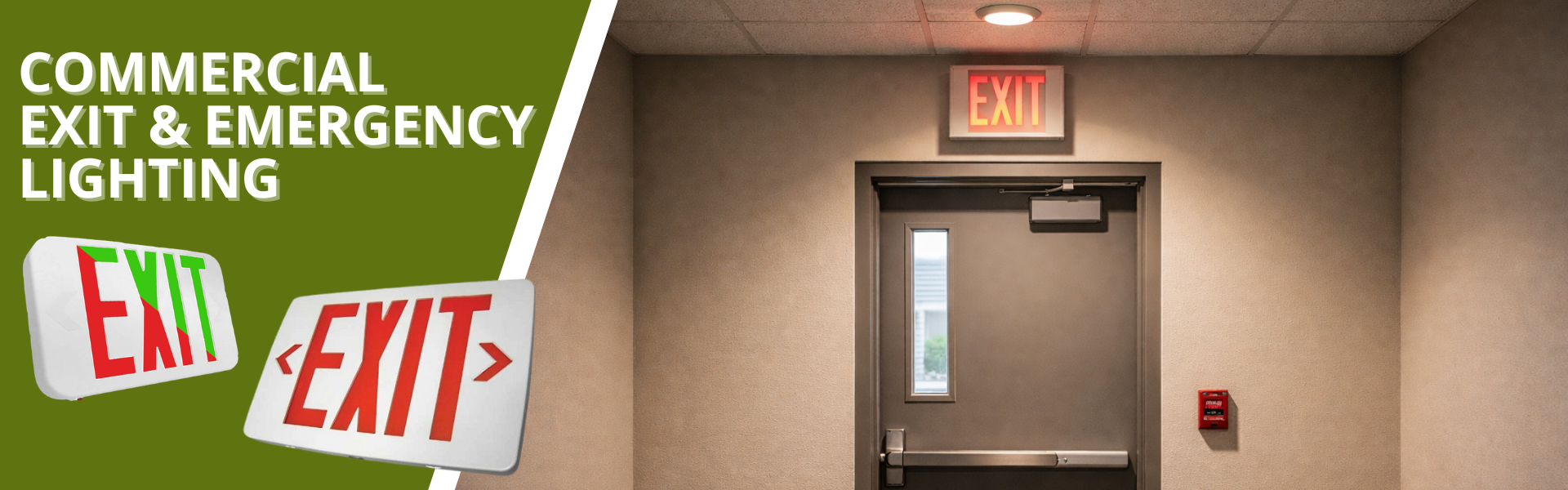
Exit and emergency lighting are included in the life safety scope of most commercial electrical plans. By the time electrical contractors are working from the drawings, fixture types and locations are already defined in the plans. The real questions tend to be practical ones. How will the fixtures mount to the existing ceiling or wall? What battery system will support the required emergency runtime? Are the units readily available to keep the project schedule on track?
During bidding and submittals, contractors work from the fixture schedule, which may include multiple device types such as exit signs, combo units, remote heads, and emergency backup equipment. Having those details organized helps teams confirm mounting requirements, environmental ratings, and battery configurations before ordering materials.
Exit and Emergency Lighting in Real Commercial Projects
Exit and emergency lighting systems are part of nearly every commercial project, but how they are handled varies by construction type. In new construction, architects typically define the life-safety layout early, and electrical contractors coordinate junction box locations, circuiting, and mounting heights during the rough-in. Tenant improvements or retrofit upgrades often require adjustments to fit existing ceiling grids, conduit runs, or junction box positions.
Inspectors focus on code minimums. They verify that exit signs remain visible along egress paths, that emergency fixtures provide required illumination coverage, and that battery runtime meets local code or jurisdictional requirements. Facility teams handle ongoing maintenance, including battery testing and periodic replacements. Access for installation and future replacement needs to be considered during layout and rough-in, since relocating devices later can be disruptive.
Exit Signs: Visibility, Mounting Options, and Installation Considerations
Exit signs are installed based on plan requirements, with mounting conditions, visibility, and electrical access driving how they are field-installed. Single- and double-face signs must be selected based on corridor width and traffic flow. Ceiling type, obstructions, and junction box availability dictate wall, ceiling, or end-mounted configurations. Retrofits often require careful evaluation of existing boxes and structural supports.
Electrical considerations include ensuring proper backup power, connecting to the right circuit, and confirming the battery and LED components support the expected service interval to avoid premature replacement. Alignment with ceiling grids, stairwell entrances, and corridor layouts ensures that the installed sign is readable along the egress path and meets local inspection expectations.

Exit and Emergency Combo Units in Space-Constrained Layouts
Combo exit and emergency units often appear in small tenant spaces, where a single device can cover both exit marking and emergency illumination. Retail suites, offices, and short corridors are common examples. Using a combo unit reduces the number of fixtures and allows installation from a single junction box.
During submittals, battery performance is checked against specified requirements to ensure the unit meets the required emergency runtime. Many jurisdictions require about 90 minutes of operation, though enforcement can vary. Ceiling height and corridor length still matter. A combo unit only works when the emergency heads can realistically cover the required path.
Remote Emergency Heads for Extending Egress Coverage
Remote heads are typically installed in long corridors, stairwells, and warehouse aisles where a single unit cannot cover the full egress path
A central emergency unit powers the remote heads through low-voltage wiring. The heads can then be aimed toward the walking path, stair landings, or corridor intersections. This approach allows contractors to expand coverage without installing additional battery units.

Emergency Backup Units for Exterior and Unconditioned Areas
Some projects require emergency lighting equipment that can operate outside conditioned spaces. Loading docks, parking garages, exterior egress paths, and unheated industrial areas often fall into this category. Standard indoor emergency units may not perform reliably in these environments, especially where temperatures drop below typical battery operating ranges.
Cold-weather and outdoor-rated backup units address those conditions. Environmental ratings and temperature limits are reviewed during submittals to ensure compliance with project requirements, especially when fixtures are located near exterior doors, canopies, or unconditioned service spaces.
Confirming these ratings early helps avoid inspection comments or premature battery failure once the building is occupied.
Why Contractors Use a Consolidated Exit and Emergency Lighting Catalog
Exit signs, combo units, remote heads, and backup units often appear together in the same lighting schedule. During estimating and submittals, contractors need to compare mounting styles, battery systems, and environmental ratings across those categories. Pulling specifications from multiple cut sheets can slow down that process.
A consolidated catalog allows project teams to review compatible fixture options in one place. Contractors can confirm mounting methods, compare battery configurations, and identify units suited for indoor, outdoor, or cold-weather conditions. This approach helps streamline fixture scheduling and simplifies future maintenance when facility teams need replacement parts or compatible units.

Explore Exit and Emergency Lighting at RelightDepot
RelightDepot offers a full selection of commercial exit signs, emergency lights, combo units, remote heads, and emergency backup systems used across offices, retail spaces, warehouses, and other commercial projects.
Browse the full Exit and Emergency Lighting collection review, available models, and specifications.
For project assistance, email [email protected] or call 888-548-6387 to speak with a lighting specialist.
Related Categories


Latest Blog Updates

Product Spotlight: Westgate LLVT 4ft LED Vapor Tight with Selectable Wattage and CCT
Most vapor tight jobs don't get much attention on the drawings, and they still end up causing proble...

MaxLite TRK Tunable White Troffer Retrofit Kits
Most commercial buildings still have a ceiling full of 2x4 and 2x2 lay-in troffers with sound housin...

EiKO HBX3 and BAYE3 Round High Bay Promo for Warehouse and Industrial Retrofits
Most high bay retrofits start with a fixture count, not a photometric plan. Someone walks the floor,...
Enerlites October Promo: Surge, TR Devices and Power Inlets Closes October 31
Enerlites has promo pricing on four devices most of us put in on every service upgrade and finish tr...

Specifying the LRS-O2 Wall Sconce for Entries, Breezeways, and Site Work
The LRS-O Series is Westgate's field-selectable up-and-down wall sconce platform, built for multifam...
MaxLite DSKL Series: Color-Selectable Disk Lights, One SKU for Five CCTs
MaxLite's DSKL Series Disk Light ships in two sizes on one platform: a 4 inch, 10W model and a 6 inc...