
Fire-Rated Slim Recessed Light Series (RSL & SSL)
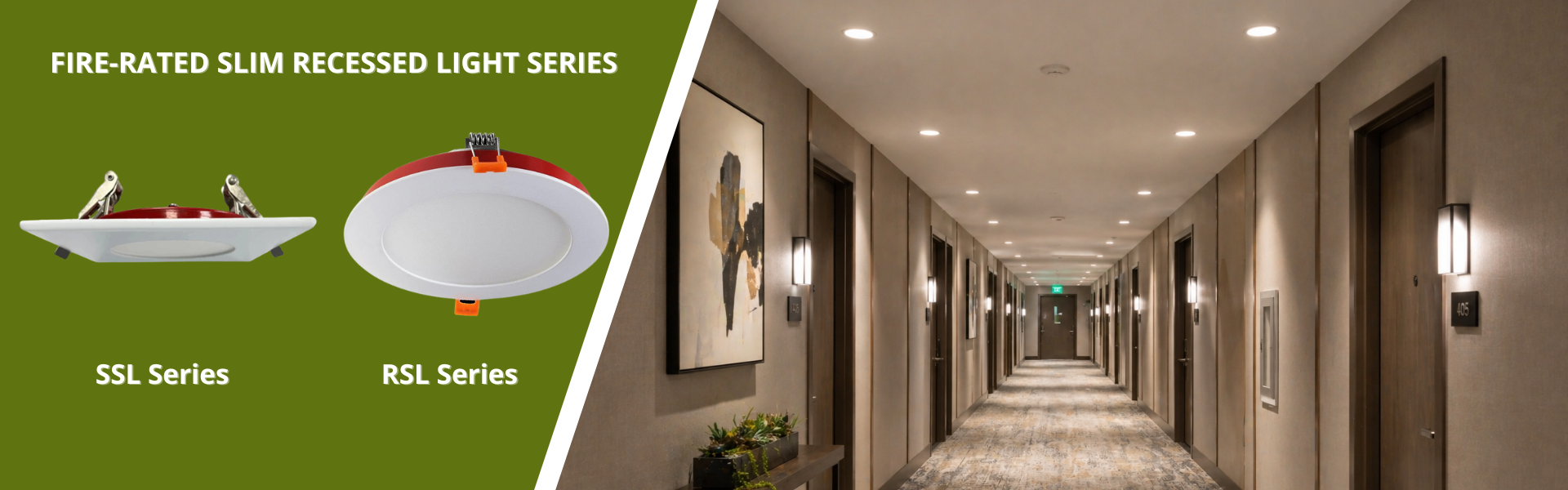
Most recessed lighting decisions happen after layout, but fire-rated recessed lighting works the opposite way. Once a project requires a 2-hour rated ceiling assembly, shallow plenum space, and clean finished ceilings, fixture options narrow fast. Multifamily corridors, hospitality floors, healthcare spaces, and common-area renovations all create the same problem: the lighting still has to perform, but the ceiling cannot be compromised.
That is where the RSL and SSL Series fit. These slim, fire-rated recessed fixtures protect the rated assembly, simplify shallow-ceiling installs, and reduce late fixture changes when field conditions stop matching the drawings. Contractors choose them because reopening rated ceilings during closeout is expensive.
RSL vs SSL Series: How Contractors Actually Separate Them
Most of the RSL versus SSL decision gets made by the ceiling plan. The round RSL Series usually stays in corridors, multifamily common areas, hospitality guest floors, and renovation work where standard recessed layouts already exist and clean repetition matters more than architectural emphasis. It fits projects where crews want predictable spacing, fast replacement, and fewer coordination issues with existing penetrations.
The square SSL Series shows up more often where ceiling lines are driving the visual layout. Lobbies, amenity spaces, hospitality public areas, and higher-end commercial interiors tend to push square trims because they align better with grid layouts and architectural symmetry.
Within both series, standard, adjustable, regressed, and gimbal options solve different field conditions without forcing a fixture family change. Adjustable and gimbal trims handle directional lighting needs, while regressed options help control glare in occupant-facing spaces. The advantage is keeping one approved family series across mixed applications instead of introducing multiple substitutions during submittals.

Fire-Rated Assemblies Drive the Entire Selection Process
With fire-rated recessed lighting, the ceiling assembly decides the fixture long before anyone debates trim style. Once the project requires a 2-hour rated ceiling assembly, the fixture has to protect that rating without introducing field-built workarounds. Multifamily corridors, hospitality floors, healthcare spaces, and rated common areas all push this early because ceiling penetrations are part of the life-safety scope, not just the lighting package.
That means coordination starts with drywall assemblies, rated floor-ceiling systems, and listed penetrations. Inspectors are checking whether the assembly remains compliant, not whether the fixture looks right on the reflected ceiling plan. If crews start modifying openings, changing unsupported housings, or improvising around framing conflicts, that turns into correction work fast.
This is why fire-rated series get locked in early. Once approvals move forward, changing fixture types could affect the rated assembly itself. If the ceiling assembly is wrong, the lighting spec stops mattering.
Field Conditions That Decide Fixture Selection
Most recessed lighting problems show up after crews open the ceiling. Shallow plenum space is usually the first issue. Between framing, ductwork, plumbing, and existing structure, traditional housing often stops being practical fast. That is where slim, canless fire-rated fixtures solve real labor problems. They protect the rated assembly without forcing deeper ceiling space than the project has.
Retrofit work adds another layer. Existing penetrations rarely match current layouts exactly, and ceiling drift from previous work makes cutout alignment harder than the drawings suggest. In renovation projects, the goal is usually clean replacement without reopening the ceiling more than necessary.
Damp locations also drive selection earlier than expected. Bathrooms, breezeways, covered corridors, and hospitality service spaces require fixtures that meet both environmental conditions and rated ceiling requirements without splitting fixture families within the same project. Install success usually depends more on what the ceiling allows once work actually starts.
CCT Selection and Owner Adjustments After Installation
Most CCT decisions get challenged after the fixtures are on and the finishes are complete. A color temperature that looked fine on submittals can read completely different once paint, flooring, and millwork are in place. That is where 5CCT selectability matters. Instead of replacing fixtures because the space feels too warm or too cold, crews adjust in the field and keep closeout moving.
It also protects procurement. Carrying one selectable fixture family series is cleaner than stocking multiple fixed-CCT versions across the same project, especially in multifamily and hospitality work where owner preferences shift late. The value is avoiding fixture swaps after installation.
Installation Behavior Contractors Watch On Site
Once ceilings close, alignment becomes the real inspection. Cutout precision matters because repeated fixtures across corridors and unit runs expose every inconsistency. A small shift in rough-in becomes obvious once trims are installed, especially across multifamily floors and hospitality corridors where fixtures are read as a continuous line.
Adjustable and gimbal trims add another layer. Final aiming happens late, and rushed adjustments usually show. Uneven trim lines, inconsistent aiming, and visible variation across units turn into punch items fast.

Controls, Dimming, and Code Expectations
TRIAC dimming works well in residential-style interiors and hospitality spaces, but only when controls are confirmed early. If the dimming scope gets assumed without checking compatibility, replacement work follows fast.
Damp-location compliance matters the same way. Bathrooms, kitchens, service corridors, and covered common areas need listed fixtures, and inspectors are checking that, along with wiring and installation compliance.
They are not evaluating light quality, glare, or visual comfort. Inspection is about minimum code compliance. Performance adjustments usually happen later through commissioning, aiming, or control settings. That is why field coordination matters more than last-minute corrections.
Why Contractors Standardize RSL & SSL Across Projects
Most contractors standardize RSL and SSL for procurement control. Keeping one fire-rated fixture family across corridors, units, common areas, and amenity spaces reduces SKU confusion and keeps submittals cleaner. Fewer fixture variations mean fewer ordering mistakes, fewer approval revisions, and faster replacement when schedules tighten.
It also makes turnover easier. Maintenance teams can stock one consistent family instead of chasing multiple trims, sizes, and configurations across the same property. On multi-building and multi-property work, that consistency saves more time. Standardization is usually about speed, replacement, and fewer problems during procurement.

Explore RSL & SSL Fire-Rated Recessed Lighting at RelightDepot
RelightDepot supplies RSL and SSL fire-rated recessed lighting used across multifamily projects, hospitality spaces, healthcare facilities, corridors, and common areas where rated assemblies and shallow ceiling conditions drive fixture selection. Multiple trim styles, selectable CCT, and slim canless installation help simplify submittals and reduce field corrections.
Our team works with contractors, electricians, and facility managers to review fixture options, support RSL versus SSL application coordination, and assist with multi-property projects where consistency matters.
For project support or product details, email [email protected] or call 888-548-6387 to speak with a lighting specialist.


Latest Blog Updates

Enerlites October Promo: Surge, TR Devices and Power Inlets Closes October 31
Enerlites has promo pricing on four devices most of us put in on every service upgrade and finish tr...

EiKO HBX3 and BAYE3 Round High Bay Promo for Warehouse and Industrial Retrofits
Most high bay retrofits start with a fixture count, not a photometric plan. Someone walks the floor,...

Specifying the LRS-O2 Wall Sconce for Entries, Breezeways, and Site Work
The LRS-O Series is Westgate's field-selectable up-and-down wall sconce platform, built for multifam...
MaxLite DSKL Series: Color-Selectable Disk Lights, One SKU for Five CCTs
MaxLite's DSKL Series Disk Light ships in two sizes on one platform: a 4 inch, 10W model and a 6 inc...

Westgate CMC-2Tone Series: One Ceiling Cylinder Platform, Three Sizes
A two-tone ceiling cylinder shows up on a bid set for a reason. The designer wanted a decorative dow...

High-Output Westgate SFP Series Pickleball and Padel Court Lights
Pickleball and padel courts are going in fast right now, on park district budgets, HOA amenity upgra...