
Recommended Office Light Levels
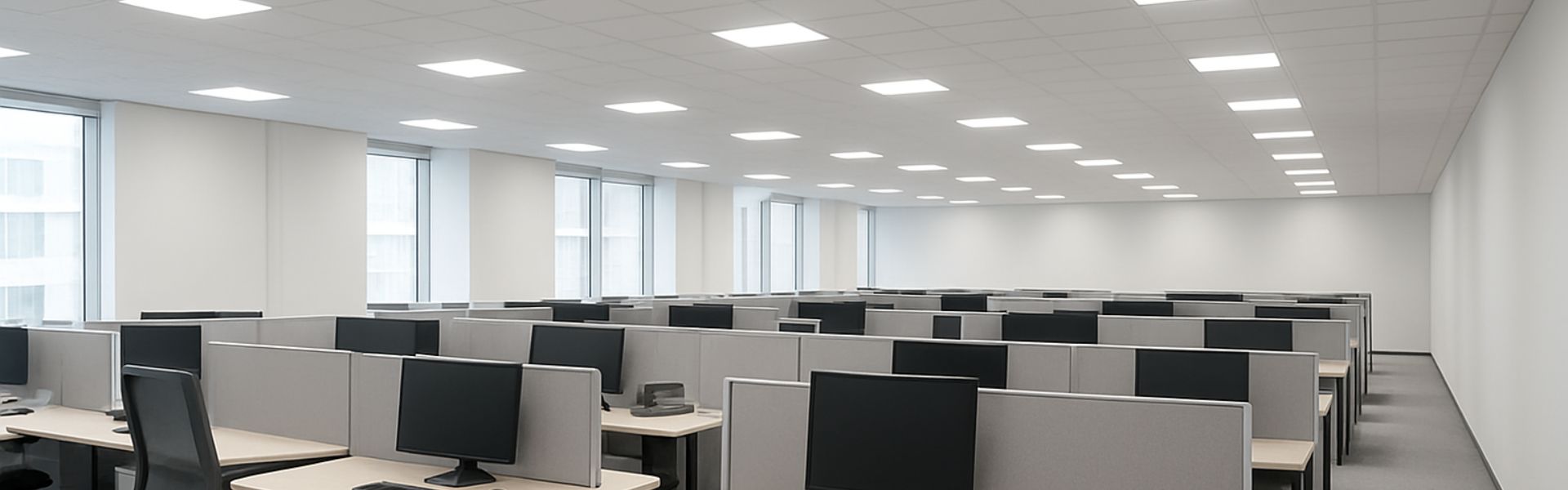
Good lighting in offices does more than help people see clearly. It shapes comfort, productivity, and how welcoming a space feels. A well-lit office can boost concentration, reduce fatigue, and make teams feel more alert throughout the day. It can also improve tenant satisfaction and help building owners control energy use without compromising quality.
Understanding Light Levels
“Light level” refers to the illuminance on a surface, measured in foot-candles (fc) in the U.S. and lux internationally. One foot-candle equals 10.76 lux.
Most office environments fall between 30 and 50 foot-candles (300 to 500 lux) at the workplane, which is the surface where people perform tasks such as reading or typing. Too little light can cause strain and lower focus, while excessive brightness wastes energy and increases glare.
Typical Office Zones and Challenges
Each area in an office has unique lighting needs based on how it is used:
- Open Work Areas: Uneven brightness, dark partitions, or overly bright fixtures can make spaces feel inconsistent.
- Private Offices: Require more control of brightness and glare, especially near windows and computer screens.
- Conference Rooms: Need flexible light levels for meetings, video calls, and presentations.
- Corridors and Stairwells: Prioritize visibility and safety while avoiding excessive illumination.
- Breakrooms, Copy Rooms, and Restrooms: Require comfortable, even light that supports cleanliness and visual comfort.
Rule of Thumb for Contractors:
In a typical office with an 8 to 9 foot ceiling and standard white ceiling tiles, an average of 30 to 50 foot-candles can often be achieved using 2x2 LED flat panels spaced approximately 8 to 10 feet apart on center. For 2x4 panels, the same light level is reached with roughly 10 to 12 feet spacing.
Many modern fixtures now include power-selectable output options, allowing you to fine-tune light levels during commissioning. By starting with this spacing and adjusting fixture output as needed, contractors can quickly achieve balanced illumination without extensive photometric modeling.
Benefits of Meeting Proper Light Levels
When lighting is properly designed, it benefits everyone involved in the project. Contractors can complete installations faster with fewer adjustments and fewer callbacks. Property managers receive fewer complaints because consistent lighting eliminates dark spots and glare. Building owners gain from lower utility costs, fewer maintenance cycles, and happier tenants who value a professional, comfortable workspace.
The right light levels also help fixtures perform at their best. LEDs that run at proper output levels last longer and maintain color quality over time. Combining well-planned lighting layouts with smart controls such as dimmers and occupancy sensors can further reduce energy use while keeping the space bright and productive.
Recommended Office Light Levels
Below are typical illuminance targets for office spaces. These values align with guidance from the Illuminating Engineering Society (IES) Lighting Handbook, 10th Edition, and IECC 2021 Lighting Power Density (LPD) tables.
| Room Type | Light Level (Foot-Candles) | Light Level (Lux) | IECC 2021 LPD (W/SF) |
|---|---|---|---|
| Open Office | 30-50 FC | 300-500 lux | 0.61 |
| Private Office | 30-50 FC | 300-500 lux | 0.74 |
| Training Room | 30-50 FC | 300-500 lux | 0.71 |
| Conference Room | 30-50 FC | 300-500 lux | 0.97 |
| Lobby / Reception | 20-30 FC | 200-300 lux | 0.84 |
| Corridor | 5-10 FC | 50-100 lux | 0.41 |
| Stairway | 5-10 FC | 50-100 lux | 0.49 |
| Breakroom / Lounge | 10-30 FC | 100-300 lux | 0.59 |
| Restroom | 10-30 FC | 100-300 lux | 0.63 |
| Mechanical / Electrical Room | 20-50 FC | 200-500 lux | 0.43 |
| Storage Room | 5-20 FC | 50-200 lux | 0.38 |
Recommended light levels summarized from the Illuminating Engineering Society (IES) Lighting Handbook, 10th Edition, and IECC 2021 Lighting Power Density tables.
Measuring and Verifying Light Levels
Testing light levels confirms that the design works as intended. The process is simple with a light meter and a consistent method.
- Use a calibrated light meter with at least ±2% accuracy.
- Turn on the lighting system and allow it to stabilize for 10 to 15 minutes.
- Disable automatic dimming or daylight sensors during testing.
- Measure at workplane height, typically 30 inches above the floor.
- Create a grid, such as 2 feet by 2 feet, and take readings across the area.
- Record average, minimum, and maximum values.
- Calculate uniformity using minimum divided by average. General office target: 0.6 or higher. Corridor target: 0.5 or higher.
Reaching Target Light Levels with Fixture Design
Most office areas require about 30 to 50 foot-candles, and there are two main strategies to achieve that level.
1. Uniform Grid Approach
Using the same fixture type across the entire space provides consistency and minimizes maintenance costs. This approach works best in large open offices where layout simplicity and predictable results are priorities.
Recommended fixture types:
2. Layered Lighting Approach
Combining fixture types adds visual depth and can make spaces feel more dynamic. A mix of recessed panels, downlights, and wall-mounted accent lights helps balance task and ambient lighting while creating visual interest.
Recommended combinations:
- Recessed LED Panels for general illumination
- Tunable White Recessed Fixtures for conference or private rooms where lighting needs change
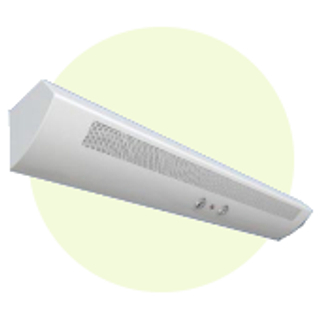
- Wall-Mounted Linear Fixtures to highlight architectural features or improve vertical brightness
Each approach has value. Consistency lowers cost and simplifies future replacements. Layering adds flexibility and supports more advanced lighting design goals.
Design Tips for Office Lighting
- Choose a 3500K to 4000K color temperature for balanced brightness and comfort.
- Integrate dimming and occupancy sensors where daylight is available to save energy.
- Review LM-79 and LM-80 data for quality assurance and accurate performance.
- Account for lumen depreciation (L70) in the design phase so light levels remain within range over time.
Long-Term ROI for Building Owners:
Lighting upgrades that meet IES standards not only enhance workspace comfort but also improve energy efficiency and property value. When paired with smart controls and high-efficacy fixtures, these systems can reduce lighting costs by up to 60%. Over time, the reduced maintenance and improved tenant satisfaction can yield measurable returns and support LEED or energy rebate goals.
Explore Office Lighting Solutions
Modern office lighting blends function and design. Whether you prefer a consistent fixture grid for simplicity or a layered approach for visual appeal, RelightDepot has the products and expertise to help you plan efficiently.
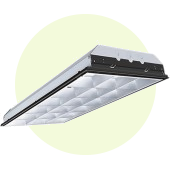
Explore our complete Indoor Lighting Collection or browse LED Troffers to find the best fit for your next project.
Related Categories
Latest Blog Updates
Westgate CMC-2Tone Series: One Ceiling Cylinder Platform, Three Sizes
A two-tone ceiling cylinder shows up on a bid set for a reason. The designer wanted a decorative dow...
High-Output Westgate SFP Series Pickleball and Padel Court Lights
Pickleball and padel courts are going in fast right now, on park district budgets, HOA amenity upgra...
Traditional Bulkhead BKH Series: One Platform, Six Field-Selectable Configurations
Bulkhead fixtures show up on more job types than most contractors give them credit for: apartment br...
Westgate UCLB Series: 120V Direct-Wire Undercabinet Lighting
Undercabinet lighting on a commercial job usually comes down to one call made early in the rough-in:...
Westgate RLB Series Low Bay: One Fixture, Selectable Wattage and CCT
One switch on top sets wattage and CCT on the RLB Series, Westgate's new selectable low bay. Pick 80...
FDLO Series Oval Flush Mount
The FDLO Series ships as a 32.5-inch oval double-ring flush mount with a field-select switch that se...