Occupancy Sensor or Vacancy Sensor: What the Energy Code Requires
The first question on any sensor spec is not the technology, it is the code. ASHRAE 90.1 and California Title 24 both require automatic lighting shutoff in most commercial spaces, and for many room types they specifically require manual-on operation, which means a vacancy sensor rather than an auto-on occupancy sensor. Manufacturer catalogs list their own sensors by model; none of them put the code decision on the category page. Here is the short version, with the usual caveat that the authority having jurisdiction and the adopted code year control the final answer.
| Space Type | Common Requirement | Why |
|---|
| Private offices, small conference rooms | Vacancy (manual-on, auto-off) | Title 24 and 90.1 favor manual-on in enclosed spaces to prevent false-on energy waste |
| Restrooms, storage, break rooms | Occupancy (auto-on, auto-off) | Full automatic operation is generally accepted where hands-free switching matters |
| Classrooms and training rooms | Vacancy or partial-on | Partial-on brings up a fraction of lighting automatically, the rest by manual switch |
| Warehouse aisles | Occupancy with partial-off dimming | Codes increasingly require lights to drop to a low level, not full off, for safety |
| Corridors and stairwells | Occupancy with partial-off | Egress paths typically may not go fully dark while the building is occupied |
PIR, Ultrasonic, or Dual Tech: Match the Sensor to the Room
Once the control strategy is set, pick the sensing technology by room geometry rather than by brand loyalty. The three families behave differently around partitions, ceiling heights, and minor motion like typing.
| Technology | How It Detects | Best For | Watch Out For |
|---|
| PIR (passive infrared) | Body heat moving across line of sight | Open rooms, restrooms, high ceilings with lens options | Blind to motion behind partitions; minor motion range is shorter than major motion range |
| Ultrasonic | Doppler shift in reflected sound waves | Restroom stalls, cubicles, L-shaped rooms | Airflow from HVAC diffusers can cause false-on; keep away from vents |
| Dual technology | PIR plus ultrasonic in one unit | Classrooms, conference rooms, spaces where false triggers are costly | Higher unit cost; confirm which technology is required to hold lights on |
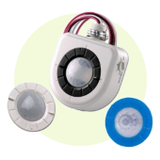
Coverage is stated per model as major and minor motion areas. Typical wall switch occupancy sensors cover on the order of 900 square feet of major motion in an open room; ceiling mounted units extend that with 360 degree lenses and are the right call for warehouses, gyms, and open offices. Always check the minor motion figure for desk work areas, since a sensor that only sees walking motion will time out on a room full of people typing.
Wall Switch Motion Sensor Switches
The fastest retrofit in the building is replacing a standard toggle with a motion sensor light switch. Wall switch occupancy and vacancy sensors install in the existing box, need no ceiling wiring, and immediately capture savings in offices, restrooms, and conference rooms. Check three things before ordering: whether the model requires a neutral conductor, the load types it supports (LED and electronic ballast loads are the norm now), and whether you need single pole or 3-way compatible units for multi-entry rooms.
Photocells and Rebates
For exterior automation, photocell controls switch on outdoor fixtures at dusk, with shorting cap and twist-lock NEMA options for area lights; see Photocell Controls. Occupancy sensors are also a standard utility rebate measure, so keep model numbers and spec sheets from the product pages for the incentive application. Browse indoor models under Occupancy Sensors, pair them with Dimmers for partial-off strategies, or see Switches and Smart Wiring Devices to complete the controls package.