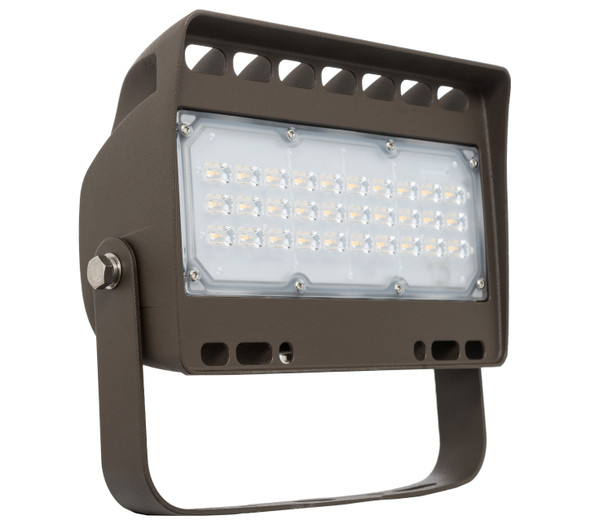
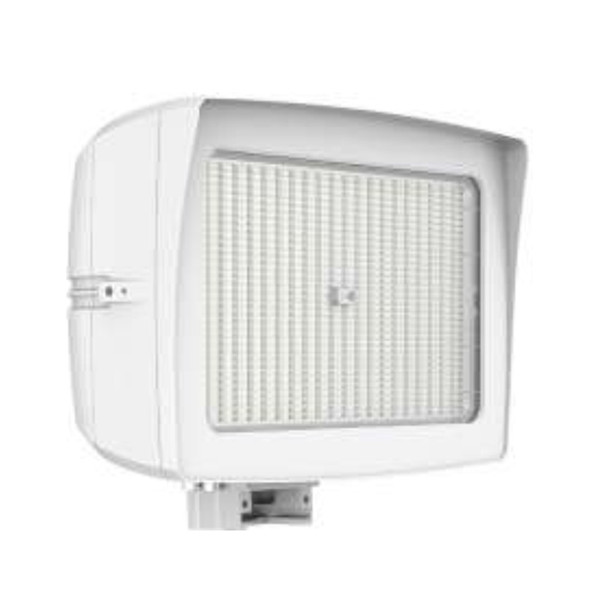
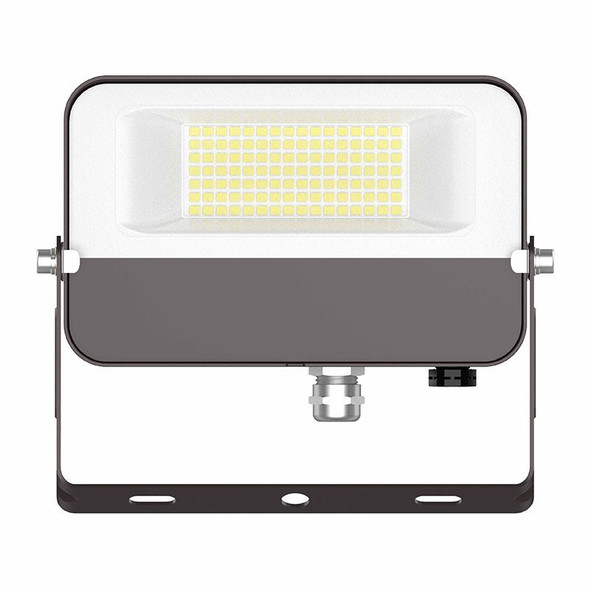
Outdoor Flood Lights Selected by Target, Not by Wattage
Most flood light listings ask you to pick a wattage and hope. That works until the fixture is 30 feet up a pole and the pavement below it is still dim. The faster path is to start from what you are lighting: the mounting height, the throw distance to the target, and the footcandle level the application needs. The tables below cover that selection math, then the mounting hardware that puts the beam where you aimed it.
Lumen Output by Mounting Height
Use mounting height as the first filter. These ranges assume a single fixture covering a typical target area; large areas at wide spacing need more fixtures, not just more lumens per fixture.
| Mounting Height | Lumen Range | Typical Applications |
|---|
| 8 to 12 ft | 3,000 to 7,000 lm | Entries, walkways, small signs, accent on low facades |
| 12 to 20 ft | 7,000 to 15,000 lm | Building facades, loading areas, small lots |
| 20 to 30 ft | 15,000 to 30,000 lm | Parking areas, storage yards, perimeter security |
| 30 to 40 ft | 30,000 to 60,000 lm | Large lots, truck courts, multi-fixture pole tops |
| Over 40 ft | 60,000 lm and up | High mast and sports applications; see the high mast category |
Beam Angle by Throw Distance
A flood light aimed at a distant target wastes most of a wide beam. Match the beam spread to how far the light has to travel and how large the target is.
| Beam Angle | Throw | Best For |
|---|
| Narrow spot, 15 to 30 degrees | Long throw, 50 ft and beyond | Flag poles, steeples, signage lit from ground level |
| Medium, 30 to 60 degrees | Mid throw, 20 to 50 ft | Facade sections, trees, monument features |
| Wide flood, 60 to 120 degrees | Short throw, area coverage | Parking, yards, security zones, general area light |
For parking and security work, plan around IES-style targets of roughly 1 to 5 footcandles maintained on the pavement, with the higher end for active vehicle areas and the lower end for perimeter zones. Facade and sign work is judged by uniformity across the surface rather than a single footcandle number, which is where beam choice matters most.
Knuckle, Yoke, or Slipfitter: Matching the Mount to the Install
The same LED flood lights often ship with a choice of bracket, and the wrong one adds a field trip. Knuckle mounts thread onto a junction box or ground stake and pivot for aiming, which suits ground-mounted facade and landscape-scale floods. Yoke and trunnion mounts bolt flat to a wall, canopy, or pole cross-arm and lock the aim with a fixed bracket, the standard choice for wall and surface installs. Slipfitter mounts slide over a 2-3/8 inch pole tenon, making them the default for pole-top area and yard lighting. Dedicated hardware for cross-arms, tenon adapters, and wall brackets is in Flood Light Mounting Brackets.
LED Flood Lights by Application
Facade and architectural work favors medium beams, 3000K to 4000K color, and fixtures placed to grade the light evenly up the surface. Signage is a linear problem: for wide sign faces, purpose-built fixtures in Sign Lights and Linear Flood Lights give better uniformity than a single point-source flood. Parking and area coverage at pole height overlaps with Area Lights and Shoebox Fixtures, which trade the aimable bracket for engineered distribution patterns. For fields and very tall poles, step up to Sports Lighters and High Mast Lights.
Contractors replacing HID floods should verify circuit capacity before a one-for-one swap; an LED unit delivering equal light typically draws 40 to 60 percent of the HID wattage, but inrush characteristics differ from ballast-driven loads. IP65 or IP66 wet-location ratings and 120-277V drivers are standard across most commercial-grade units, with 0-10V dimming on spec-grade models.
Flood Lights with Photocells and Motion Sensors
Dusk-to-dawn photocells suit perimeter and yard fixtures that should run all night. A floodlight with a movement sensor fits security zones where light on demand is the point: the fixture holds at off or a dim standby level, then drives to full output on detection. Many commercial units accept a twist-lock photocell receptacle, sensor, or shorting cap on the same fixture, so the control choice can be made per location rather than per model. Standalone controls are in Photocell Controls, and dedicated motion-activated fixtures are in Motion Sensor Lights.