Parking garages are lighting workhorses. Decks, ramps, stairwells, and entry canopies all run 12 to 16 hours a day, sometimes 24, and the fixtures doing that work are often 20 year old HID. This guide covers what to replace, how to meet IES RP-20 (Lighting for Parking Facilities) and ASHRAE 90.1, which controls move the needle, and how to capture DLC utility rebates on the retrofit. For a full overview of commercial lighting applications, see the RelightDepot Commercial Lighting hub.
Why Parking Garage Lighting Matters
Outdated lighting in a parking facility creates three problems at once: safety, energy cost, and maintenance cost. Old HID fixtures consume 300 to 400 watts each, take minutes to warm up, flicker as they age, and burn out on a two to four year cycle. A 200 fixture garage on HID can run $30,000 to $42,000 a year in electricity alone, before a single bulb change.
LED technology changes the economics. Modern LED fixtures cut parking garage energy consumption by 50 to 70 percent compared to HID, turn on instantly, provide better color rendering, integrate with occupancy and daylight controls, and qualify for DesignLights Consortium rebates through most utilities. The rest of this guide walks through fixture selection, code compliance, controls, and ROI.

Parking Areas and Lighting Challenges
Not every zone in a parking structure needs the same fixture. Each area has its own mounting height, exposure, and use pattern.
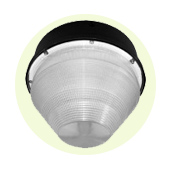
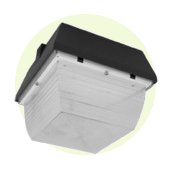
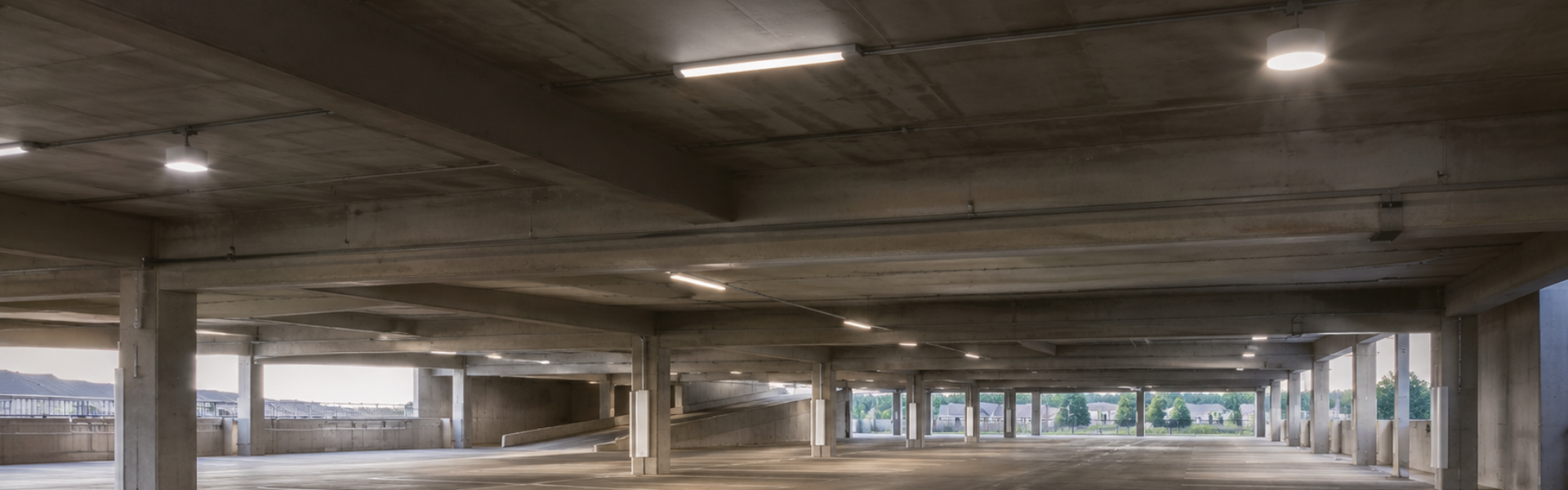
Covered parking decks are the bulk of most garages. They need consistent overhead lighting to eliminate shadows for drivers and pedestrians. LED garage fixtures or linear high bays mount flush or semi recessed and deliver even, flicker free illumination.
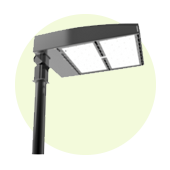
Open air and rooftop lots are exposed to weather and ambient light. Pole mounted area lights or wall packs work best here, sized for the mounting height and pole spacing. Durability and a wet location rating are non negotiable.
Entrance and exit transitions require careful light level stepping. Drivers coming in from bright daylight need a transition zone where eyes adapt; drivers exiting at night need the opposite. IES RP-20 provides transition zone recommendations for stepping light levels over the entry and exit distances.
Stairwells and pedestrian paths carry a life safety lighting requirement. Dedicated stairwell fixtures combined with emergency battery backup lighting keep you compliant with NFPA 101. See the Stairwell Lighting Guide for code details and fixture recommendations.
Canopies and ticket booths are focal points for users. Canopy lights or surface mounted fixtures with good glare control keep entry lanes and the pay booth as bright as the deck around them.
EV charging stalls are a new zone in most retrofits. Reliable illumination at the charger and task lighting for cable connections keep drivers from fumbling for the charge port in the dark.

Recommended Parking Garage Fixtures
For covered decks and general parking areas, LED garage fixtures in the 80 to 150 watt range replace 250 to 400 watt HID one for one. Look for 4000K color temperature for clarity, a minimum 70 CRI, IK08 impact rating for vandal resistance, and DLC Premium listing to maximize rebate eligibility.
Wall Packs for Garage Exteriors
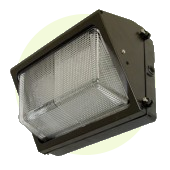
For the outside of the structure, at entry ramps, and along perimeter walls, LED wall packs mount 12 to 18 feet up and project light outward across drive lanes and adjacent sidewalks. Full cutoff models reduce light trespass onto neighboring properties and qualify for Dark Sky compliance where required.
756
Browse all Wall Packs
Occupancy Sensors for Energy Savings
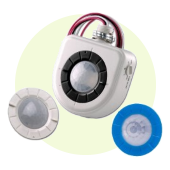
Most parking garages run at 30 to 50 percent capacity for large portions of the day. Occupancy and vacancy sensors let fixtures dim to a low level, typically 20 to 30 percent, when no one is present, then return to full output when they detect motion. Microwave sensors work best in garages because they penetrate vehicles and see motion through low partitions. Layered with daylight harvesting in open air decks, controls can add another 15 to 30 percent on top of the baseline LED savings.
974
Browse all Occupancy Sensors
Design Guidelines and Code Compliance
Parking garage lighting sits at the intersection of three standards. Getting all three right up front avoids redesign later.
IES RP-20 light levels. The Illuminating Engineering Society's recommended practice for parking facilities calls for roughly 5 foot candles average in basic parking areas and 10 to 20 foot candles in pedestrian zones and ramps, with higher levels at entry and exit transitions where adaptation is required. Confirm the figures against the current RP-20 edition before finalizing a photometric layout.
ASHRAE 90.1 controls. ASHRAE 90.1 requires automatic shutoff or dimming in parking facilities. Occupancy sensors, astronomical time clocks, and daylight harvesting all satisfy the requirement. The controls must zone at a reasonable granularity, not the whole garage on/off.
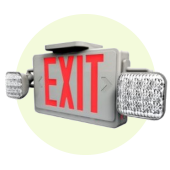
NFPA 101 emergency egress. The Life Safety Code mandates minimum illumination on the path of egress for a set duration under emergency battery power. Integrated LED fixtures with emergency backup drivers satisfy this without adding separate emergency fixtures.
Daylight harvesting. On open air and semi open decks, photocells reduce artificial lighting during daylight hours. Pair with dimmable drivers so the transition is smooth rather than stepped.
Glare and color. Use fixtures with proper shielding to reduce glare, which is both a safety hazard and a code concern in some jurisdictions. Stick to 4000K in security-sensitive areas; 3000K may read as lower contrast on older security camera systems.

ROI: 200-Fixture Retrofit Example
A 500 space covered garage running 200 fixtures of 400W HID for 12 hours a day at $0.12 per kWh costs roughly $42,000 a year in electricity. Replacing those with 150W LED fixtures drops the annual bill to about $15,700, a savings of $26,300 per year. A typical project cost of $40,000 for fixtures, controls, and labor yields an 18 month payback before rebates. Utility rebates covering 20 to 30 percent of fixture cost shorten that further, and the 10 year lifecycle savings typically clear $200,000. Numbers shift with your actual utility rate and duty cycle; request a custom ROI from our team for a site-specific estimate.
200-Fixture Retrofit: The Math
HID electricity cost: about $42,000/year. LED electricity cost: about $15,700/year. Annual savings: $26,300. Project cost: $40,000. Payback before rebates: about 18 months. 10 year lifecycle savings: $200,000+.
Get a Quote
DLC Premium fixtures paired with sensor based controls are what turn an 18 month payback into something faster once rebates land. A parking garage retrofit quote comes down to four numbers: fixture count by zone, mounting height, current wattage, and hours of operation. Send us those, and we'll turn around a fixture and control package with DLC Premium options, a rebate estimate for your utility territory, and a payback timeline you can hand to whoever signs off on the budget.
Straight one-for-one LED swap or a full retrofit with sensors and daylight harvesting layered in, RelightDepot will get you pricing and lead times fast. Contact us to get started, or reach the team directly.
Phone: 888-548-6387 Email: [email protected]