Athletic fields, courts, and recreational complexes serve their communities far beyond daylight hours, but only when the lighting system is up to the task. A poorly lit field creates safety hazards for players, frustrates spectators, and leaves a capital asset underutilized. An over-specified installation burns money that could go toward program improvements. Getting the design right means understanding your applications, the governing standards, and the fixture types that best match each zone of your facility.
This guide covers the most common sports lighting applications, IES RP-6 light level requirements, fixture selection by area, controls strategies, and the practical ROI case for LED. For other commercial and municipal applications, visit our lighting applications guide hub.
Common Sports Lighting Applications
Sports facilities typically include several distinct lighting zones, each with different target light levels, mounting requirements, and glare considerations. Designing each zone on its own terms, then integrating them into a coherent site plan, is the right starting point for any project.
Athletic Fields
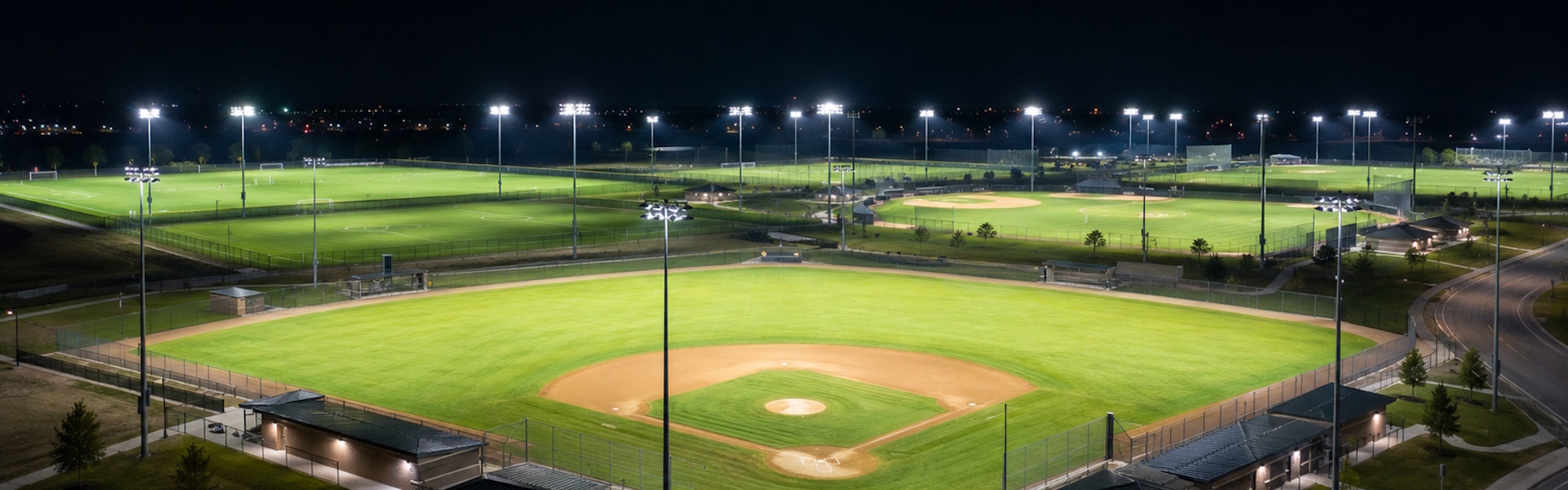
Football, soccer, baseball, and softball fields are the most demanding outdoor lighting installations. High mounting heights (typically 50 to 80 feet on poles around the field perimeter), wide coverage areas, and strict uniformity requirements all point toward purpose-built LED sports floodlights. Pole placement, aiming angles, and fixture wattage must all be coordinated through a photometric study before poles go in the ground. A full-size recreational football field typically requires 4 to 6 poles, each fitted with 4 to 6 LED sports fixtures in the 500W to 1,000W range, to reach 50 foot-candles across the playing surface.
Tennis and Pickleball Courts
Court sports require precise glare control. Players track fast-moving balls against the sky and background surfaces, so fixtures positioned above and behind the court must minimize direct glare into athletes' sightlines. LED shoebox area lights on 20 to 25-foot poles, aimed inward toward the court surface, are the standard solution for individual court lighting. IES recommends 30 foot-candles for recreational play and 50 foot-candles for club-level competitive courts.
Multipurpose Recreational Facilities
Parks and recreation departments often need a single lighting system to serve multiple sports on the same footprint: a football field that hosts flag football and soccer, or a hardcourt used for basketball, volleyball, and pickleball. Flexible fixture selection and dimmable LED controls let facility managers adjust output by sport and event type, maximizing facility use hours without proportional increases in energy cost.
Parking and Site Areas
Sports facilities generate concentrated pedestrian and vehicle traffic well after dark. Parking lots, access roads, and pathways around the facility need their own lighting plan, separate from the athletic field design. Area and site lighting on 15 to 25-foot poles covers these zones efficiently. Proper site lighting reduces liability and helps families and spectators navigate the facility safely during evening events.
Recommended Fixtures by Application
Each zone of a sports facility has different mounting requirements, coverage areas, and performance targets. Matching the right fixture type to each zone is the key to a cost-effective installation that meets light level targets without over-specifying.
Sports Field and Stadium Fixtures
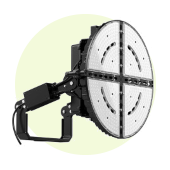
Open athletic fields need high-output LED sports floodlights on tall poles. These fixtures use precision optics to throw narrow, controlled beams across large distances with minimal spill light onto adjacent properties. A 1,000W LED sports light is the workhorse for full-size competitive fields, while 500W fixtures serve recreational fields and smaller sports complexes. DLC-listed fixtures qualify for utility rebate programs that help offset upfront installation costs.
Top-Selling LED High-Mast and Stadium Lights
791
Browse all High Mast Lights
Switching from metal halide or high-pressure sodium to LED delivers immediate and ongoing financial returns. A 1,000W metal halide stadium fixture typically draws 1,080 watts at the fixture, accounting for ballast losses. A comparable LED replacement runs 600 to 700 watts, cutting per-fixture energy consumption by 35 to 45 percent. LED fixtures reach full output instantly, with no 15 to 20-minute warm-up delay, which also enables dimming for practice sessions and full-power output for game night. Lamp life for LED sports fixtures typically exceeds 50,000 hours at L70, meaning far fewer maintenance cycles over the life of the installation.
Light poles are the other half of the equation. Courts and parking lots run on poles in the 15 to 25-foot range, which is the heart of what we stock (our pole range runs up to 39 feet). Athletic field poles in the 50 to 80-foot range require a structural engineer's foundation design and are typically sourced through specialty pole manufacturers. See our light poles and site lighting accessories for court and parking pole specifications.
Court and Hardcourt Fixtures
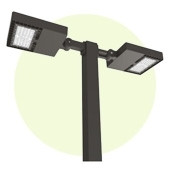
Tennis, pickleball, basketball, and multipurpose hardcourts work well with LED shoebox area lights on moderate-height poles. Adjustable-wattage models, such as the WSD Selectable LED Shoebox Light, let you set the output at installation based on the court's level of play. Position fixtures behind the baselines and sidelines to keep direct glare out of players' sightlines, and aim fixtures downward at a steep enough angle to minimize backlight spill onto neighboring properties.
LED Shoebox and Area Lights for Sports Courts
893
Browse all Area Lights and Shoebox Fixtures
Parking and Site Lighting
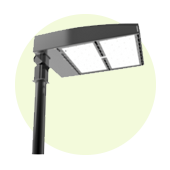
For parking lots and access roads around sports facilities, a quality LED area light on a 20 to 25-foot pole is the standard specification. Look for DLC-qualified fixtures to capture utility rebate dollars, and select a color temperature of 4000K to 5000K for good color rendition and visibility across the parking area. Controls that tie parking lighting to the game-night schedule reduce energy waste on nights when the facility is dark.
Light Poles for Parking Lots
1018
Browse all Light Poles and Accessories
Design Guidelines and Light Level Standards
The Illuminating Engineering Society publishes IES RP-6, the North American standard for sports and recreational area lighting. RP-6 specifies foot-candle targets, uniformity ratios, and glare control requirements for dozens of specific sports and facility types. Any new construction or major retrofit should be designed to meet RP-6 minimums for the applicable sport and level of play.
Foot-Candle Requirements by Level of Play
Light level requirements scale directly with the level of competition. Recreational fields serving youth leagues and casual adult programs typically need 50 foot-candles (fc) average horizontal illuminance. Scholastic and high school competitive sports call for 75 to 100 fc. College-level competitive facilities move to 100 to 150 fc. Broadcast-capable venues often target 200 fc or higher on both the horizontal and vertical planes, so cameras can focus cleanly from multiple angles. A photometric study completed before pole locations are finalized is the most reliable way to confirm your design hits the target before construction begins.
Uniformity Ratios
RP-6 specifies maximum-to-minimum uniformity ratios for each sport. A ratio of 3:1 or better (meaning the brightest measured point is no more than three times brighter than the darkest) is typical for recreational fields. Competitive facilities tighten this to 2:1. Poor uniformity creates visual fatigue for players and makes video production difficult, even when average foot-candle levels look adequate on paper.
Glare Control and Spill Light
Glare from sports lighting affects athletes, spectators, and surrounding neighbors. Modern LED sports fixtures address this through precision optical design: narrow-beam distributions for tall poles, BUG (backlight-uplight-glare) ratings that quantify spill light in each direction, and full-cutoff housing designs that eliminate upward light waste. For facilities near residential areas, the BUG rating is often specified in the zoning or site permit. Verify your fixture's BUG rating matches the site requirements before ordering.
Color Rendering and Color Temperature
A minimum CRI of 70 is acceptable for recreational sports lighting, but any facility that hosts video recording or broadcast-level competition should specify LED sports floodlights rated at CRI 90 or higher. Higher CRI makes team uniform colors accurate on camera and improves contrast between the ball and playing surfaces under artificial light. A 5000K color temperature (cool daylight) is the standard choice for outdoor sports applications: it reads as clean white light, supports player visibility, and pairs well with the natural daylight color that athletes are accustomed to during daytime play.
Controls and Energy Management
LED sports lighting delivers its best financial returns when paired with controls that match output to demand. A well-controlled system reduces energy consumption on off-peak nights, extends fixture life, and eliminates the "lights left on all night" problem common at facilities that rely on manual switching.
Photocell controls automate on/off based on ambient light levels. Field lights activate at dusk and shut off at a set time without manual intervention. This is a low-cost upgrade with an immediate impact on energy bills for any facility that currently relies on manual switching.
Time-clock and scheduler controls let facility managers program lighting for specific game and practice windows. A typical high school athletic program might schedule lights for Monday through Friday from 5 PM to 10 PM and Saturday from 8 AM to 6 PM, with the control system handling on and off automatically.
Dimming for multi-use scenarios is one of the defining advantages of LED over HID. Metal halide fixtures cannot dim effectively. LED sports lights can step from 100 percent output for game night down to 50 percent for a practice session, with no warm-up delay between states. This also means you can bring lights up instantly if a game runs long, without waiting for HID re-strike time.
Wireless control systems let facility managers adjust zones, monitor energy consumption, and receive fault alerts through a web interface. For parks departments managing multiple facilities across a city, this kind of remote visibility is increasingly standard and practically pays for itself in staff time savings alone.
Utility rebates apply to most DLC-listed LED sports lighting products. Rebate amounts vary by utility, but in many markets they offset 20 to 40 percent of the fixture cost. Combined with the energy savings from the fixture itself, the simple payback period on a well-designed LED sports lighting project typically falls in the 3 to 6-year range.
Plan Your Sports Lighting Project with RelightDepot
The RelightDepot team works with municipal parks and recreation departments, school athletic directors, and electrical contractors on sports lighting projects across the country. We carry the fixtures, poles, and controls you need for a complete athletic facility installation, and we can help you match products to your project's foot-candle targets, pole heights, and budget.
Call us at 888-548-6387, email [email protected], or visit our Contact Us page to discuss fixture selection, pole specifications, and product availability for your project. You can also browse our full outdoor lighting catalog to explore the complete range of sports and athletic facility lighting products.