Electrical Conduit Fittings, Organized by System
Every conduit fitting question starts the same way: which raceway system are you running, and what does the connection need to do? The matrix below crosses the four common systems against the connection types, so you can go straight from the print to the parts list. All standard trade sizes from 1/2 in through 4 in are covered in this category.
| Conduit System | Joining Runs | Entering a Box or Enclosure | Wet Location Choice | Notes |
|---|
| EMT | Set-screw or compression couplings | Set-screw or compression connectors with locknuts | Raintight compression fittings, listed for wet locations | The workhorse of light commercial interiors; set-screw is fine indoors, compression where vibration or moisture is a factor |
| Rigid / IMC | Threaded couplings; three-piece (Erickson) couplings where neither pipe can turn | Threaded hubs, or locknut and bushing at knockouts | Threaded hubs with sealing rings (Myers style) | Threads are the standard for industrial and exterior work needing maximum physical protection |
| PVC | Solvent-weld couplings | Terminal adapters, male or female | Solvent-welded joints are inherently sealed; use listed expansion fittings on long exposed runs | The direct-burial and concrete-encased standard for site and landscape circuits |
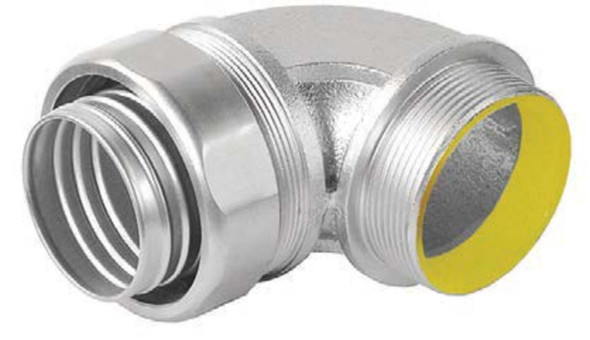
| Liquidtight flex | Not typically coupled; run in continuous lengths | Liquidtight connectors, straight and angled | Liquidtight connectors listed for wet locations | The final connection to motors, HVAC equipment, transformers, and vibrating gear |
Beyond the matrix, this category carries the completion hardware every conduit job consumes: locknuts, grounding and insulated bushings, chase nipples, reducing washers, squeeze connectors for flexible metal conduit, and elbows in standard sweeps.
NEC Notes That Save an Inspection
Three code points account for most fitting-related red tags. First, wet locations: fittings installed outdoors or in washdown areas must be listed raintight or wet location rated, which in practice means compression-type EMT fittings or threaded hubs, not set-screw hardware. Second, grounding continuity: metallic conduit usually serves as the equipment grounding path, so fittings must be made up tight, and concentric or eccentric knockouts may require bonding bushings or jumpers to maintain the path. Third, conductor protection: where conductors 4 AWG and larger enter an enclosure, the NEC requires an insulated throat fitting or insulating bushing to protect insulation at the entry.
Choosing Between Set-Screw and Compression
For dry interior EMT work, set-screw fittings install faster and cost less, which is why they dominate tenant buildouts and lighting circuits. Compression fittings earn their premium in three situations: damp or wet locations where raintight listing is required, installations subject to vibration, and anywhere the AHJ requires concrete-tight construction. Steel fittings take rough service better; die-cast zinc runs cheaper for volume interior work. When a job crosses systems, for example PVC risers transitioning to EMT overhead, transition couplings in this category bridge the two without improvised stacking of adapters.
Boxes and Support to Finish the Raceway
Fittings terminate into boxes, so spec them together. Browse Metallic Boxes and Accessories for interior conduit work and Plastic Boxes for nonmetallic systems. Outdoor terminations pair raintight fittings with our Weatherproof Boxes and In-Use Covers, the companion category for any wet location circuit. Straps, hangers, and rod hardware are in Raceway Support and Box Positioning, and the full department is at Boxes and Fittings. Buying fittings by the box for a project? Ask for contractor volume pricing on the sizes your takeoff calls for.