A light pole order is an engineering check wrapped in a purchase: will this pole carry these fixtures in the wind this site actually sees? Answer that with the EPA math below, pick the mounting style, and the rest of the specification falls into place. Get it wrong and the failure mode is not a returned fixture, it is a pole on the ground.
How to Match Light Poles to Fixture EPA and Wind Zone
Every luminaire, arm, and bracket has a published EPA, or effective projected area, in square feet. Every pole carries manufacturer EPA ratings at specific wind speeds, typically 90, 100, 110, and 130 mph, derived from AASHTO criteria and the ASCE 7 wind maps that set your site's design wind speed. The check is one line of addition: total the EPA of everything mounted on the pole and compare it to the pole's rating at your wind speed.
Worked example: a site plan calls for two shoebox area lights at 1.0 sq ft EPA each on a twin arm rated at 0.8 sq ft, a total of 2.8 sq ft. A 25 ft square steel pole rated for 7.0 sq ft at 110 mph carries that load with margin. Move the same package to a 150 mph coastal zone and the pole's rating can drop below 3 sq ft, which turns a comfortable spec into a marginal one. These figures are illustrative; confirm against the specific pole's rating sheet and your jurisdiction's design wind speed before ordering.
Anchor Base or Direct Burial
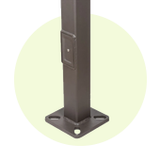
Anchor base poles bolt to a poured concrete foundation using an anchor bolt set and template, which allows precise leveling, straightforward future replacement, and installation on finished sites. Order the anchor bolts with the pole so the template is on site before the pour. Direct burial poles skip the foundation entirely; the common embedment rule of thumb is 10 percent of pole height plus 2 feet, so a 25 ft pole buries roughly 4.5 ft, subject to soil conditions. Sandy or disturbed soils, high water tables, and deep frost lines all push the decision back toward an engineered foundation.
Pole Height and Material at a Glance
| Mounting Height | Typical Application | Common Materials |
|---|
| 10 to 15 ft | Walkways, pedestrian areas, small lots | Aluminum, fiberglass |
| 20 to 25 ft | Parking lots, campus drives, commercial frontage | Steel, aluminum |
| 30 to 39 ft | Large parking fields, roadways, auto dealerships | Steel |
Material choice in one paragraph: steel delivers the most EPA capacity per dollar and dominates at 20 ft and above; aluminum shrugs off corrosion without paint and suits coastal and pedestrian-scale work; fiberglass is light, non-conductive, and easy to handle on remote sites. The full trade-offs live on our steel light poles, aluminum light poles, and fiberglass light poles pages.
Order the Pole and the Luminaire as One Package
A light pole is only half an order. Pair the pole with its luminaire at order time so the drilling pattern, tenon size, and EPA all reconcile before anything ships. Shoebox fixtures pair with square straight poles for parking lots; roadway fixtures ride round tapered poles with slip-fitter tenons. Browse area lights and shoebox fixtures and street lights and cobraheads to build the pairing. And if your drawings call the same product a light post or a lamp pole, no matter; the selection logic for outdoor pole lights is identical whatever the site plan names it.
Accessories and Foundation Hardware
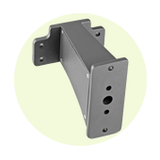
Anchor bolt sets, base covers, tenon adapters, cross arms, and vibration dampers complete the order. Dampers earn their line item on open, windy sites and on single-fixture poles, where vortex shedding does slow damage that shows up years later as cracked welds. Keep hand-hole covers and spare base covers on the order too; they are the parts that go missing between delivery and energization. Everything lives in light pole accessories.
Send the site plan and fixture schedule and we will quote a matched pole and luminaire package, anchor bolts and freight to the job site included.