Sign Lights Sized to the Sign, Not the Other Way Around
Every sign lighting question an installer actually has reduces to three numbers: how many fixtures, how far apart, and how long an arm. Start with the spacing table, then pick the fixture family. As a working rule, plan one fixture for every 3 to 4 feet of sign width for even coverage without scalloping between beams.
| Sign Width | Fixture Quantity | Placement |
|---|
| Up to 4 ft | 1 | Centered above the sign |
| 4 to 8 ft | 2 | Set in from each end about a quarter of the sign width |
| 8 to 12 ft | 3 | Evenly spaced, roughly one per 4 ft of width |
| 12 to 16 ft | 4 | Even spacing; step up to linear bars if arms crowd the fascia |
| Over 16 ft | 1 per 3 to 4 ft | Continuous linear sign lights usually beat multiple heads here |
Arm length follows sign height. The head needs enough projection to aim the beam center at the middle of the sign face at roughly 30 to 45 degrees; for most wall signs that means an arm about one third to one half the sign height. A 4 ft tall sign lights evenly from an 18 to 24 in gooseneck arm, while a shallow 2 ft fascia sign only needs a short-projection fixture. Too short an arm grazes the top of the sign and leaves the bottom dark; too long flattens contrast and throws spill past the sign edges.
Gooseneck Lights
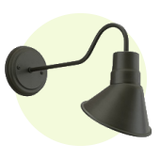
The gooseneck light is the storefront classic: a curved arm off the wall with an angled shade that puts a controlled pool of light on the sign and adds daytime character to the facade. Goosenecks suit narrow signs, building nameplates, and brand-forward storefronts where the fixture is part of the look. Most models in our Gooseneck Sign Lights range mount to a standard junction box, run on 120 to 277V, and take photocell control for dusk-to-dawn operation. Westgate, one of the core brands we distribute, fields a deep gooseneck and LED sign lighting lineup; browse the Westgate brand page for the full family.
Monument Signs vs Wall Signs: Pick the Optic First
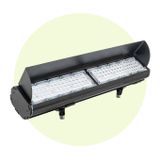
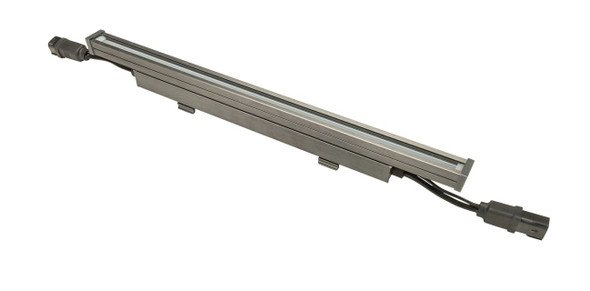
Ground-set monument signs and building-mounted wall signs need different beams. A monument sign is lit from below or from the landscape strip in front of it, which calls for a linear flood light with a wide, rectangular pattern that covers the full face from a short throw, or ground-mounted floods aimed up. A wall sign is lit from above, where downward-aimed goosenecks or top-mounted Linear Sign Lights give even coverage and keep the light source out of drivers' eyes. Channel-letter and cabinet signs with internal illumination need neither; for those, exterior sign lights only fill in during outages or add facade accent. For CCT, 4000K to 5000K produces the best contrast on printed and painted sign faces.
Light Trespass and Dark-Sky Notes
Sign lighting draws complaints when beams overshoot the sign. Downward-aimed, top-mounted fixtures are the dark-sky preferred arrangement because spill lands on the building, not the sky. Where fixtures must aim upward at a monument sign, use tight optics, shields, and the shortest throw available, and confirm the local ordinance; many municipalities cap sign luminance and require lights out after business hours. A photocell plus timer combination from Photocell Controls handles curfew schedules automatically.
This category sits inside Flood Lighting; for wider area coverage beyond the sign, see Outdoor Flood Lights, and grab arms and knuckles in Flood Light Mounting Brackets. Lighting a full storefront or a franchise rollout? Send the sign schedule and we will quote fixtures, arms, and controls per elevation.