
Product Spotlight: ATG’s Field Adjustable Flush Mount Luminaire (FLT Series)
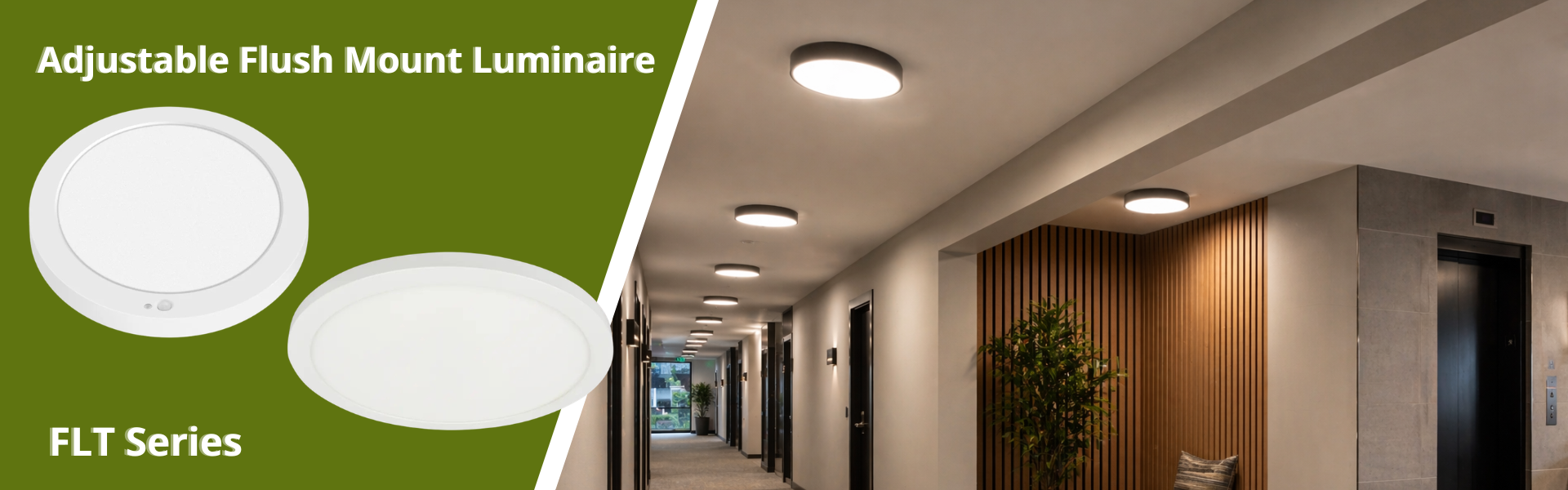
Flush mount fixtures like the FLT Series are built for projects where clean surface-mounted lighting has to work within existing ceiling conditions, limited rough-in flexibility, and fast turnover schedules. Corridors, stairwells, multifamily common areas, hospitality back-of-house, and renovation packages all create the same problem: the ceiling condition is already deciding the fixture before procurement starts.
The value is not appearance. It is flexibility when field conditions stop matching the drawings. Existing junction boxes shift, ceiling conditions vary, and finish decisions change late. A fixture with selectable CCT, sensor options, multiple sizes, and retrofit capability reduces change orders and keeps turnover moving without introducing another fixture family.
This gets specified because it solves coordination problems, not because it is a decorative flush mount.
Why the FLT Series Stays in the Submittal Package
The 5-step selectable CCT helps when finishes change how light reads at closeout. Instead of replacing fixtures because the selected CCT no longer works in the space, crews adjust in the field and keep turnover moving.
Sensor options reduce re-submittals when occupancy requirements shift during construction. In multifamily corridors and common areas, that happens more often than most schedules admit.
Surface mount comes standard, but retrofit mounting is where the fixture earns its place. Reusing existing junction boxes without opening finished ceilings saves labor and avoids unnecessary patchwork. That only works if latch requirements are confirmed early.
The 5-inch, 7-inch, 9-inch, and 12-inch sizes keep fixture families consistent across different spaces. Since emergency configurations are only available on the 7-inch and 9-inch sizes, fixture layout has to align with the required egress locations before approval. The same applies to wet location listings and TRIAC dimmer compatibility. These are not details to solve at closeout. They need to be resolved before procurement, while substitutions and corrections are still manageable.

Technical Performance That Matters on Site
The FLT Series runs on standard 120V input and covers 8W to 24W output, which fits corridor, stairwell, and common-area applications where these fixtures are typically specified. The goal is to maintain one fixture family across multiple spaces without creating inconsistency.
The precision optical stack and frosted polycarbonate lens matter because repeated fixtures expose poor uniformity fast. In corridors and stair towers, uneven diffusion shows before anyone asks about lumen output.
With 80+ CRI and selectable CCT from 2700K to 5000K, the fixture provides sufficient range to serve both service spaces and resident-facing areas without requiring separate SKUs.
ETL wet location listing, Energy Star, FCC, and RoHS compliance support covered exterior corridors, breezeways, and procurement requirements where inspectors and ownership teams are checking compliance, not aesthetics.
The 100,000-hour rated life matters after turnover. Long life does not remove maintenance, but it reduces how often teams reopen ceilings for routine replacement. That is where the spec proves its value.
Mounting and Installation Conditions Before Approval
Most FLT Series approval issues stem from assumptions about existing conditions. Plans may show a standard junction box layout, but renovation work rarely matches what is above the ceiling.
Surface mount solves a lot, but only if the box location, ceiling condition, and finish tolerance are verified early. If crews are reusing existing openings, the retrofit mount and extra latch requirements need to be confirmed before release. That is where late substitutions usually start.
The steel bracket and quick connectors help during installation, but they do not fix bad field verification. If the ceiling is uneven or patched poorly, the fixture will show it. Most delays come from approving the fixture before confirming what it is actually mounting to.
Emergency Units, Sensors, and Controls
Late control changes create more rework than fixture failures. The FLT Series offers integral PIR sensor options, which helps when occupancy requirements shift during construction or owner review. That flexibility matters most in corridors, stairwells, and covered exterior paths where controls are often adjusted late.
Emergency unit availability is limited to the 7-inch and 9-inch sizes, so fixture selection has to align with required egress locations early. This is not something to solve during closeout.
TRIAC dimmer compatibility also needs to be checked upfront. If a dimming scope is assumed without confirming controls, replacement work follows, especially on hospitality and multifamily common area projects.

What Contractors Watch During Rough-In and Finish
Once install starts, consistency matters more than the fixture itself. Repeated fixtures across corridors and common areas expose alignment issues fast. A small box shift may pass rough-in, but once trims are in, uneven spacing becomes a visible punch item.
Sensor placement also matters. Fixtures placed too close to doors, diffusers, or constant movement zones create false triggering that usually shows up after occupancy, not during install. Inspectors check listing, wiring, and code compliance. Owners notice crooked fixtures, mismatched trims, and lens inconsistency across finished spaces. That is where correction costs rise.
Maintenance After Turnover
After turnover, speed matters more than perfect spec matching. If a fixture can be opened, serviced, and replaced without disturbing finished ceilings, maintenance stays simple. If not, even a minor driver or sensor issue turns into unnecessary labor.
Standardizing sizes, trims, and sensor configurations across corridors and common areas reduces downtime fast. Maintenance teams want one fixture family they can stock, replace, and move on from.
Emergency unit servicing follows the same logic. Since emergency options are limited to the 7-inch and 9-inch sizes, planning that consistency early avoids replacement issues later. Most facility teams would rather restore operation quickly than wait on an exact match from an old submittal.
Why Contractors Standardize This Fixture Across Projects
Most contractors standardize fixtures like the FLT Series for procurement reasons, not design reasons. Fewer SKUs mean fewer ordering mistakes, cleaner submittals, and faster replacement when schedules tighten. Using the same fixture across corridors, stairwells, and common areas also simplifies closeout. Spare stock is easier to manage, maintenance teams know what they are dealing with, and future replacements stay predictable across multiple buildings or properties.
In practice, availability and mounting simplicity usually wins. If the fixture fits standard conditions, ships on time, and avoids field corrections, it stays in the schedule.

Explore FLT Series Flush Mount Luminaires at RelightDepot
RelightDepot supplies FLT Series field-adjustable flush-mount luminaires for use in corridors, stairwells, multifamily common areas, hospitality spaces, and renovation projects where clean surface mounting and fixture consistency matter. Selectable CCT, sensor options, and standard mounting compatibility help reduce field adjustments and simplify replacements after turnover.
Our team works with contractors, electricians, and facility managers to review fixture options, support submittal coordination, and assist with multi-property projects where standardization matters.
For project support or product details, email [email protected] or call 888-548-6387 to speak with a lighting specialist.
Latest Blog Updates

Westgate CMC-2Tone Series: One Ceiling Cylinder Platform, Three Sizes
A two-tone ceiling cylinder shows up on a bid set for a reason. The designer wanted a decorative dow...

High-Output Westgate SFP Series Pickleball and Padel Court Lights
Pickleball and padel courts are going in fast right now, on park district budgets, HOA amenity upgra...

Traditional Bulkhead BKH Series: One Platform, Six Field-Selectable Configurations
Bulkhead fixtures show up on more job types than most contractors give them credit for: apartment br...

Westgate UCLB Series: 120V Direct-Wire Undercabinet Lighting
Undercabinet lighting on a commercial job usually comes down to one call made early in the rough-in:...

Westgate RLB Series Low Bay: One Fixture, Selectable Wattage and CCT
One switch on top sets wattage and CCT on the RLB Series, Westgate's new selectable low bay. Pick 80...

FDLO Series Oval Flush Mount
The FDLO Series ships as a 32.5-inch oval double-ring flush mount with a field-select switch that se...