
Product Spotlight: LCEU Series European-Style Pendant Lights
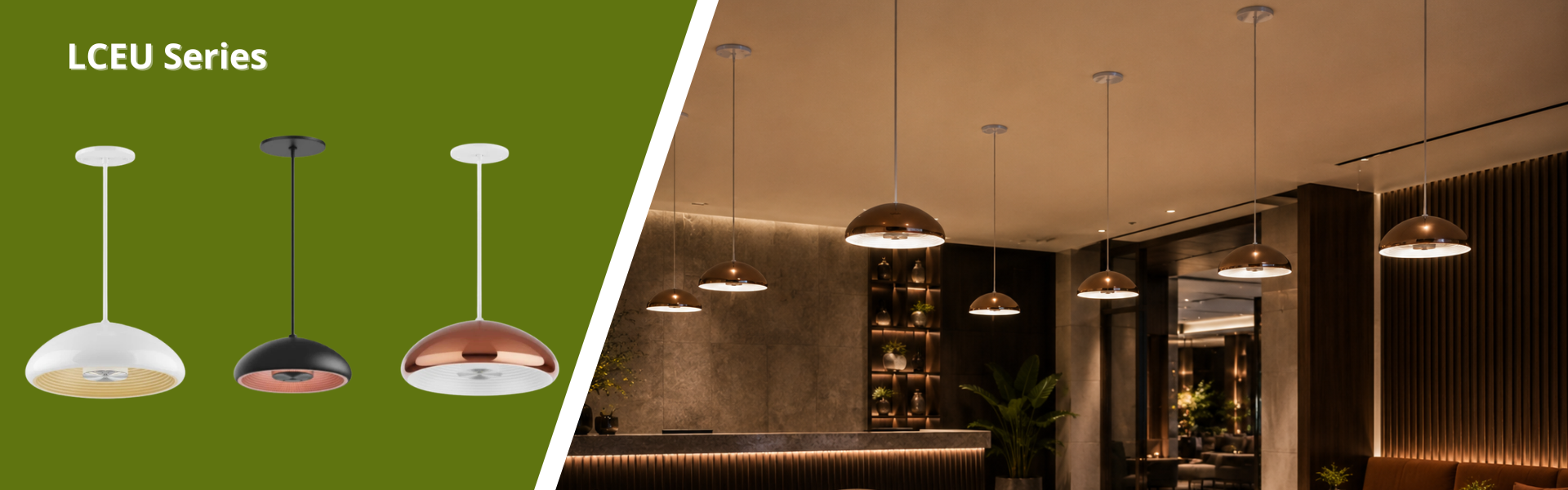
The LCEU Series is built for hospitality, lounge, retail, and reception spaces where decorative lighting stays exposed after turnover. In these projects, the fixture becomes part of the ceiling layout, finish package, and final walkthrough at the same time. Suspension height, glare, dimming response, and finish consistency all become visible once the space is energized.
Unlike decorative pendants that create harsh direct brightness or inconsistent appearance across a space, the LCEU Series uses indirect illumination to soften fixture presence at the occupant level. The suspension kit helps simplify installation across open and finished ceilings without adding coordination issues late in the job.
Why Decorative Pendants Become Coordination Issues on Commercial Projects
Decorative lighting usually gets approved early, but most issues show up after ceilings close, and systems are energized. Small height variation across repeated pendants becomes obvious in lobbies, bars, reception areas, and dining spaces. Finish variation and uneven dimming follow the same pattern.
Indirect pendants help reduce harsh brightness and reflected glare across polished surfaces and darker interiors. This becomes most noticeable during final walkthroughs when the space is reviewed under actual operating conditions. Most decorative lighting issues are alignment, dimming, glare, and finish consistency problems that only appear after installation.

What Makes the LCEU Series Practical Beyond Appearance
Most decorative pendants get value-engineered when installation risk shows up. If a fixture complicates installation or creates inconsistency after turnover, it rarely survives review. The LCEU Series stays in play because it installs cleanly and behaves predictably in the field.
The indirect distribution reduces direct glare in lounges, dining areas, and reception spaces, where visual comfort becomes a real complaint once energizing happens. The included suspension kit removes coordination steps during installation. With warm 3000K output, standard dimming compatibility, and 8-inch and 12-inch options, contractors can maintain one fixture family across multiple spaces without fragmentation. Decorative fixtures typically survive value engineering when they install predictably, dim consistently, and do not generate owner complaints after occupancy.
Browse all LCEU Series collection
Ceiling Conditions and Suspension Layout Decide the Install
Pendant layouts rarely fail on paper; they fail in the ceiling. Structural coordination, junction box placement, sprinkler runs, diffusers, speakers, and access panels all compete for space. Small deviations in rough-in become visible once fixtures are hanging in finished interiors.
Open ceilings and finished ceilings change the installation logic. In exposed structures, suspension alignment becomes part of the architectural read. In finished ceilings, spacing consistency becomes the priority. Either way, pendant fixtures expose layout drift immediately once energized.

Dimming, Glare, and What Gets Adjusted After Energizing
Most decorative lighting adjustments happen after finishes and furniture change how the space reads at night. A balanced fixture during rough-in can feel completely different once reflective materials and final interiors are in place.
Indirect distribution helps control that shift. The LCEU Series reduces direct brightness at the occupant level, which is more stable across hospitality, lounge, and reception environments. The 3000K output also stays consistent across mixed finishes without exaggerating glare. Most corrections happen through dimming and commissioning. Rewiring after turnover is rarely realistic, so adjustments are typically handled at the control level.
Inspection and Compliance Reality
Inspection is limited to compliance. Inspectors verify mounting security, junction box support, fixture listing, conductor terminations, and installation alignment with approved drawings. If dimming is included, compatibility may be reviewed depending on scope and jurisdiction.
They are not evaluating visual balance, glare behavior, or fixture spacing aesthetics. Those issues surface later during owner walkthroughs and punch.
Why Contractors Standardize Decorative Fixture Families
One fixture family simplifies execution. On hospitality and commercial interiors, consistency in finish, suspension hardware, and dimming behavior reduces coordination issues across multiple spaces.
It also simplifies turnover. Maintenance teams are not tracking multiple decorative fixture types across a property. One consistent family reduces replacement complexity and avoids mismatched fixtures after partial swaps.
From a procurement standpoint, standardization reduces schedule risk. Fewer SKUs means fewer submittal revisions, fewer substitutions, and fewer delays when lead times shift. Most contractors standardize decorative lighting to reduce coordination risk, not to improve design.

Explore LCEU Series Pendant Lights at RelightDepot
RelightDepot supplies LCEU Series pendant lights used across hospitality spaces, lounges, reception areas, restaurants, and commercial interiors where decorative lighting must align with real installation conditions.
Our team supports contractors, electricians, and facility managers with layout review, fixture coordination, and project-level selection support. For project support or product details, email [email protected] or call 888-548-6387 to speak with a lighting specialist.
Latest Blog Updates
Enerlites October Promo: Surge, TR Devices and Power Inlets Closes October 31
Enerlites has promo pricing on four devices most of us put in on every service upgrade and finish tr...
EiKO HBX3 and BAYE3 Round High Bay Promo for Warehouse and Industrial Retrofits
Most high bay retrofits start with a fixture count, not a photometric plan. Someone walks the floor,...
Specifying the LRS-O2 Wall Sconce for Entries, Breezeways, and Site Work
The LRS-O Series is Westgate's field-selectable up-and-down wall sconce platform, built for multifam...
MaxLite DSKL Series: Color-Selectable Disk Lights, One SKU for Five CCTs
MaxLite's DSKL Series Disk Light ships in two sizes on one platform: a 4 inch, 10W model and a 6 inc...
Westgate CMC-2Tone Series: One Ceiling Cylinder Platform, Three Sizes
A two-tone ceiling cylinder shows up on a bid set for a reason. The designer wanted a decorative dow...

High-Output Westgate SFP Series Pickleball and Padel Court Lights
Pickleball and padel courts are going in fast right now, on park district budgets, HOA amenity upgra...