
Top 10 Facade or Landmark Lighting Fixtures
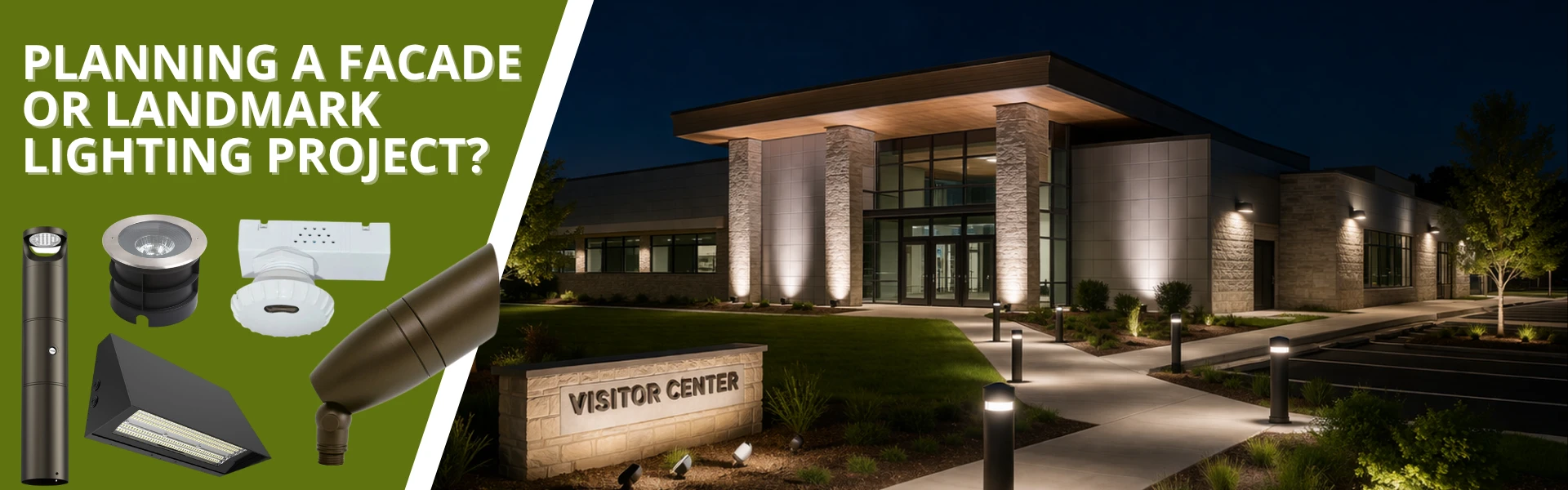
Facade and landmark lighting comes down to what installs clean, survives conditions, and integrates with existing circuits. These are the fixtures that consistently get installed on exterior projects where finish, control, and site conditions matter. They cover facade wash, perimeter lighting, pathways, and feature accents across visitor centers, historic sites, and commercial exteriors.
Selection comes down to what mounts clean, works with available power, and performs without creating issues during install or closeout. This list reflects what actually holds up from submittals through installation on real projects.
How Exterior Fixtures Actually Get Approved on Real Projects
Exterior fixtures are not chosen in isolation. They are defined in the design documents, then reviewed during submittals before anything is purchased.
Approval usually comes down to mounting conditions, output at actual install heights, and whether the fixture aligns with the specified controls and power setup. If it does not fit the site or deviates too far from the design intent, it gets returned with comments.

How Contractors Evaluate Exterior Fixtures on Real Projects
Once fixtures are specified, contractors focus on whether they will install cleanly and perform as expected in the field.
Output is checked against mounting height to avoid underlighting or overlighting. Beam spread is reviewed for spill, especially on public-facing buildings or tight property lines. Power and control compatibility must align with what is already designed or installed.
Access also matters. If a fixture creates issues for installation or future maintenance, it often leads to substitutions or field coordination before approval is finalized.
Product Breakdown: How Each Fixture Performs on Site
These fixture selections solve specific field conditions. The design team defines intent, but approval and use come down to coverage at mounting height, control compatibility, and whether the install will hold up without rework.
FLDX-RGBW (Smart App-Controlled RGBW Floodlight (Round)
The FLDX-RGBW series is used where the design calls for programmable facade lighting tied to events or branding. It typically shows up in documents when the lighting designer includes color control in the sequence.
It gets approved when it aligns with the already-specified control system. Teams avoid mixing control platforms, so compatibility matters more than features. On site, mounting height and spacing drive color consistency. Wider spacing often leads to uneven color across the facade, which gets flagged during mockups or early activation.
Installation requires coordination before the rough-in is closed. Control wiring, addressing, and fixture grouping must match the control intent. Final aiming and programming happen after energization, usually at night.
TC-FLS (Smart App-Controlled RGBW Floodlight (Square)
The TC-FLS series serves the same role as other RGB floods, but is typically selected when fixture visibility is part of the architectural review. It is often evaluated during submittals alongside elevations to confirm it does not conflict with the facade.
It is chosen when both beam control and fixture appearance matter. On flatter or more modern surfaces, tighter control can reduce spill and keep the lighting contained to the facade.
Installation follows the same path as other RGB systems. Control coordination happens early, and aiming is completed after installation. Fixture placement is often more deliberate since it may remain visible.
LFX SERIES (High Output Flood Light (White Light)
This is the baseline for facade lighting when the scope calls for consistent white light without control complexity. The LFX series is commonly carried through projects because it simplifies both submittals and installation.
It gets selected when the design intent is coverage, not flexibility. Teams avoid adding control layers when they are not required, which keeps procurement and installation straightforward.
On site, performance comes down to spacing and mounting height. Poor layout shows immediately on the facade, so installers typically adjust aiming during startup to clean up the wash.
LFXPRO SERIES (Premium Flood Light (High Performance)
The LFXPRO fixture is used when mounting heights or facade depth require more output. Instead of increasing fixture count, the design shifts to higher output units to maintain coverage.
It gets approved when it reduces fixture quantity without compromising distribution. This is often reviewed during value engineering or submittals to balance cost and performance.
Installation requires more attention to placement. Each unit carries more coverage, so misalignment is more visible. Mounting support and aiming are handled carefully to avoid hot spots.
WPCX SERIES (Wall Pack (Perimeter & Entry Safety)
This fixture is used for perimeter and service lighting where coverage needs to be reliable and repeatable. The WPCX series is often included in base building scopes and carried through without much revision.
It gets selected because it fits standard mounting and wiring conditions. It does not introduce coordination issues, which keeps procurement moving.
Installation is direct. Mounting points align with typical box locations, and controls tie into the building’s exterior lighting circuit. Performance is driven by spacing and height, which are usually defined in the plans.
WPMAX SERIES (Full Cutoff Wall Pack (No Glare / No Spill)
This fixture is used where the project requires controlled distribution. It typically appears on sites with public exposure or where spill light is a concern.
The WPMAX series gets approved based on its distribution pattern during submittals. Designers use it to keep light contained without relying on field adjustments.
Installation requires correct orientation. If mounted incorrectly, the cutoff performance is compromised. Contractors pay attention to alignment during installation to maintain the intended distribution.
BOL-G4 SERIES (Walkway + Landscape Accent)
This BOL-G4 series carries light across pedestrian areas where building-mounted fixtures do not provide coverage. It is typically laid out in site plans before construction begins.
It gets selected based on spacing and layout, not individual output. Designers define placement to maintain consistent coverage across paths and plazas.
Installation is tied to site work. Conduits and bases are set before concrete placement. Once installed, adjustments are limited, so layout accuracy is critical.
IGLC SERIES (In-Ground Uplight (Architectural Highlighting)
This fixture is used where the design calls for concealed uplighting. The IGLC series is common for columns and facade elements where visible fixtures are not acceptable.
It gets selected early because it requires coordination with structural and site work. Placement is fixed once concrete is poured.
Drainage and housing placement are critical. Poor coordination leads to long-term failures, which is why these details are typically reviewed before installation begins.
Landscape Spotlight Series (Trees, Signs, Features)
Landscape spotlights are used for targeted lighting where adjustability is needed after installation. It is common for signage, planting areas, and feature elements.
It gets selected because the final aiming can be adjusted without rework. This is useful when exact focal points are not finalized until late in the project.
Installation depends on site conditions. Fixtures are mounted on grade and adjusted after energization to align with surrounding lighting.
Photocell + Controls Accessories
These controls handle switching across exterior lighting systems. They are included in electrical plans and tied into multiple fixture types.
They get selected based on the control strategy defined by the engineer. The goal is consistent operation without manual intervention.
Installation requires proper placement. If the sensor detects artificial light, it can malfunction. Coordination during rough-in ensures correct function at turnover.
How These Fixtures Work Together on a Project
These fixtures do not get installed in isolation. They are layered based on function and how the site is used.
Flood lights handle the facade wash and set the visual baseline. Wall packs cover entries and perimeter zones where visibility and safety matter. Bollards define walkways and pedestrian movement. Accent fixtures pick up columns, signage, and landscape features. Controls tie everything together so the system runs without manual intervention.
On most projects, this layout is not about preference. It is about coverage, code minimums for egress areas, and how the space is actually used at night.
Installation and Coordination Considerations
Layout decisions on paper rarely hold without adjustment. Field conditions drive final placement and performance.
Access usually determines where fixtures can realistically be mounted and serviced. Aiming is handled after installation, often during night sessions or late punch, once power is live. Controls need to be coordinated early with the electrical scope to avoid rewiring or added labor. Maintenance access also matters, especially for facade fixtures mounted above grade or in hard-to-reach areas.
These factors do not show up in product specs, but they decide whether the install goes smoothly or turns into rework.

Explore Exterior Lighting Solutions at RelightDepot
RelightDepot offers a range of exterior lighting fixtures used across facade, site, and architectural applications, including flood lights, wall packs, bollards, and accent lighting. These products are typically reviewed during submittals and procurement, where output, distribution, mounting, and control compatibility are checked against project requirements.
If you are planning a facade or site lighting project, explore our exterior lighting categories or reach out for assistance.
Email [email protected] or call 888-548-6387 to speak with a lighting specialist.
Latest Blog Updates

Product Spotlight: Westgate LLVT 4ft LED Vapor Tight with Selectable Wattage and CCT
Most vapor tight jobs don't get much attention on the drawings, and they still end up causing proble...

MaxLite TRK Tunable White Troffer Retrofit Kits
Most commercial buildings still have a ceiling full of 2x4 and 2x2 lay-in troffers with sound housin...

EiKO HBX3 and BAYE3 Round High Bay Promo for Warehouse and Industrial Retrofits
Most high bay retrofits start with a fixture count, not a photometric plan. Someone walks the floor,...

Enerlites October Promo: Surge, TR Devices and Power Inlets Closes October 31
Enerlites has promo pricing on four devices most of us put in on every service upgrade and finish tr...

Specifying the LRS-O2 Wall Sconce for Entries, Breezeways, and Site Work
The LRS-O Series is Westgate's field-selectable up-and-down wall sconce platform, built for multifam...
MaxLite DSKL Series: Color-Selectable Disk Lights, One SKU for Five CCTs
MaxLite's DSKL Series Disk Light ships in two sizes on one platform: a 4 inch, 10W model and a 6 inc...