
MaxLite TRK Tunable White Troffer Retrofit Kits
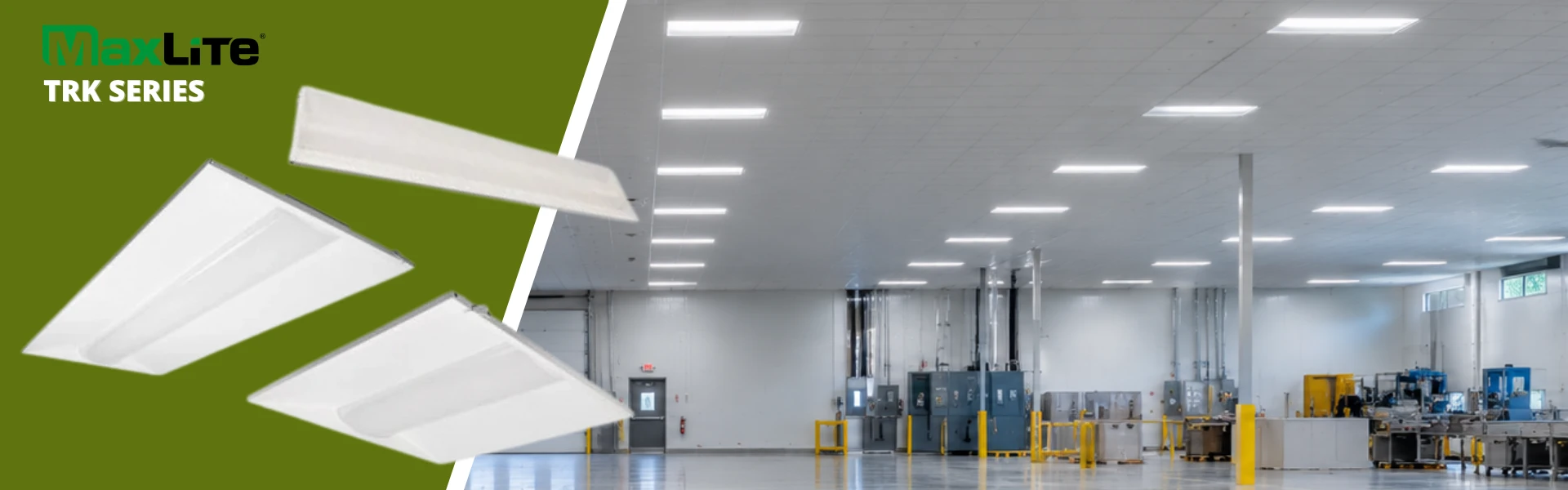
Most commercial buildings still have a ceiling full of 2x4 and 2x2 lay-in troffers with sound housings. Some still run fluorescent lamps. Others got an early LED retrofit that is already showing its age. Owners and facility managers are now hearing about tunable white from tenants, from designers on renovation work, and from wellness programs. What they are not getting is budget for ceiling demo, new grid, or plenum work in an occupied building.
MaxLite's TRK Troffer Retrofit Kit Control Ready Series now comes in a tunable white version that covers 2700K to 6500K and installs into the existing housing from below. The kit is only half the order, though. Tunable control runs through a separately purchased c-Max network node, and that detail decides whether the job gets priced right. Here is what the series covers, how the ordering code works, and what to plan for in the field.

Why Tunable White Is Showing Up on Retrofit Scopes
Tunable white used to live mostly on new-construction specs for high-end office and healthcare work. It now shows up on renovation and retrofit scopes for a simple reason: the existing ceiling is usually fine. The housings are sound, the grid is straight, and nobody wants to open the plenum over occupied space.
The decision rarely starts with the contractor. On a renovation with a design team, the lighting designer or engineer writes tunable white into the spec, and the electrical contractor bids it, buys it, and installs it. On an owner-driven retrofit, the facility manager or property manager scopes the work, often to support leasing or answer a tenant request, and a contractor or in-house crew executes it. Either way, the call gets made at budget or design phase and gets tested again at bid, when tunable white is one of the first line items put on the value-engineering list.
Retrofit kits hold their place in that conversation because of the conditions that come with occupied buildings:
- Work happens after hours or floor by floor, so each fixture has to be converted and the space put back the same night.
- Ceilings with suspect tile, or healthcare areas under an infection control risk assessment (ICRA), make every lifted tile a cost. Working from below the housing reduces that disturbance, but it does not replace the ICRA process.
- Owners and landlords often want existing housings and grid left in place to avoid patching, painting, and tile replacement.
How the TRK Tunable White Platform Works
A tunable white troffer retrofit kit replaces the lamps, ballast, and lens inside an existing troffer with an LED assembly that can shift both correlated color temperature (CCT) and intensity. The MaxLite TRK tunable white series covers 2700K to 6500K, dims over 0-10V with dim-to-off, and carries an integral receptacle for MaxLite's c-Max network nodes.
"Controls Ready" means the receptacle is there, not the controls. Per MaxLite's spec sheet, CCT programming requires one of two c-Max nodes, sold separately:
- NN-RTW-TW (order code 109463): rectangular network node, tunable white.
- NN-RTPSW-TW (order code 109464): rectangular network node with PIR occupancy sensing and daylight harvesting, tunable white.
With a node in place, scenes and CCT are set through the c-Max app or a c-Max wall switch. MaxLite also lists Bluetooth, energy monitoring, high-end trim, and luminaire-level lighting control (LLLC) among the supported control features. Wall switches and time clocks are separate purchases; check the c-Max compatibility guide for what the controls layout calls for.
The feature that gets owners asking questions is the built-in circadian schedule. Know exactly what it does before anyone promises it in a meeting.
The Circadian Lighting Preset
The preset runs on a fixed daily curve. It starts from the Auto button on the wall switch or from the app, and a scheduled scene or a manual change at the switch or app interrupts it.
| Time of Day | CCT Behavior |
|---|---|
| 8 AM to 12 PM | Rises from 2700K to 6500K in 1% steps |
| 12 PM to 6 PM | Falls from 6500K back to 2700K in 1% steps |
| 6 PM to 8 AM | Holds at 2700K |
The curve is fixed to an 8 AM to 6 PM day. A building that opens at 6 AM or runs a second shift will sit at 2700K during those hours unless someone programs scenes to cover them. Raise that with the owner or facility manager before turnover, not after the first complaint.
Every size in the series sits on the same platform, which keeps the submittal package simple.
Specs Shared Across the Series
| Spec | TRK Tunable White Series |
|---|---|
| Input voltage | 120-277V, 50/60 Hz |
| Dimming | 0-10V with dim-to-off (dim-to-off at 0.3V, plus or minus 0.2V) |
| CCT | Tunable, 2700K to 6500K |
| CRI | 80 or higher |
| Rated life | L70 of 100,000 hours or more (calculated) |
| Power factor | 0.87 or higher |
| Surge protection | 2.5 kV |
| Operating temperature | -4°F to 122°F (-20°C to 50°C); battery backup models 32°F to 122°F (0°C to 50°C) |
| Location rating | Damp location, 10% to 80% RH non-condensing |
| Listings | cULus Classified, FCC Part 15 |
| Construction | Sheet metal housing, PMMA lens, 3.1 in. depth |
| Warranty | 10 years; see MaxLite's warranty terms for details |
One discrepancy is worth catching early. MaxLite's sheet lists the dimming range as 10% to 100% in the feature list and 0% to 100% with dim-to-off in the spec tables. If the low end matters to the sequence of operations, get it confirmed in writing on the submittal.
TRK Tunable White Sizes, Wattages, and Lumen Packages
The series covers the three standard troffer sizes. The 1x4, 2x2, and 2x4 come in field-selectable wattage versions, and MaxLite also builds fixed-wattage versions of the 2x2 and 2x4. Lumen values below come from MaxLite's spec sheet and are listed at 2700K, 4500K, and 6500K.
| Size | Base Model | Wattage | Lumens (2700K / 4500K / 6500K) | Efficacy (lm/W) |
|---|---|---|---|---|
| 1x4 | TRK14D13WTWCR (selectable) | 13W | 1,716 / 1,807 / 1,833 | 132 to 141 |
| 20W | 2,620 / 2,740 / 2,780 | 131 to 139 | ||
| 26W | 3,380 / 3,510 / 3,562 | 130 to 137 | ||
| 2x2 | TRK22D13WTWCR (selectable) | 13W | 1,690 / 1,716 / 1,742 | 130 to 134 |
| 20W | 2,600 / 2,640 / 2,680 | 130 to 134 | ||
| 26W | 3,380 / 3,432 / 3,484 | 130 to 134 | ||
| TRK22D13TWCR (fixed) | 13W | 1,703 / 1,807 / 1,820 | 131 to 140 | |
| 2x4 | TRK24D22WTWCR (selectable) | 22W | 2,860 / 3,014 / 3,080 | 130 to 140 |
| 28W | 3,640 / 3,836 / 3,920 | 130 to 140 | ||
| 34W | 4,420 / 4,658 / 4,760 | 130 to 140 | ||
| TRK24D19TWCR (fixed) | 19W | 2,470 / 2,527 / 2,565 | 130 to 135 |
Two things to watch. First, selectable-wattage models ship set to the lowest wattage. If the design or the scope calls for the middle or high setting, it gets set at install, fixture by fixture, and that belongs in the crew's instructions. Second, output drops slightly at warm CCTs, so the 2700K figure is the conservative number for anyone comparing against the existing layout's light levels.
Shop the MaxLite TRK Troffer Series
Browse the full TRK Series lineup

Reading the TRK Ordering Code and Building the Takeoff
The TRK part number builds left to right. A base selectable 2x4 reads TRK24D22WTWCR. Here is how each segment breaks down.
| Segment | Code | What It Means |
|---|---|---|
| Family | TRK | Troffer Retrofit Kit |
| Size | 14 / 22 / 24 | 1x4, 2x2, or 2x4 |
| Dimming | D | 0-10V dimmable |
| Wattage | 13W, 22W (selectable) or 13, 19 (fixed) | Selectable models carry a W after the wattage and ship at the lowest setting |
| Color temperature | TW | Tunable white, 2700K to 6500K |
| Controls | CR | Controls Ready (c-Max node sold separately) |
| Options | Blank / EM / E2 | None, emergency battery backup unit, or made-to-order emergency backup |
| Packaging | Blank / /2PK | Single kit or 2-pack |
| Sourcing | Blank / TA | Standard or TAA-compliant country of origin |
The TA suffix matters on federal work and any project where the contract requires TAA-compliant sourcing. The /2PK option cuts carton count, which helps on a floor-by-floor job where cardboard has to come out every night. Confirm the exact suffix format on the quote before the PO goes out.
Emergency is where retrofit takeoffs most often need a second look. The series offers three routes to battery backup, and each one changes lead time, labor, and line items.
Choosing an Emergency Option
| Option | What You Order | Emergency Output (per spec tables) | Field Considerations |
|---|---|---|---|
| EM suffix | Factory emergency battery backup unit | 1,260 lm for 90 minutes, fully charged | Ships with the kit; battery models rated 32°F minimum |
| E2 suffix | Made-to-order emergency backup | 1,050 lm for 90 minutes, fully charged | Made to order, so confirm lead time before it goes on the schedule |
| Field-installed | 15W inverter EBUUP17015N200B (108566), BBU plate TRK-BBUPLATE14 (110402) or TRK-BBUPLATE2224 (110403), test switch EBU-RTST-E15 (111289) | 2,100 lm for 90 minutes, fully charged | Three line items per fixture; works for adding emergency to kits already in stock or installed |
MaxLite's feature list also cites a 700-lumen minimum in emergency mode, which does not match the spec tables. Egress illumination is a design and code question, governed by NFPA 101 Section 7.9 and IBC Section 1008 where adopted. Make sure whoever owns the egress layout is working from the confirmed emergency output for the option you are ordering.
Installation Considerations for Electrical Contractors
MaxLite rates the TRK kit at under 15 minutes per fixture. Treat that as a best case on a clean housing. Real time per fixture depends on what you find when the door drops, so survey a sample before you commit to a production rate. The sections below cover what to check before the work starts, inside the housing, on emergency circuits, and at turnover.
Before the First Door Comes Down
- Pull a sample of fixtures per floor. Check housing condition, door frames, return-air slots, and what is actually feeding each fixture.
- Identify ballast age. Ballasts made before 1979 may contain PCBs and need separate handling and disposal.
- Plan lamp disposal. Fluorescent lamps fall under EPA universal waste rules (40 CFR Part 273), and some states are stricter.
- Check the energy code. Depending on the adopted code and how many fixtures the project alters, a retrofit can trigger lighting control requirements. Confirm with the design team or AHJ before bid. The NN-RTPSW-TW node's occupancy and daylight functions may help, but the AHJ makes that call.
Inside the Housing
The kit installs into the existing troffer without breaking the plenum, and its 3.1 in. depth fits the standard lay-in housings MaxLite designed it for. Follow MaxLite's instructions for removing lamps, sockets, and ballast, then land the existing feed on the kit driver. Because this is a cULus Classified retrofit kit, apply the retrofit marking label per MaxLite's instructions so the inspector can see the luminaire was modified per a classified kit. Set selectable wattage before the kit goes up, and plug the c-Max node into the receptacle at the same time so the fixture does not need a second visit.
For return-air troffers, add the air return bracket so the housing keeps its return path. If the mechanical engineer counts on those troffers for return air, losing that path becomes a mechanical problem, not a lighting one.
Commissioning and Turnover
Settle who programs the c-Max nodes at bid, not at punch. Whether it is the electrical contractor, a controls startup tech, or the owner's team, someone has to group fixtures, build scenes, set the Auto preset, and hand the facility manager working app access and a scene list. If that labor is not in the number, it becomes a change order or free work.
Where TRK Tunable White Fits on Real Projects
The series fits best where the ceiling stays, the space stays occupied, and someone on the owner or design side has asked for CCT control. These are the project types where that combination shows up most often:
- Office renovations and tenant improvements. Owners use tunable white to compete for tenants, ceilings are standard T-bar, and work runs after hours. See our office and workspace lighting guide.
- K-12 classrooms and administrative areas. Summer work windows and wall-to-wall 2x4 grids suit a kit retrofit. See our school lighting guide.
- Healthcare non-clinical spaces. Staff stations, administration, waiting areas, and corridors benefit from working below the ceiling. See our healthcare lighting guide.
- Senior living common areas. Operators and designers often ask for circadian scheduling here. The owner or design team sets the program; the preset gives them a starting point.
- Federal and institutional buildings. The TA option covers TAA-compliant sourcing where the contract requires it.
- Warehouse offices and mezzanines. Office space inside industrial buildings often has the same lay-in ceilings. See our warehouse office and mezzanine guide.
It is the wrong fit where the spec calls for CRI 90 or higher, as with clinical exam areas and some retail. It also does not belong in wet locations, or in unconditioned spaces that need battery backup. In those cases, look at a full LED troffer or panel or a different retrofit platform.

Explore the TRK Tunable White Series
The MaxLite TRK troffer retrofit kits are available through RelightDepot in 1x4, 2x2, and 2x4 sizes, with 2-pack options for multi-unit retrofit orders. The line runs on one shared platform: 0-10V dimming, field-selectable wattage, and a damp-location rating, so one submittal covers the full range of troffer sizes a job calls for. For tunable white CCT control and the Circadian Lighting preset, each tunable white kit needs a c-Max network node, which our team can quote with the kits.
Our team works with electrical contractors and facility teams to support takeoffs, wattage and emergency-option configuration questions, and lead-time questions across the TRK line.
Email [email protected] or call 888-548-6387 to speak with a lighting specialist.
shop this series
-

-
-
-

Troffer Retrofit Kit Value Series, 2'x2', Dimmable, 20W/25W/30W, Color Selectable, 2 Pack
MX-TRKE22D20WCS2P
$146.15 -
LED Troffer Retrofit Kit, 2x2, Dimmable, 13W, Color Selectable (3500K, 4000K, 5000K), Control Ready, 2 Pack
MX-TRK22D13CSCR/2PK
$167.65 -

Troffer Retrofit Kit, 2'x2', Dimmable, 20W/25W/30W, Color Selectable, Emergency Battery Back Up
MX-TRKE22D20WCSEM
$186.15 -

Troffer Retrofit Kit Value Series, 2'x4', Dimmable, 25W/30W/35W, Color Selectable, 2 pack
MX-TRKE24D25WCS2P
$190.75
Latest Blog Updates
MaxLite TRK Tunable White Troffer Retrofit Kits
Most commercial buildings still have a ceiling full of 2x4 and 2x2 lay-in troffers with sound housin...
EiKO HBX3 and BAYE3 Round High Bay Promo for Warehouse and Industrial Retrofits
Most high bay retrofits start with a fixture count, not a photometric plan. Someone walks the floor,...
Enerlites October Promo: Surge, TR Devices and Power Inlets Closes October 31
Enerlites has promo pricing on four devices most of us put in on every service upgrade and finish tr...
Specifying the LRS-O2 Wall Sconce for Entries, Breezeways, and Site Work
The LRS-O Series is Westgate's field-selectable up-and-down wall sconce platform, built for multifam...
MaxLite DSKL Series: Color-Selectable Disk Lights, One SKU for Five CCTs
MaxLite's DSKL Series Disk Light ships in two sizes on one platform: a 4 inch, 10W model and a 6 inc...
Westgate CMC-2Tone Series: One Ceiling Cylinder Platform, Three Sizes
A two-tone ceiling cylinder shows up on a bid set for a reason. The designer wanted a decorative dow...