
Product Spotlight: Westgate LLVT 4ft LED Vapor Tight with Selectable Wattage and CCT
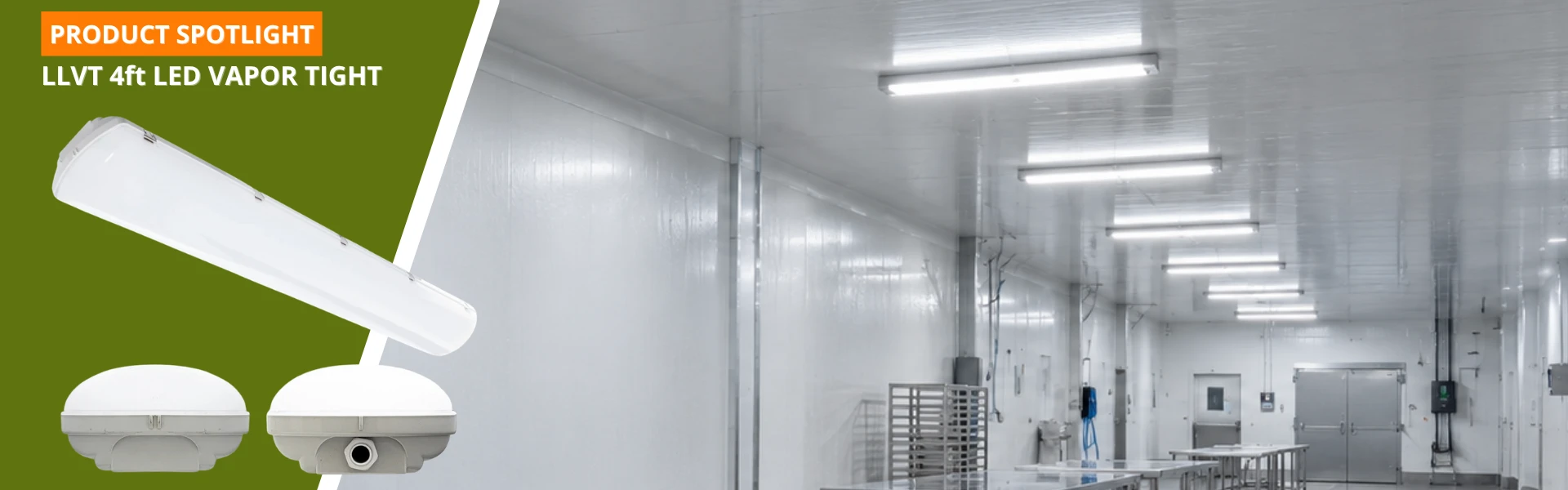
Most vapor tight jobs don't get much attention on the drawings, and they still end up causing problems. A food plant scope calls for sealed 4ft linears in the processing room, the dock, and the walk-in. A garage retrofit needs fixtures that survive salt, water, and the occasional bumper. A facility manager wants one fixture on the maintenance shelf instead of four. On most of these jobs, the problem isn't the light output. It's the number of part numbers, the submittal, and getting material on site when the schedule says it should be there.
The Westgate WM-LLVT-4FT-75W-MCTP-D is built for that situation. It's a 4ft polycarbonate vapor tight with field-selectable wattage and color temperature, NSF/ANSI 2 certification for splash and non-food zones, and a newly lowered price. Here's where it fits, what to check before you quote it, and what to watch for on install.

What the Westgate LLVT 4ft Vapor Tight Is
The WM-LLVT-4FT-75W-MCTP-D is a 4ft LED vapor tight fixture with a Bayer polycarbonate housing, a UV-stabilized polycarbonate diffuser, and stainless steel clips and mounting brackets. Internal switches set the output at 40W, 60W, or 75W and the color temperature at 3500K, 4000K, or 5000K. It runs on 120 to 277V, dims on 0-10V, and is rated for wet locations.
On retrofit work, it typically replaces 2-lamp and 4-lamp T8 vapor tights, T5HO enclosures, and older gasketed fluorescent fixtures where the lens has yellowed and the gaskets no longer seal. The table below pulls the headline specs from the manufacturer and RelightDepot product data.
| Specification | Value |
|---|---|
| Input voltage | 120 to 277VAC, 50/60Hz |
| Selectable wattage and lumens | 40W / 5,200 lm; 60W / 7,800 lm; 75W / 9,750 lm |
| Efficacy | 130 lm/W |
| Selectable CCT | 3500K, 4000K, 5000K (switch inside fixture) |
| CRI | 80 minimum |
| Power factor | Greater than 0.98 |
| Dimming | 0-10V |
| Ingress protection | IP65, wet location |
| Food equipment listing | NSF/ANSI 2, splash zone and non-food zone |
| Operating temperature | -22°F to 110°F (-30°C to 43°C) |
| Housing and lens | Polycarbonate housing, UV-stabilized polycarbonate diffuser, stainless steel clips |
| Dimensions | 50-1/4" L x 6-3/4" W x 3-3/4" H |
| Rated life | 50,000 hours |
Note the length. At 50-1/4", the fixture runs a couple of inches past nominal 4ft. That rarely matters on an open deck, but check it before you commit to fixed spacing between joists, beams, or cooler panel seams.
Why Selectable Wattage and CCT Matter on a Real Job
On paper, selectable wattage and CCT look like a feature bullet. In the field, they solve problems that usually show up after the PO is cut. The light level and color temperature still come from the spec or the facility's standard. The switches just make it easier to meet that requirement without reordering. Here's where that pays off:
- Fewer line items. One part number can cover the processing room at 5000K, the break area at 4000K, and the dock at a lower wattage. That means a shorter submittal, a simpler takeoff, and one line on the PO.
- Field corrections without a return. If the owner or designer walks the space and wants it brighter or dimmer, you change a switch setting instead of sending fixtures back and waiting on new ones.
- Simpler MRO stock. A maintenance team can keep one fixture on the shelf and set it to match whatever area it's replacing.
- Lower risk on substitutions. When the spec allows an approved equal, a fixture that can match several wattage and CCT callouts covers more of the schedule with a single submittal package.

Where the LLVT 4ft Vapor Tight Fits
The applications below are where this fixture earns its place. In each case, the spec or the facility scope defines the light level and CCT. The fixture's job is to survive the environment and make that requirement easy to meet.
Food Processing, Commercial Kitchens, and Bakeries
The NSF/ANSI 2 certification covers the splash zone and the non-food zone. It does not cover the food zone. That distinction matters to food-safety auditors and health inspectors, so match the listing to where the fixture actually hangs. Typical locations include processing rooms, back-of-house prep, dish rooms, bakery production floors, and dry storage. Ask the facility's sanitation lead which chemicals the crew uses for washdown. Some caustic and chlorinated cleaners attack polycarbonate over time, so confirm compatibility with the manufacturer if the cleaning program is aggressive. For broader space planning, see our fast food restaurant lighting guide.
Walk-In Coolers, Freezers, and Cold Storage
The -22°F rating covers most standard coolers and freezers. Blast freezers and some low-temperature storage run colder than that, so confirm the box temperature before you quote the job. Condensation at the door is often the bigger problem than the cold itself, which is where the sealed housing and IP65 rating earn their keep.
Parking Garages, Loading Docks, and Covered Canopies
Garages and docks deal with road salt, wind-driven rain, exhaust, and hose-down cleaning. A sealed polycarbonate fixture with stainless hardware holds up better than painted steel strips in that setting. Garage lighting is usually engineered to a foot-candle and uniformity target, and the 4ft linear form factor suits the low ceilings and beam pockets common in older parking structures. Our parking garage lighting guide covers the broader fixture mix.
Pool Support Spaces, Locker Rooms, and Workshops
Pool equipment rooms, locker rooms, and natatorium support spaces need a sealed fixture with corrosion-resistant hardware, and chlorine in the air is the main concern there. Maintenance garages, wash bays with indirect spray, and mechanical rooms round out the list. For direct high-pressure washdown, IP65 is not the right rating, so confirm the requirement before quoting a car wash bay.
Shop the Westgate LLVT Vapor Proof Fixtures
Browse the LLVT Vapor Proof Fixtures
Installation Notes for Electrical Contractors
On sealed fixtures, the failures that come back as warranty calls usually start at install, not at the factory. These are the points to cover with your crew before the first fixture goes up.
Mounting and Entry
The stainless steel mounting brackets on the back of the housing handle surface mounting to deck, block, or FRP. Before you order fittings, check the spec sheet for entry locations, chain or pendant mounting options, and whether the housing supports through-wiring for continuous rows. Use a listed wet-location fitting sized to the entry, and bring conduit or cord in from the side or below where you can. Water tracking down a conduit run from above is the most common way a sealed fixture ends up full of water.
Dimming and Controls Wiring
The 0-10V leads are Class 2 control conductors. Keep them separated from line voltage according to the fixture instructions and the NEC, or use conductors rated for the higher voltage where they share a raceway or enclosure. In a wet location, every splice outside the fixture needs a wet-rated connection. No integral occupancy sensor is listed for this model, so if the spec calls for one, carry a separate wet-location sensor or a control module on the 0-10V pair.
Temperature and Environment Limits
The operating range is -22°F to 110°F. The low end covers most cold storage. The high end deserves a second look in places like a bakery ceiling near the ovens, an uninsulated canopy deck in a Sun Belt summer, or a mechanical room with poor ventilation. If the ambient at fixture height can run past 110°F, raise it with the engineer or owner before rough-in, not after the first driver failure.
Energy Codes, Controls, and Rebates
Two items affect the paperwork side of a vapor tight job. Settle both early, because they're hard to fix after the material ships.
Controls. Commercial energy codes based on ASHRAE 90.1 and the IECC require automatic lighting reduction or shutoff in many of the spaces where vapor tights go, parking garages in particular. The exact time delay and power-reduction thresholds depend on the code edition your jurisdiction has adopted, so check the local amendment rather than assuming. The 0-10V input lets a sensor drop the fixture to a low setting instead of switching it off. Owners usually prefer that in garages and docks for safety reasons.
Rebates. Utility prescriptive programs pay on DLC-qualified model numbers, not on product families. Before you include a rebate in a proposal, look up the exact catalog number on the DLC Qualified Products List and confirm which wattage settings are covered. Some programs also require pre-approval before the fixtures are installed.

Explore the Westgate LLVT 4ft Vapor Tight on RelightDepot
The Westgate LLVT 4ft LED Vapor Tight is available through RelightDepot at a newly lowered price. One SKU covers field-selectable 40W, 60W, and 75W output (5,200, 7,800, and 9,750 lumens) and 3500K, 4000K, and 5000K CCT on a 120 to 277V, 0-10V dimmable platform. The fixture is IP65 rated and NSF/ANSI 2 certified for splash and non-food zones. Stainless steel clips and mounting brackets come standard. Because it's one part number, a single stock order can cover the cooler, the dock, and the garage level, and you can match the final light level and CCT on site without reordering. Our team works with electrical contractors and facility teams on takeoffs, wattage and CCT configuration, substitution requests, and lead-time questions across the vapor tight line.
Email [email protected] or call 888-548-6387 to speak with a lighting specialist.
shop the sale
-

LED Traditional Linear Vapor Light, 75W, Multi Color Temperature & Multi Power/Wattage, 4FT, Dimmable
WM-LLVT-4FT-75W-MCTP-D
$234.15
Latest Blog Updates

Product Spotlight: Westgate LLVT 4ft LED Vapor Tight with Selectable Wattage and CCT
Most vapor tight jobs don't get much attention on the drawings, and they still end up causing proble...

MaxLite TRK Tunable White Troffer Retrofit Kits
Most commercial buildings still have a ceiling full of 2x4 and 2x2 lay-in troffers with sound housin...

EiKO HBX3 and BAYE3 Round High Bay Promo for Warehouse and Industrial Retrofits
Most high bay retrofits start with a fixture count, not a photometric plan. Someone walks the floor,...
Enerlites October Promo: Surge, TR Devices and Power Inlets Closes October 31
Enerlites has promo pricing on four devices most of us put in on every service upgrade and finish tr...

Specifying the LRS-O2 Wall Sconce for Entries, Breezeways, and Site Work
The LRS-O Series is Westgate's field-selectable up-and-down wall sconce platform, built for multifam...

MaxLite DSKL Series: Color-Selectable Disk Lights, One SKU for Five CCTs
MaxLite's DSKL Series Disk Light ships in two sizes on one platform: a 4 inch, 10W model and a 6 inc...