A school lighting retrofit covers more different use cases under one roof than almost any other commercial job: classrooms running eight hours a day, a gym that doubles as an event space, a cafeteria that has to flip from bright and functional at lunch to relaxed after hours, and exterior lots that need to stay secure long after the buses leave. Get the fixture, CCT, and controls wrong in any one of those spaces and you'll hear about it in week one.
Old ballasts flicker, buzz, and shift color as they age, and it wears on people over a full school day. Cutting that out, along with dialing in the right color temperature for each space, is one of the more straightforward facility upgrades a district can make. The maintenance side matters just as much: fewer ballast failures, fewer lamp change-outs, and a fixture that holds its output for years instead of months.
Here's what to spec, area by area, from the classroom to the parking lot. For a deeper look at two of the highest-traffic spaces, see our School Gymnasium Lighting Guide and Cafeteria and Multipurpose Room Lighting Guide.
Pro Tip
Plan a full-building retrofit for summer break so crews get uninterrupted access and any punch-list items get closed out before students return. If the district plans to apply for a utility rebate, confirm DLC Qualified Products List status on the exact SKU before ordering; non-DLC fixtures typically don't qualify.

Classrooms
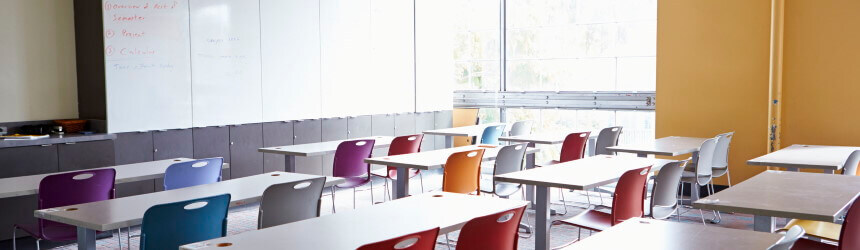
Teachers and students spend more time in classrooms than in any other space on campus. A buzzing ballast and a slight strobe most people don't consciously register add up over a 50-minute period, especially by fifth or sixth hour. Steady, flicker-free LED output plus consistent color rendering fixes both at once, which is why classrooms are usually the first phase a district tackles.
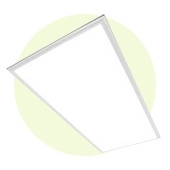
LED panel lights and lay-in troffers in 2x2 or 2x4-foot configurations are the standard fixture for drop-ceiling classrooms and drop straight into a T-bar grid, which keeps install labor down on a retrofit. They also wire in directly with occupancy sensors and daylight harvesting controls if the district wants to chase deeper savings. Where the existing troffer housing is in good shape, a retrofit kit can beat a full fixture swap on cost.
LED Troffers and Panel Lights for Classrooms
843
Browse all LED Panel Lights and Lay-In Troffers
Library
The library needs bright, even light without hot spots or shadow lines between the stacks. Run overhead fixtures parallel to the bookshelves, not perpendicular to them. That single layout call does more to cut shadow lines across reading surfaces than any fixture upgrade.
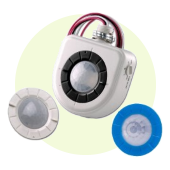
LED panel fixtures and surface-mounted LED linear fixtures at 4000K hold a clean, even output without the color shift and lumen drop you get from an aging fluorescent system. Pair either with occupancy sensors so lights stay on where students are, and unoccupied stacks and study rooms dim or shut off on their own.
Hallways and Stairwells
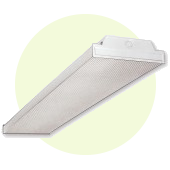
A flickering fluorescent tube in a hallway does more damage to how a building feels than almost any other single fixture on campus. Corridors and stairwells need consistent light to keep people from tripping on a landing and to keep the building from feeling abandoned after dark. LED wrap-around fixtures and surface-mounted LED strips are the standard choice for corridor upgrades, and both run for years without a service call.
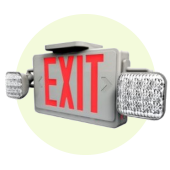
Pair any corridor upgrade with a look at emergency lighting and exit signs. NFPA 101 (Life Safety Code) and local building codes require illuminated egress paths and exit signage that keeps working through a power failure. LED emergency units last longer and need far less maintenance than the old incandescent heads, which makes them the obvious add-on any time a corridor is already opened up.
Exit and Emergency Lighting for Schools
739
Shop Exit and Emergency Lighting
Gymnasiums
How much light a gym needs depends on what's happening on the floor. A full competition court needs more light and more uniformity than a practice space, and a middle school gym running intramurals isn't held to the same standard as a college court. IES guidance for gymnasium lighting is commonly cited as roughly 30 foot-candles for recreational use and 50 or more for competitive play; confirm the current figure against the IES Lighting Handbook or your local code before finalizing a layout. See our full gymnasium lighting breakdown for foot-candle targets by activity level and ceiling height.
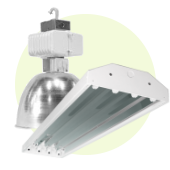
LED high bay fixtures are the standard for gyms, built for the lumen output and throw distance large open volumes need at ceiling heights of 20 to 35 feet. High bays in the 150W to 250W range cover full-court areas with the uniformity and vertical foot-candle levels athletic play requires. Grid-mount is the faster install where there's already a structural grid to hang from; suspended mount gives more layout flexibility where there isn't.
Gym-rated high bays typically use a polycarbonate or acrylic lens reinforced with a wire guard to take a hit from a stray ball. That guard is what makes them a safe, low-maintenance swap for older metal halide fixtures, which run hot, take several minutes to restrike after a power blip, and lose output fast.

High Bay Lighting for School Gymnasiums
731
Shop High Bay Lighting
Building Exteriors
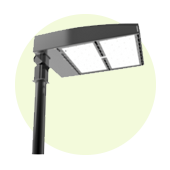
Students and staff need to feel safe walking to and from campus before sunrise or after an evening event. Area lights and shoebox fixtures cover parking lots, walkways, building perimeters, and drive lanes with even, glare-controlled light that acts as a real security deterrent, not just a compliance checkbox. Properly lit exteriors also cut liability exposure and give a surveillance system something usable to work with after dark.
For cameras and foot traffic, cooler CCT in the 4000K to 5000K range beats warmer light. It renders closer to daylight, so both cameras and the human eye pick up color and facial detail better than under the amber cast of a 3000K fixture or an aging metal halide wall pack. CCT and CRI are two different specs, though: pair that cooler color temperature with a fixture that carries a CRI of 70 or higher, or a cool-white fixture with poor color rendering still leaves faces washed out on camera footage.
Exterior fixtures should carry at least an IP65 rating to handle direct weather exposure. Metal halide wall packs lose initial lumens fast and shift yellow as they age; LED wall packs hold their output and color for the life of the fixture, and many mount straight to an existing HID wall pack's junction box, which keeps the install simple. Swapping to LED on exterior circuits typically cuts energy use 50 to 70 percent, depending on wattage and run hours.
Cafeterias
Cafeterias do double duty: a food-service space that needs to move a lunch line quickly and safely, and a gathering space where students hang out between classes and during events. Lighting has to cover both jobs. See our Cafeteria and Multipurpose Room Lighting Guide for zone-by-zone fixture recommendations.
Fixture choice depends on how much natural light the room gets, how the space is laid out, and which zones get used for what. Troffers or suspended LED linear fixtures work well over high-traffic service and tray-return areas. Add dimming controls on the dining zones so the room can drop to a softer level for evening events without running two separate lighting systems.
Faculty Room
Teachers need a workspace that actually functions, and it's easy to forget that on a retrofit focused on classrooms. Faculty rooms are where educators plan lessons, grade papers, and get a break between periods, and the lighting should support all three without feeling like an afterthought.
Surface-mount LED wraps or LED panel troffers at 3500K to 4000K strike the right balance of brightness and warmth for a room used for focused planning and quick breaks in the same hour.

Get Your Campus Lighting Plan Started
Every space on a campus needs its own fixture, CCT, and control strategy, not a one-size-fits-all swap. Send us the room list, and we'll spec it, price it, and get you a quote fast. Contact RelightDepot, call 888-548-6387, or email [email protected] to talk through your project with a commercial lighting specialist.