
Traditional Bulkhead BKH Series: One Platform, Six Field-Selectable Configurations
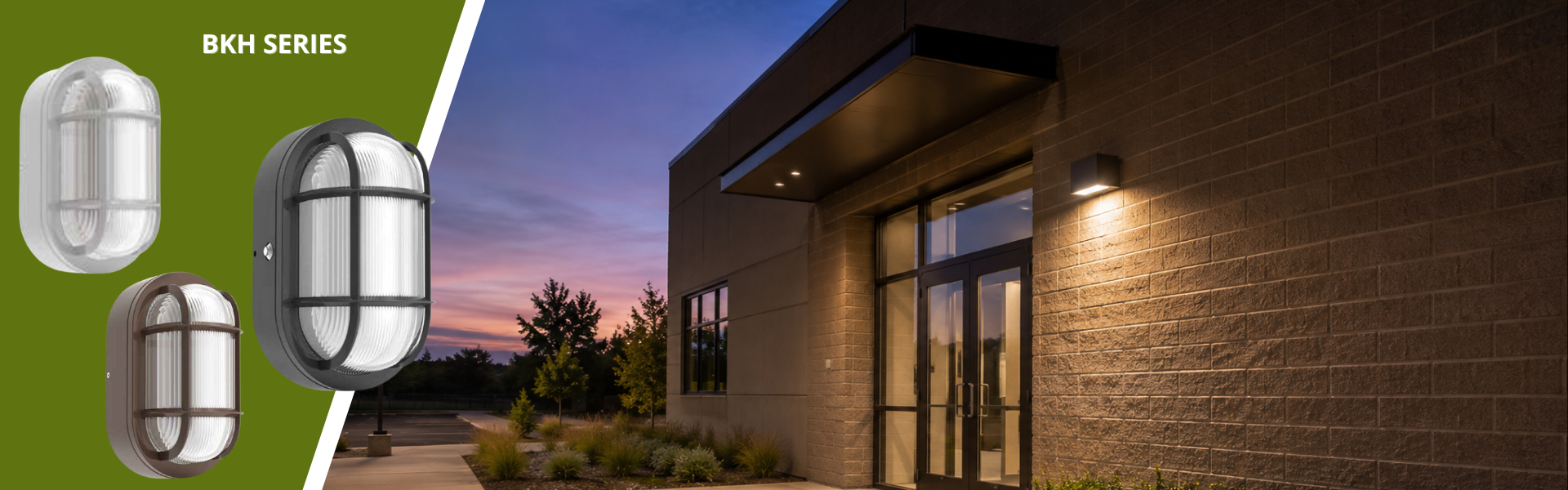
Bulkhead fixtures show up on more job types than most contractors give them credit for: apartment breezeways, hotel corridor exits, courtyard perimeter walls, back-of-house doors at retail and restaurant sites. The spec is usually simple, wall-mount, wet-location rated, dusk-to-dawn, but the SKU count behind that simple spec adds up fast once you factor in wattage, CCT, and finish. The Westgate BKH Traditional Bulkhead collapses most of that variation into two base models: a 6/8/10W unit at 850 lumens and a 12/18/20W unit at 1700 lumens, each field-selectable across 3000K, 4000K, and 5000K, each available in bronze or black, and each shipping with a built-in photocell. Here is what that platform actually means for how you quote it, stock it, and put it in the wall.

Why a Selectable Bulkhead Platform Matters on the Job
A typical bulkhead line forces a choice at order time: pick the wattage, pick the CCT, pick the finish, and live with it. On a multi-building job, that turns into a long list of line items on the material take-off for what is functionally one fixture. The BKH's selectable wattage and CCT do not eliminate that decision; they just move it from the supply house counter to the fixture housing. You still land on a specific output and color temperature before the wall goes up, but you are not carrying six separate part numbers to get there, and a wrong call in the field does not automatically mean a return.
The built-in photocell removes a second coordination point. Instead of specifying a separate photocell receptacle or tying the fixture into a lighting control panel, the bulkhead switches itself at dusk and dawn out of the box. That is one less line on the controls schedule and one less device for the inspector to check against a separate control spec.
What's Actually in the BKH Platform
Every BKH bulkhead, regardless of wattage or finish, shares the same core build. That consistency is what makes the line worth stocking as a platform instead of shopping fixture by fixture:
- Die-cast aluminum back plate, IP65 rated, built for wet-location wall mounting
- Non-cutoff optics with a 100 degree beam angle for broad wall-wash coverage, not a tight cutoff distribution
- 0-10V dimming for jobs where the control spec calls for a dimming tie-in
- 2835 Lumileds LED engine rated for a 70,000 hour service life
- Power factor above 0.90 and CRI of 70 or better, adequate for wall-wash and security-type exterior work, not a fixture you'd pull onto a CRI-critical elevation
- UL listed, 120-277V, so one SKU covers both a 120V and a 277V commercial panel
- 7-year warranty per the spec sheet
One inconsistency worth flagging before you write this into a submittal: the general spec sheet lists a waterproof-sealed glass lens, but the SKU variation table lists a polycarbonate lens and housing. Confirm the actual lens material with your Westgate rep before committing to specific language in a submittal package, since spec sheets get checked against the physical fixture at inspection.
The Range
The full family breaks into two base models, split by lumen package, with three wattage taps and three CCT settings inside each one.
| Model | Wattage Taps | Lumens | CCT Options | Finish | Voltage |
|---|---|---|---|---|---|
| BKH-10W-MCTP | 6W / 8W / 10W | 850 lm | 3000K / 4000K / 5000K | Bronze or Black | 120-277V AC |
| BKH-20W-MCTP | 12W / 18W / 20W | 1700 lm | 3000K / 4000K / 5000K | Bronze or Black | 120-277V AC |
Shop the BKH Bulkhead Line

Matching Wattage and CCT to the Space
CCT and output level are typically called out in the lighting spec, or on a lot of these exterior wall applications, left open because nobody wrote a formal spec for a breezeway or a service entrance. Either way, here is how the range actually breaks down in practice.
- 850 lm (6-10W) covers a standard single or double entry door, a breezeway, or a stairwell exit landing.
- 1700 lm (12-20W) suits a taller mounting height, a wider courtyard wall, or a location doing double duty as area lighting for an adjacent walkway.
- 3000K reads warm and is the common call for hospitality entrances and multifamily curb appeal.
- 4000K is the neutral default most commercial exteriors land on when nothing more specific is called out.
- 5000K shows up on industrial and higher-security exteriors where the owner wants a cooler, brighter look at the perimeter.
Finish is the one variable on this fixture that has nothing to do with performance, and it is usually the last thing decided.
Where Bronze vs. Black Actually Gets Decided
Finish selection sits with the designer or the property owner, not the installing contractor, and it is almost always driven by what is already on the building. A property doing a phased retrofit will match whatever bronze or black hardware is already mounted on adjacent walls rather than pick a finish in isolation. Your job as the contractor is less about picking a color and more about confirming the finish called out on the order matches what's already on the wall before you break the case open, since a bronze bulkhead next to twenty black units on the same elevation is the kind of punch-list item nobody wants to explain.
Sourcing, Stocking, and Installing the Line
The spec sheet covers performance. The rest of this is what actually happens between the truck and the wall.
- Photocell orientation. The built-in photocell handles dusk-to-dawn switching on its own, but where it's aimed still matters. Keep it clear of the fixture's own light output and away from other exterior sources like floods or signage that could cause false triggering.
- Mounting. The die-cast back plate mounts to a standard round or octagon exterior box the way most traditional bulkheads do; the selectable feature doesn't change the rough-in. Confirm the box depth and gasket seating before applying final torque to the housing screws to maintain the IP65 rating. A pinched gasket is the most common way a wet-location fixture loses its wet-location rating.
- Emergency battery option. Westgate lists a factory-installed emergency battery option, OPT-EM-BKH, for this line. That has to be specified at the time of order. It is not a field-retrofit kit, so if a corridor exit or egress-adjacent wall needs battery backup, get that called out on the PO before the fixture ships.
- Inspection. IP65 covers dust and low-pressure water jets from any direction, which is the rating inspectors generally expect to see on an exterior wall fixture. Keep the cut sheet in the submittal folder since that's usually what gets checked against the fixture on a final walk.
Where the BKH Line Actually Gets Used
The BKH's application list reads like a cross-section of exterior wall work: entrances, courtyards, hotels, industrial buildings, landscape walls. In practice, that breaks down into a handful of recurring job types.
- Multifamily and apartment breezeway entries, where the fixture handles both the door wash and after-dark security without a separate photocell control.
- Hotel corridor exterior doors and courtyard perimeter walls, where bronze or black finish needs to match existing exterior hardware.
- Retail and restaurant back-of-house and service entrances, where dusk-to-dawn operation with no controls tie-in keeps the job simple.
- Light industrial and warehouse exterior doors, where the 1700 lm package covers a taller mounting height or a wider wall section.
- School and institutional exterior doors, where a CRI of 70 and a 100 degree beam are enough for security and wayfinding without needing a higher-CRI fixture built for a different application.

Explore the BKH Traditional Bulkhead Series
The BKH Traditional Bulkhead line is available through RelightDepot in bronze and black finishes, each field-selectable across 3000K, 4000K, and 5000K, built on two lumen platforms: an 850 lm unit spanning 6W, 8W, and 10W, and a 1700 lm unit spanning 12W, 18W, and 20W. That's four base SKUs covering six wattage taps and three CCTs apiece, with a built-in photocell on every unit. A factory-installed option coded OPT-EM-BKH is available on request for jobs that need it (confirm the exact scope with your rep before quoting it for an egress application), so whichever configuration a job calls for is in stock and ready to build to spec.
Our team works with electrical contractors and facility teams to support takeoffs, wattage and CCT configuration questions, and stocking questions across the BKH line.
Email [email protected] or call 888-548-6387 to speak with a lighting specialist.
shop this series




Frequently Asked Questions
Latest Blog Updates
Traditional Bulkhead BKH Series: One Platform, Six Field-Selectable Configurations
Bulkhead fixtures show up on more job types than most contractors give them credit for: apartment br...
Westgate UCLB Series: 120V Direct-Wire Undercabinet Lighting
Undercabinet lighting on a commercial job usually comes down to one call made early in the rough-in:...
Westgate RLB Series Low Bay: One Fixture, Selectable Wattage and CCT
One switch on top sets wattage and CCT on the RLB Series, Westgate's new selectable low bay. Pick 80...

FDLO Series Oval Flush Mount
The FDLO Series ships as a 32.5-inch oval double-ring flush mount with a field-select switch that se...
EiKO AAL1 and VERT Light Clearance: 17 SKUs In Stock Now
RelightDepot is running an EiKO sale on AAL1 area lights and VERT site lights, with select SKUs mark...
MaxLite MLFP Series: FlatMax G6 Flat Panels
MaxLite's FlatMax G6 turns three separate flat panel SKUs into one line item on a takeoff: 1x4, 2x2,...