
Westgate LVTF 4FT Fiberglass LED Vapor Tight for Washdown, Garage, and Egress Work
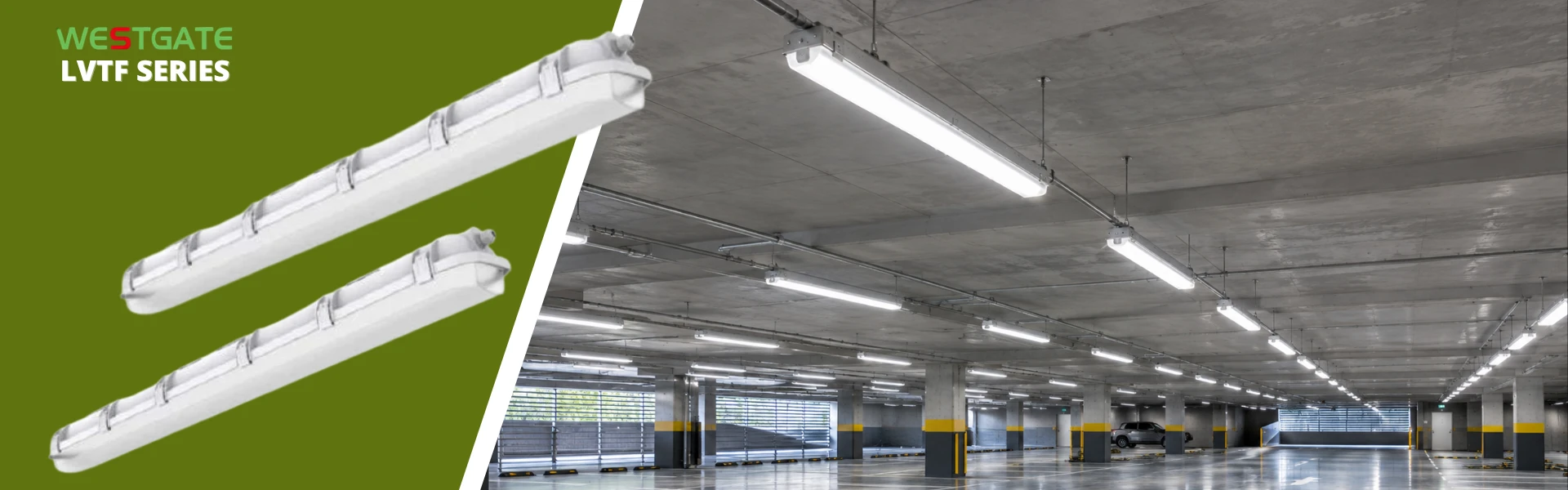
Walk any food plant, car wash, or parking deck that went LED eight or ten years ago, and you will find the same thing. The polycarbonate vapor tights have yellowed and crazed from sanitizer. Half the plastic clips are snapped or missing. Water sits in the bottom of the lens. Maintenance replaces a few every month, and every replacement is another lift rental, another lockout, and another fixture that will fail the same way.
The Westgate LVTF 4FT is a fiberglass LED vapor-tight fixture built for that problem. It pairs a fiberglass housing with stainless steel latches and a poured-in-place gasket, and it carries IP67, NEMA 4X, IK10, NSF, and DLC Premium in one catalog number. Here is where it makes sense in industrial lighting and commercial work, how to configure it, and what to watch for during installation.

Why Fiberglass Housings Outlast Polycarbonate in Washdown and Corrosive Areas
Housing material decides how long a vapor tight survives in a chemical environment. Polycarbonate handles impact well, but chlorinated and caustic sanitizers, ammonia, and some degreasers attack it over time. It crazes, loses clarity, and gets brittle. Die-cast aluminum, common on vapor tight high bays, holds up mechanically, but it needs a good coating to resist salt and washdown chemicals, and it is heavier to hang.
Fiberglass-reinforced polyester sits between the two. It resists most cleaning chemicals, does not corrode, and stays rigid, which helps the gasket hold an even seal over the life of the fixture. The LVTF housing carries two ratings worth knowing:
- UL 5VA: the highest UL 94 flammability rating for plastics. The material self-extinguishes and resists burn-through.
- F1 weatherability: the material holds its properties after UV exposure and water immersion testing, so it is suitable for outdoor and semi-exposed use like open garage decks.
On sealing, IP67 means the fixture is dust-tight and tested for temporary immersion. NEMA 4X adds hose-directed water and corrosion resistance. Neither one is the same as IP69K, which is the test for high-pressure, high-temperature spray at close range. If a plant's sanitation crew runs hot, high-pressure wands directly at the fixtures, ask Westgate to confirm before you submit. Also keep in mind that vapor tight does not mean hazardous-location rated. A Class I, Division 1 or Division 2 area needs a fixture listed for that classification.
Westgate LVTF 4FT Specs at a Glance
The table below covers the published specs for catalog number LVTF-4FT-30-60W-MCTP. Confirm final values against the current spec sheet before submittal.
| Spec | LVTF 4FT |
|---|---|
| Input voltage | 120 to 277VAC, 50/60Hz |
| Wattage (field selectable) | 30W / 45W / 60W |
| Efficacy | Up to 140 LM/W |
| CCT (field selectable) | 3500K / 4000K / 5000K |
| Dimming | 0 to 10V |
| Lens | Acrylic or impact-resistant polycarbonate |
| Housing | UL 5VA flame-retardant fiberglass, F1 weatherability |
| Sealing | Poured-in-place gasket, stainless steel latches |
| Ratings | IP67, NEMA 4X, IK10, wet location |
| Listings | NSF listed, DLC Premium (Stairway and Passageway) |
| Max ambient | 131°F (55°C) |
| Mounting | Surface, pendant, suspended, or 45° wall |
| Factory options | Emergency battery, microwave bi-level sensor, network sensors, photocell, cord and plug, 10kV surge protection |
Configuration Choices That Affect the Submittal
On new construction, the engineer's fixture schedule sets most of these choices. On retrofit and MRO work, the facility manager usually makes the call. Either way, these four decisions determine whether the LVTF clears the submittal and performs once it is hung.
Wattage: 30W, 45W, or 60W
At the published 140 LM/W, the settings work out to roughly 4,200, 6,300, and 8,400 lumens. Efficacy can shift slightly between settings, so pull exact delivered lumens from the spec sheet before you match a fixture schedule. One catalog number can cover two or three fixture types on the same job. On energy-code projects, make sure the installed setting matches the wattage used in the lighting power density calculation, because that is what the inspector and the commissioning agent check.
CCT: 3500K, 4000K, or 5000K
The spec sets the color temperature. The field selector earns its keep when the CCT changes late in the job, when you are submitting an approved equal, or when the owner's maintenance team wants to stock one SKU instead of three.
Lens: Acrylic or Polycarbonate
This is the choice that gets missed most often. Food and beverage plants running SQF or BRCGS audits generally require shatter-resistant materials in production areas, which points to the impact-resistant polycarbonate lens. Acrylic holds clarity better under long-term UV exposure and resists some chemicals better, so it can be the better pick for open garage decks or outdoor canopies. Check the plant's glass and brittle plastics policy before you order.
Dimming, Controls, and DLC Premium
The 0 to 10V driver needs a control to do anything. Stairwells are where this matters: recent editions of ASHRAE 90.1 and the IECC include automatic output reduction requirements for unoccupied stairwells, so check the edition your jurisdiction has adopted. Westgate offers a factory-installed microwave bi-level sensor (OPT-SEN-2MDR-36), which saves you from field-mounting one of the standalone occupancy sensors on a sealed housing. The DLC Premium qualification falls in the Stairway and Passageway category. Before you promise an owner a rebate, confirm the exact listing on the DLC Qualified Products List and the utility program's requirements.

Where the LVTF Fits, Who Calls for It, and When
The LVTF covers a wide range of wet and corrosive spaces, but the decision-maker and timing vary by application. Use the table below to see how each job typically comes together.
| Application | Who makes the call | When it happens | Why the LVTF gets picked |
|---|---|---|---|
| Food and beverage processing | Engineer on new work; plant facility or sanitation manager on retrofit | Design phase, or planned shutdown windows | NSF listing, IP67, NEMA 4X, polycarbonate lens option, chemical-resistant housing |
| Parking garages | Engineer or design-build EC; property manager on retrofit | Design phase, or retrofit tied to a rebate | Corrosion resistance, IK10, DLC Premium for incentives |
| Stairways and egress passageways | Engineer, with energy and life safety code driving controls | Design phase and submittal review | DLC Premium category, 45° wall mount, sensor and emergency battery options |
| Car washes | Owner or operator, often directly with the EC | Remodel or bay equipment upgrade | Constant spray and chemical mist, sealed fiberglass housing |
| Commercial kitchen dish and washdown rooms | Food service designer or engineer; facility manager on replacement | Design phase, or after a health inspection finding | NSF listing, washable sealed housing |
| Cold storage, coolers, and freezers | Refrigeration designer or facility manager | New build or rack-out retrofit | Sealed housing and stainless latches that do not snap in the cold (confirm low-temperature rating) |
| Pharmaceutical and lab support areas | Engineer or facility manager | Design phase or renovation | Washable, sealed fixture for utility corridors and support rooms |
One note on the last two rows. Westgate publishes a maximum ambient of 131°F but no minimum on the product page, so confirm the low-temperature rating before you quote freezers. In pharma, the LVTF suits support spaces; ISO-classified cleanroom ceilings typically call for gasketed recessed cleanroom fixtures.
Shop Vapor Tight Fixtures
Shop the LVTF vapor tight fixture
Installation Notes for Electrical Contractors
A vapor tight is only as good as its install. Field failures usually trace back to wire entry, mounting hardware, or a gasket that was not seated. These are the points worth covering with the crew before the first fixture goes up.
- Set selectors on the ground. Set wattage and CCT before the fixture is hung. On jobs that mix settings, mark the setting on the housing or the carton so the foreman can verify it without opening the fixture.
- Seal every penetration. Use liquid-tight fittings or the cord option, and use the factory entry points. Do not field-drill the housing without checking the spec sheet. One unsealed penetration defeats the IP67 rating.
- Match mounting hardware to the space. Use stainless chain, cable, and hardware in washdown and garage areas. Zinc-plated hardware rusts long before the fixture fails. Use the 45° wall mount in stairwells and car wash bays to keep the fixture out of traffic and brush paths.
- Check the service voltage. The LVTF runs 120 to 277VAC. Plants and garages on 480V services need 277V circuits, or a fixture rated for 480V. Westgate's LLVT line offers 480V versions where you need them.
- Plan for egress and controls up front. Order the emergency battery (OPT-EM-LLVT-25-46) and sensor options at the time of order. Retrofitting them into a sealed housing in the field is slow and risks the seal. Verify that the emergency output meets the egress design. NFPA 101 (Section 7.9.2) sets the baseline at 1 foot-candle average and 0.1 foot-candle minimum along the egress path for 90 minutes. If the engineer calls for standalone units instead, see our exit and emergency lighting.
- Close every latch. Stainless latches only seal when all of them are closed. Leave a note for the maintenance team that a missing or open latch means water in the fixture.
Retrofit and MRO: Replacing Failed Vapor Tights
Vapor tight retrofits rarely come from a design team. A facility manager scopes the job after the existing fixtures keep failing, the owner approves it on rebate and payback, and the work gets scheduled into a planned shutdown or sanitation window. In a food plant, that window is short, so stock on hand and fixture count matter as much as price.
When the existing fixtures are T8 vapor tights with brittle, yellowed housings, or open industrial strip fixtures that never belonged in a wet area, full fixture replacement beats relamping. LED tubes or strip retrofit kits do not fix a cracked housing or a gasket that has taken a set. The field-selectable wattage also lets you match light levels without a new photometric study on every room. As a starting point, compare the 30W setting against a 2-lamp T8 vapor tight and the 45W or 60W setting against a 4-lamp. Hang a test fixture and take a few meter readings before you commit to a setting for the whole job.

Explore the Westgate LVTF 4FT Fiberglass Vapor Tight on RelightDepot
The Westgate LVTF 4FT fiberglass vapor tight is available through RelightDepot alongside the rest of our vapor tight lighting lineup. One fixture covers 30W, 45W, or 60W and 3500K, 4000K, or 5000K through field selectors, on a 120 to 277VAC input with 0 to 10V dimming, so a single catalog number can cover several fixture types on a schedule. The UL 5VA fiberglass housing, stainless steel latches, and poured-in-place gasket carry IP67, NEMA 4X, and IK10 ratings, with NSF listing for food processing and DLC Premium qualification for stairway and passageway applications. Factory emergency battery, bi-level sensor, and cord options let you handle egress and controls requirements at the time of order instead of in the field. Our team works with electrical contractors, GCs managing washdown and parking garage lighting scopes, and facility teams on takeoffs, catalog number and lens confirmation, approved-equal submittals, DLC listing checks for rebates, and lead-time questions.
Email [email protected] or call 888-548-6387 to speak with a lighting specialist.
shop the series
Latest Blog Updates

Westgate LVTF 4FT Fiberglass LED Vapor Tight for Washdown, Garage, and Egress Work
Walk any food plant, car wash, or parking deck that went LED eight or ten years ago, and you will fi...

RelightDepot Black Friday Sale: Up to 73% Off
Our Black Friday Sale is on now, and it's the biggest one we run all year: up to 73% off contractor-...

Westgate DPL Filament Lamps and DSP Socket Pendants
Exposed-lamp pendants rarely show up on the original drawings with a model number attached. On resta...
Westgate LIH Series: Indirect LED High Bays for Natatoriums and Corrosive High-Ceiling Spaces
Every aquatics job has a fixture count nobody wants to talk about: the fixtures over the water. Serv...

Westgate BKR Bulkhead: One Outdoor SKU for Three Wattages, Three CCTs, and a Built-In Photocell
Pull the fixture schedule on almost any garden-style apartment complex, medical office building, or...

Product Spotlight: Westgate LLVT 4ft LED Vapor Tight with Selectable Wattage and CCT
Most vapor tight jobs don't get much attention on the drawings, and they still end up causing proble...